


Taipei Mayor Ma Ying-jeou (
Ma's article was published yesterday for the 85th anniversary of the May Fourth Movement (五四運動), a movement launched in China in 1919 in which intellectuals and students staged demonstrations against the feudal and traditional Chinese culture, spurred on by the allocation of German concessions in China to Japan as part of the Treaty of Versailles. The movement is considered the beginning of China's modernization.
Ma has published newspaper articles commemorating the May Fourth Movement for several years. This year he used the words of a key figure in the May Fourth Movement, philosopher and essayist Hu Shih (
Ma stressed in his article that the presidential election showed many of the negative sides of democracy, such as social unease and rifts and confrontation between ethnic groups, which he attributed to the DPP's agitation and vilification of its opponents during the campaign trail.
"This presidential election was an ominous omen for Taiwan. The ruling party repeatedly told people that holding referendums and writing a constitution is a universal human right and a means of supporting democracy and loving Taiwan," Ma wrote. "The DPP's campaign appeals rapidly eroded political diversification and tolerance in democratic politics, through populism."
He blamed the DPP for developing a "new holy trinity" combining the promotion of referendums, writing a new constitution and Taiwan's independence as the party's "endless extension of power."
On the other hand, Ma said the Chinese Nationalist Party (KMT) should be credited for facilitating the transfer of power in 2000, and it also abandoned negative campaigning in this election.
On March 12, the KMT sponsored five full-page newspaper advertisements in which Adolf Hitler's photograph featured prominently, while calling on voters to end President Chen Shui-bian's (陳水扁) "dictatorship" on election day.
Ma said that he put forth his ideas clearly and did not make any unwarranted accusations in his article.
"People who delve into my article will realize what I'm talking about. I don't have to explain more," Ma told reporters yesterday.
Hsu Yung-ming (徐永明), a researcher at the Institute of Social Sciences at Academia Sinica said Ma's article showed that the KMT has not developed a strong political discourse which could rival the DPP's.
"What Ma criticized was the form of democracy, rather than the substance of democracy," Hsu said.
"I think Ma could focus more on the KMT's reform and hammer out a new political discourse for his party, instead of continuing the thinking advocated on March 13 Rally , which was anti-Chen," Hsu said.
Hsu added that Ma's words were too intellectual for the public to understand and it was also untenable to accuse the DPP of populism just because the DPP used a language that was more familiar to people.
"It will expose the KMT shortcoming of being so remote from public opinion," said Hsu.
DPP Legislator Gao Jyh-peng (
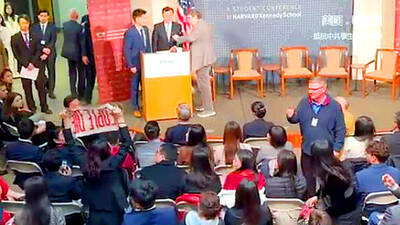
A group of Taiwanese-American and Tibetan-American students at Harvard University on Saturday disrupted Chinese Ambassador to the US Xie Feng’s (謝鋒) speech at the school, accusing him of being responsible for numerous human rights violations. Four students — two Taiwanese Americans and two from Tibet — held up banners inside a conference hall where Xie was delivering a speech at the opening ceremony of the Harvard Kennedy School China Conference 2024. In a video clip provided by the Coalition of Students Resisting the CCP (Chinese Communist Party), Taiwanese-American Cosette Wu (吳亭樺) and Tibetan-American Tsering Yangchen are seen holding banners that together read:

UNAWARE: Many people sit for long hours every day and eat unhealthy foods, putting them at greater risk of developing one of the ‘three highs,’ an expert said More than 30 percent of adults aged 40 or older who underwent a government-funded health exam were unaware they had at least one of the “three highs” — high blood pressure, high blood lipids or high blood sugar, the Health Promotion Administration (HPA) said yesterday. Among adults aged 40 or older who said they did not have any of the “three highs” before taking the health exam, more than 30 percent were found to have at least one of them, Adult Preventive Health Examination Service data from 2022 showed. People with long-term medical conditions such as hypertension or diabetes usually do not
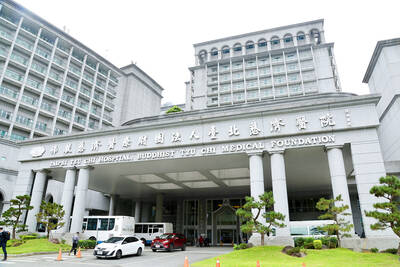
POLICE INVESTIGATING: A man said he quit his job as a nurse at Taipei Tzu Chi Hospital as he had been ‘disgusted’ by the behavior of his colleagues A man yesterday morning wrote online that he had witnessed nurses taking photographs and touching anesthetized patients inappropriately in Taipei Tzu Chi Hospital’s operating theaters. The man surnamed Huang (黃) wrote on the Professional Technology Temple bulletin board that during his six-month stint as a nurse at the hospital, he had seen nurses taking pictures of patients, including of their private parts, after they were anesthetized. Some nurses had also touched patients inappropriately and children were among those photographed, he said. Huang said this “disgusted” him “so much” that “he felt the need to reveal these unethical acts in the operating theater
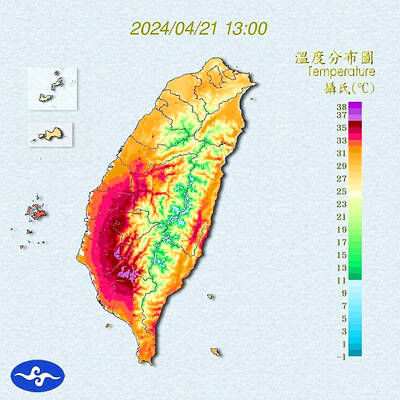
Heat advisories were in effect for nine administrative regions yesterday afternoon as warm southwesterly winds pushed temperatures above 38°C in parts of southern Taiwan, the Central Weather Administration (CWA) said. As of 3:30pm yesterday, Tainan’s Yujing District (玉井) had recorded the day’s highest temperature of 39.7°C, though the measurement will not be included in Taiwan’s official heat records since Yujing is an automatic rather than manually operated weather station, the CWA said. Highs recorded in other areas were 38.7°C in Kaohsiung’s Neimen District (內門), 38.2°C in Chiayi City and 38.1°C in Pingtung’s Sandimen Township (三地門), CWA data showed. The spell of scorching


 RSS
RSS