


The nation's expenditure for environmental protection is shared almost evenly by the government and industry, with the government handling and recycling waste while the industrial sector treats waste water and tackles air pollution, the Environmental Protection Administration (EPA) said yesterday.
For future policy analysis, the EPA will adopt the definition of pollution abatement and control (PAC) created by the Organization for Economic Cooperation and Development (OECD) to obtain executive details about environmental expenditure.
According to Pong Sheng-ming (
"Details obtained from our statistics will be also used in the calculation of our Green GNP," Pong told a press conference yesterday.
Hsieh Mei-hsiu (謝美秀), a specialist in the Statistics Office, said Taiwan's environmental expenditure in 2002 -- NT$115.7 billion -- included NT$52.1 billion from the government and the industry's NT$63.6 billion.
Statistics show that 65 percent of the government's money for environmental protection, or NT$34 billion, is spent on household waste management tasks conducted by local authorities. Most of the money is used to pay the salaries of sanitation workers and maintenance fees for landfills and waste incinerators. About half of the money, NT$21.3 billion, is shared by the governments of Taipei County, Taipei City and Kaohsiung City.
The statistics show that the government spent NT$9.5 billion less in 2002 than in 2001.
"The cut of more than NT$3 billion for sewer construction in Taipei City meant the country invested NT$5.6 billion less as a whole on water pollution prevention than in 2001," Hsieh said.
The completion of a waste incinerator in Changhua County also helped the government spend NT$4.3 billion less in 2002 than it did the year before.
EPA officials said, however, that a recent survey on residents' feeling about environmental quality suggests that respondents' responses did not match the investment in a variety of areas.
Taking air quality as an example, the officials said that the investment on related fields had been increased and records of air-quality indicators suggest that the situation in 2002 was better than that in 2001. However, the survey found that 59 percent of the respondents did not think air quality had improved.
In terms of waste management, the expenditure on related fields was reduced in 2002. But 80 percent of responsdents believe that the government's waste management had improved that year.
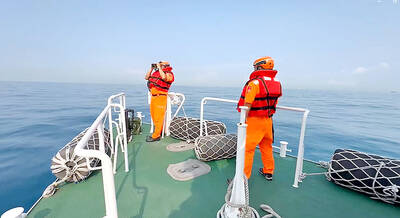
An increase in Taiwanese boats using China-made automatic identification systems (AIS) could confuse coast guards patrolling waters off Taiwan’s southwest coast and become a loophole in the national security system, sources familiar with the matter said yesterday. Taiwan ADIZ, a Facebook page created by enthusiasts who monitor Chinese military activities in airspace and waters off Taiwan’s southwest coast, on Saturday identified what seemed to be a Chinese cargo container ship near Penghu County. The Coast Guard Administration went to the location after receiving the tip and found that it was a Taiwanese yacht, which had a Chinese AIS installed. Similar instances had also

GOOD DIPLOMACY: The KMT has maintained close contact with representative offices in Taiwan and had extended an invitation to Russia as well, the KMT said The Chinese Nationalist Party (KMT) would “appropriately handle” the fallout from an invitation it had extended to Russia’s representative to Taipei to attend its international banquet last month, KMT Chairman Eric Chu (朱立倫) said yesterday. US and EU representatives in Taiwan boycotted the event, and only later agreed to attend after the KMT rescinded its invitation to the Russian representative. The KMT has maintained long-term close contact with all representative offices and embassies in Taiwan, and had extended the invitation as a practice of good diplomacy, Chu said. “Some EU countries have expressed their opinions of Russia, and the KMT respects that,” he
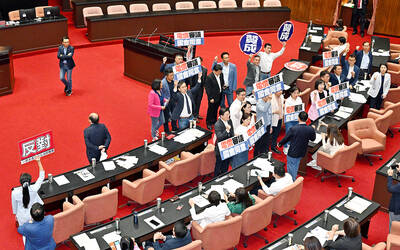
AMENDMENT: Contact with certain individuals in China, Hong Kong and Macau must be reported, and failure to comply could result in a prison sentence, the proposal stated The Chinese Nationalist Party (KMT) and the Taiwan People’s Party (TPP) yesterday voted against a proposed bill by Democratic Progressive Party (DPP) lawmakers that would require elected officials to seek approval before visiting China. DPP Legislator Puma Shen’s (沈伯洋) proposed amendments to the Act Governing Relations Between the People of the Taiwan Area and the Mainland Area (臺灣地區與大陸地區人民關係條例), stipulate that contact with certain individuals in China, Hong Kong and Macau should be reported, while failure to comply would be punishable by prison sentences of up to three years, alongside a fine of NT$10 million (US$309,041). Fifty-six voted with the TPP in opposition
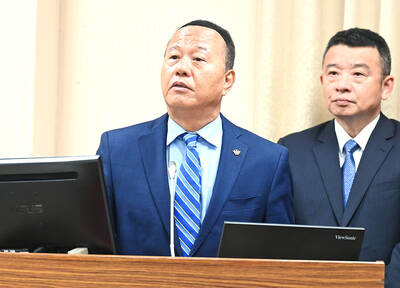
VIGILANCE: The military is paying close attention to actions that might damage peace and stability in the region, the deputy minister of national defense said The People’s Republic of China (PRC) might consider initiating a hack on Taiwanese networks on May 20, the day of the inauguration ceremony of president-elect William Lai (賴清德), sources familiar with cross-strait issues said. While US Secretary of State Anthony Blinken’s statement of the US expectation “that all sides will conduct themselves with restraint and prudence in the period ahead” would prevent military actions by China, Beijing could still try to sabotage Taiwan’s inauguration ceremony, the source said. China might gain access to the video screens outside of the Presidential Office Building and display embarrassing messages from Beijing, such as congratulating Lai


 RSS
RSS