


In a reaffirmation of their strategy, the pan-blues vowed to counter the groundswell of support enjoyed by their nemesis, President Chen Shui-bian (
The opposition Chinese Nationalist Party (KMT) and People First Party (PFP) legislative caucuses yesterday again resolved to formulate a resolution that could force Chen to cancel the referendums on the two questions he officially unveiled yesterday.
The questions are scheduled to be approved by the Cabinet during its weekly meeting today.
The Referendum Law (公民投票法) stipulates that the president has the right to initiate a referendum to safeguard the sovereignty and security of the nation if the president deems national security is under threat and sovereignty is in jeopardy. The initiative, however, must also be endorsed by a Cabinet resolution.
KMT Legislator Liao Fung-te (
"What we want to do here is to tell the president that the referendum is unnecessary and inappropriate because the legislative body can handle the matter via a legislative resolution," Liao said.
Due to their majority in the legislative body, the pan-blue parties should easily be able to pass a legislative resolution, which requires approval from half of the 225-member legislature. The petition requires at least 30 lawmakers' signatures.
If such a resolution were passed, opposition parties could demand that the Central Election Commission (CEC) stop preparations for the referendum, according to Article 20 of the Referendum Law.
Article 20 states that the CEC should immediately halt a referendum if the legislature holds a vote on an issue similar to the intended referendum.
In the referendum, the voters would be asked whether they support enhancing the nation's defenses should China refuse to withdraw the missiles it has targeted at Taiwan and to openly renounce the use of force, as well as whether the government should hold talks with China on cross-strait peace and stability.
The opposition caucuses, however, will scrap their original idea of petitioning for a constitutional interpretation and ordering pan-blue magistrates and mayors to boycott the referendum, Liao said.
"We don't think it's necessary [to request a constitutional interpretation] because the referendum is a matter of breaking the Referendum Law not the Constitution," he said.
Instead of ordering county commissioners and city mayors in the pan-blue camp to boycott the referendum, Liao said that the pan-blue parties will ask CEC members to express their party's stance via "pliable moral persuasion." Dismissing the opposition bloc's move to formulate a legislative resolution is aimed at boycotting the planned referendum, another KMT Legislator Huang Teh-fu (
"I think the DPP overestimates our power to hinder the planned referendum," Huang said. "What we can do is just to remind them of the legality of the referendum and that what we care about is that the presidential election goes as smoothly as possible."
Cabinet Spokesman Lin Chia-lung (
"Over the past 20 years, Taiwan has pried open three doors of democracy and traveled across three mountains of freedom, including lifting the ban on political parties, directly electing the head of state and electing new legislators," Lin said. "Now we're opening the fourth door and scaling the fourth mountain: that is, to hold the nation's first national referendum."
To better educate the public about the planned referendum and encourage the electorate to cast their ballots, Lin said that the Cabinet will launch a full-scale information campaign in a week.
"We plan to distribute 9 million brochures to 7 million families nationwide by the middle of this month," Lin said. "We'll also run an ad about the two questions for referendum on the front pages in seven of the nation's newspapers tomorrow [Wednesday]."
In addition, the Cabinet will start running TV commercials in the middle of this month encouraging the public to cast their votes and advocating the necessity, urgency and appropriateness of the referendum.
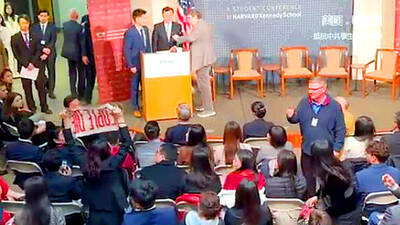
A group of Taiwanese-American and Tibetan-American students at Harvard University on Saturday disrupted Chinese Ambassador to the US Xie Feng’s (謝鋒) speech at the school, accusing him of being responsible for numerous human rights violations. Four students — two Taiwanese Americans and two from Tibet — held up banners inside a conference hall where Xie was delivering a speech at the opening ceremony of the Harvard Kennedy School China Conference 2024. In a video clip provided by the Coalition of Students Resisting the CCP (Chinese Communist Party), Taiwanese-American Cosette Wu (吳亭樺) and Tibetan-American Tsering Yangchen are seen holding banners that together read:

UNAWARE: Many people sit for long hours every day and eat unhealthy foods, putting them at greater risk of developing one of the ‘three highs,’ an expert said More than 30 percent of adults aged 40 or older who underwent a government-funded health exam were unaware they had at least one of the “three highs” — high blood pressure, high blood lipids or high blood sugar, the Health Promotion Administration (HPA) said yesterday. Among adults aged 40 or older who said they did not have any of the “three highs” before taking the health exam, more than 30 percent were found to have at least one of them, Adult Preventive Health Examination Service data from 2022 showed. People with long-term medical conditions such as hypertension or diabetes usually do not
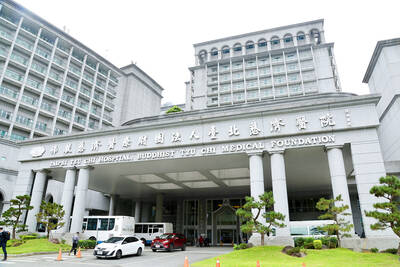
POLICE INVESTIGATING: A man said he quit his job as a nurse at Taipei Tzu Chi Hospital as he had been ‘disgusted’ by the behavior of his colleagues A man yesterday morning wrote online that he had witnessed nurses taking photographs and touching anesthetized patients inappropriately in Taipei Tzu Chi Hospital’s operating theaters. The man surnamed Huang (黃) wrote on the Professional Technology Temple bulletin board that during his six-month stint as a nurse at the hospital, he had seen nurses taking pictures of patients, including of their private parts, after they were anesthetized. Some nurses had also touched patients inappropriately and children were among those photographed, he said. Huang said this “disgusted” him “so much” that “he felt the need to reveal these unethical acts in the operating theater
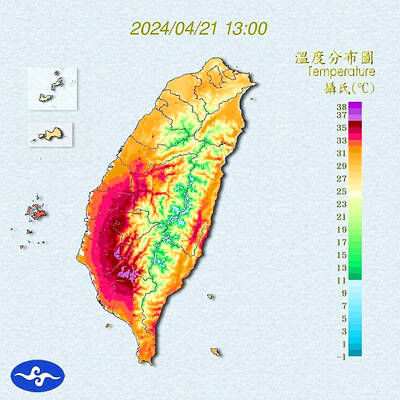
Heat advisories were in effect for nine administrative regions yesterday afternoon as warm southwesterly winds pushed temperatures above 38°C in parts of southern Taiwan, the Central Weather Administration (CWA) said. As of 3:30pm yesterday, Tainan’s Yujing District (玉井) had recorded the day’s highest temperature of 39.7°C, though the measurement will not be included in Taiwan’s official heat records since Yujing is an automatic rather than manually operated weather station, the CWA said. Highs recorded in other areas were 38.7°C in Kaohsiung’s Neimen District (內門), 38.2°C in Chiayi City and 38.1°C in Pingtung’s Sandimen Township (三地門), CWA data showed. The spell of scorching


 RSS
RSS