


Following the example of the Presidential Office and the Executive Yuan, the 89-year-old Control Yuan will open its doors to the public for tours after the Lunar New Year, a senior official of the watchdog body said last week.
"The Control Yuan will be regularly open to the public soon, after we complete a multimedia exhibition room and set regulations for public tours," said Control Yuan Secretary-General Tu Shang-liang (
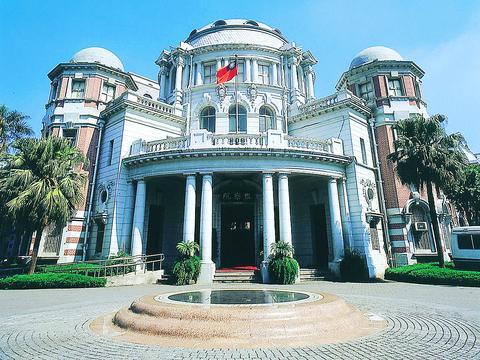
PHOTO COURTESY OF THE CONTROL YUAN
The Control Yuan had restricted access to researchers or domestic and foreign dignitaries. Even couples who wanted to take wedding pictures in the European-style compound had to make advance reservations.
Tu said that opening the majestic compound to the public would allow people to learn about the building's history.
"We also hope to educate people on how the supervisory system works to protect their civil liberties through their visits to the ombudsmen's offices," he said.
The Control Yuan is opposite the Executive Yuan, another historic government compound built by the Japanese during their 50 years of occupation. It is located on the intersection of Zhongxiao East Road and Zhongshan South Road, where Japanese rulers built a three-lane highway, the widest on the island.
Designed by Japanese architect Moriyama Matsunosuke, one of the main designers of Taiwan's offices under Japanese colonial rule, the two-story building of steel, concrete and brick was completed in 1915.
Japanese colonists first used the building as the Taipei Prefecture Office, the headquarters for the northern counties of Taipei, Keelung and Ilan.
Between 1945 and 1947, it was the office of the provincial administrator of Taiwan after Taiwan's "retrocession."
The building later became the office of educational functionaries and hygienists under the Chinese Nationalist Party (KMT) government. Control Yuan members moved into the building in 1958, when the KMT government decided to make it the permanent office for its ombudsmen.
The building has housed nine Control Yuan presidents since then, including Yu You-jen (
Using techniques from English architect Josiah Conder, Moriyama represented the generation of Jap-anese architects who modeled their style on Western architectonics.
The young Japanese architect put a three-floor high Byzantine copper dome in the facade. The eight-column corridor in the main entrance gives the naturally lighted entrance hall a solemn atmosphere.
There are four sets of Tuscan-style columns surrounding the entrance hall, which has an 18m-high ceiling and is connected by a M-shaped staircase to two hallways with arched doors.
Moriyama also applied French-style mansard roofs on the two wings of the main building and covered them with copper sheets. Visitors will be able to explore most areas of the Control Yuan, including the extremely narrow passageway under the mansard roofs, Tu said.
The secretary-general said that a refurbishment project lasting several years had made the Control Yuan the best preserved building of all the remaining post-Renaissance buildings in Taiwan.
In 1998, the Ministry of the Interior declared that the Control Yuan was a historical monument and should be managed in accordance with rules for national heritage conservation.
The extra restrictions made the refurbishment work challenging, Tu said.
"We had to make sure every repair was true to the original design. That posed dozens of challenges for the architects during the refurbishment. Searching for the new roof tiles was one example," he said.
The roof tiles used by Moriyama were used by Chinese royal palaces and require 60 days of firing and drying to make them moisture-proof and solid.
The architects in charge of the refurbishment eventually found a kiln in China that still made this kind of tile. The order for 50,000 took hundreds of the villagers more than six months to fulfill.
Restoring the bricks on the pillars in the two corridors extending from the entrance hall was another challenge, since the brick had been covered with paint and dust over several decades.
When asked which part of the building was his favorite, Tu said that every part of the Control Yuan deserved a mention.
Tu also has visions for the building to house the planned National Human Rights Museum proposed by the Presidential Office to mark the ombudsmen's utmost duty of safeguarding people's rights.
A new office building next to the aging building to accommodate Control Yuan personnel reveals a contrast between old and new in the ways the Control Yuan monitors the government, Tu said.
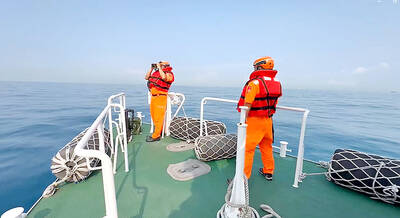
An increase in Taiwanese boats using China-made automatic identification systems (AIS) could confuse coast guards patrolling waters off Taiwan’s southwest coast and become a loophole in the national security system, sources familiar with the matter said yesterday. Taiwan ADIZ, a Facebook page created by enthusiasts who monitor Chinese military activities in airspace and waters off Taiwan’s southwest coast, on Saturday identified what seemed to be a Chinese cargo container ship near Penghu County. The Coast Guard Administration went to the location after receiving the tip and found that it was a Taiwanese yacht, which had a Chinese AIS installed. Similar instances had also

GOOD DIPLOMACY: The KMT has maintained close contact with representative offices in Taiwan and had extended an invitation to Russia as well, the KMT said The Chinese Nationalist Party (KMT) would “appropriately handle” the fallout from an invitation it had extended to Russia’s representative to Taipei to attend its international banquet last month, KMT Chairman Eric Chu (朱立倫) said yesterday. US and EU representatives in Taiwan boycotted the event, and only later agreed to attend after the KMT rescinded its invitation to the Russian representative. The KMT has maintained long-term close contact with all representative offices and embassies in Taiwan, and had extended the invitation as a practice of good diplomacy, Chu said. “Some EU countries have expressed their opinions of Russia, and the KMT respects that,” he
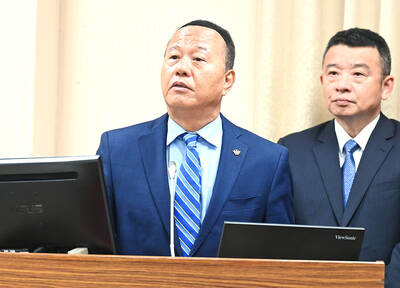
VIGILANCE: The military is paying close attention to actions that might damage peace and stability in the region, the deputy minister of national defense said The People’s Republic of China (PRC) might consider initiating a hack on Taiwanese networks on May 20, the day of the inauguration ceremony of president-elect William Lai (賴清德), sources familiar with cross-strait issues said. While US Secretary of State Anthony Blinken’s statement of the US expectation “that all sides will conduct themselves with restraint and prudence in the period ahead” would prevent military actions by China, Beijing could still try to sabotage Taiwan’s inauguration ceremony, the source said. China might gain access to the video screens outside of the Presidential Office Building and display embarrassing messages from Beijing, such as congratulating Lai
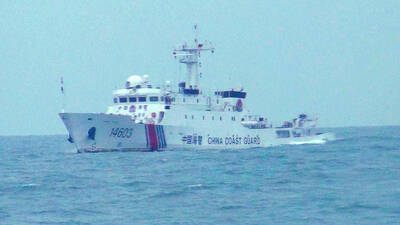
Four China Coast Guard ships briefly sailed through prohibited waters near Kinmen County, Taipei said, urging Beijing to stop actions that endanger navigation safety. The Chinese ships entered waters south of Kinmen, 5km from the Chinese city of Xiamen, at about 3:30pm on Monday, the Coast Guard Administration said in a statement later the same day. The ships “sailed out of our prohibited and restricted waters” about an hour later, the agency said, urging Beijing to immediately stop “behavior that endangers navigation safety.” Ministry of National Defense spokesman Sun Li-fang (孫立方) yesterday told reporters that Taiwan would boost support to the Coast Guard


 RSS
RSS