


Modern medicine might not give everyone with a disability a chance at recovery, but a new mobile phone repair shop with an all-disabled staff provides handicapped people a chance at a stable livelihood.
Tsai Ching-hua (

PHOTO: CODY YIU, TAIPEI TIMES
"At this point, my right arm is of no use, and my left arm, though it is mobile, is unable to reach over my shoulder," Tsai said while demonstrating his left arm's limited range of motion.
Tsai comes from a well-to-do family in Tainan which used much of its financial resources to provide him with the best available medical care when he was diagnosed.
"Unfortunately, the doctors were only able to save half of an arm," Tsai said.
Tsai attended a vocational school, majoring in electronics and learning about the workings of many electronics products. This expertise became a valuable asset later on.
"When I told my family and friends that I wanted to study electronics, they laughed at me because of the limitation of my arms' movement. However, I proved them wrong. I was able to learn and graduate," Tsai said.
After vocational school, Tsai moved to Taipei hoping to find a job.
"Unfortunately, I could not get a job because of my physical condition. Every employer said to me, `It doesn't matter how fast you try to work, you are still slower than others,' which shattered my hopes for getting a start after school," Tsai said.
Later, a friend who worked for the audio equipment department at Chinese Culture University offered Tsai a job fixing the school's equipment, such as walkmen and stereos.
"Back then there were no mobile phones. In addition to the school's audio equipment, we fixed students' walkmen and stereos on the side. After a while, my friend was displeased with my performance and asked me to pick up my pace or he was going to hire someone else. I told him that it was the fastest I could go, and he went ahead and hired another person," Tsai said.
Although this made Tsai despair at first, it eventually motivated him to hone his skills, which enabled him to work as quickly as technicians with healthy arms.
"During my period of unemployment, I tried to work as fast as average people and I did eventually," Tsai said.
Tsai also sold lottery tickets for a year in an eastern district of Taipei City, but business was poor. His income averaged about NT$20,000 per month.
"As I didn't use a wheelchair and I had two healthy-looking arms, people didn't consider me a handicapped person. They would rather buy from people who used wheelchairs," Tsai said.
After he stopped selling tickets, Tsai heard a piece of good news that turned his life around.
Tsai had served as a member of a group that assisted the disabled with job searches. The head of the group, Liu Tian-fu (
Last year, Liu signed up for a year-long training course in mobile phone repair.
"Liu hired a mobile phone specialist from Motorola to train us. This instructor was no average mobile phone technician, but an expert. The students in the workshop were able to receive the best training," Tsai said.
Tsai graduated at the top of his class, which astounded Liu.
"Liu couldn't believe it. He said `But you only have one good arm!'" Tsai said.
Tsai has learned to use his mouth to help him handle certain tools. And because he is not able to use his right hand, the one he naturally favors, he has learned to depend on his left hand.
"I had to learn to be dexterous with my left arm," Tsai said.
When the first group of students finished the training program, an unofficial mobile phone repair shop was started in the back room of a video store at 123 Chunghua Road, Section 2, in Taipei City. On Jan. 15 this year, the shop officially opened.
"Lately, because we've had a lot of news coverage, we have gotten so much work that all of us have been literally working around the clock. We can repair many mobile phones that technicians at other mobile phone stores are not able to repair. We have better knowledge and skills," Tsai said proudly.
The minimum charge for a mobile phone repair is NT$300. It usually takes three days to repair a mobile phone.
On the other hand, most mobile phone stores charge a minimum fee of NT$800 for repairing a mobile phone, and so-called `repair while you wait' service often does not turn out as advertised.
"When a mobile phone store claims that it can fix a mobile phone in as little as half an hour, what the technician usually does is replace the PC card with another PC card from a second-hand mobile phone in the store," Tsai said.
Tang Wen-chieh (
"I had to jump from the fourth storey of a building onto a floor five times and injured my spine, which in turn affected the nerves in my legs. That's why I am sitting in wheelchair now," Tang said.
After losing the use of his legs, Tang was not able to perform stunts any longer. Instead, he turned to juggling.
"I juggled for many years, but it was a very unstable job and my income fluctuated wildly. Then I met a friend who told me about this mobile phone workshop and I decided to enroll," Tang said.
Tang is still a student in the workshop and has learned to fix the basic types of mobile phones.
"However, being stuck in the back room can be rather stifling. I prefer interactions with the outside world. The goal of our mobile phone clinic is finally to have our own mobile phone store where we can sell and repair mobile phones," Tang said.
Liu said that establishing a mobile phone repair center might cause communication hardware giants such as Motorola and Nokia to decide that the disabled are actually as able as others.
"Big companies like those are usually unwilling to hire the disabled, as stereotypes say that we are not as able as ordinary people," Liu said.

A group of Taiwanese-American and Tibetan-American students at Harvard University on Saturday disrupted Chinese Ambassador to the US Xie Feng’s (謝鋒) speech at the school, accusing him of being responsible for numerous human rights violations. Four students — two Taiwanese Americans and two from Tibet — held up banners inside a conference hall where Xie was delivering a speech at the opening ceremony of the Harvard Kennedy School China Conference 2024. In a video clip provided by the Coalition of Students Resisting the CCP (Chinese Communist Party), Taiwanese-American Cosette Wu (吳亭樺) and Tibetan-American Tsering Yangchen are seen holding banners that together read:

UNAWARE: Many people sit for long hours every day and eat unhealthy foods, putting them at greater risk of developing one of the ‘three highs,’ an expert said More than 30 percent of adults aged 40 or older who underwent a government-funded health exam were unaware they had at least one of the “three highs” — high blood pressure, high blood lipids or high blood sugar, the Health Promotion Administration (HPA) said yesterday. Among adults aged 40 or older who said they did not have any of the “three highs” before taking the health exam, more than 30 percent were found to have at least one of them, Adult Preventive Health Examination Service data from 2022 showed. People with long-term medical conditions such as hypertension or diabetes usually do not
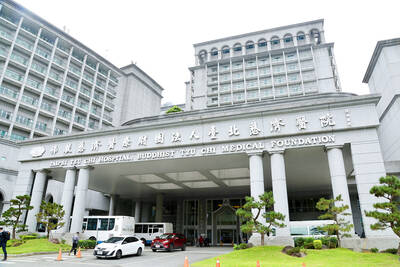
POLICE INVESTIGATING: A man said he quit his job as a nurse at Taipei Tzu Chi Hospital as he had been ‘disgusted’ by the behavior of his colleagues A man yesterday morning wrote online that he had witnessed nurses taking photographs and touching anesthetized patients inappropriately in Taipei Tzu Chi Hospital’s operating theaters. The man surnamed Huang (黃) wrote on the Professional Technology Temple bulletin board that during his six-month stint as a nurse at the hospital, he had seen nurses taking pictures of patients, including of their private parts, after they were anesthetized. Some nurses had also touched patients inappropriately and children were among those photographed, he said. Huang said this “disgusted” him “so much” that “he felt the need to reveal these unethical acts in the operating theater
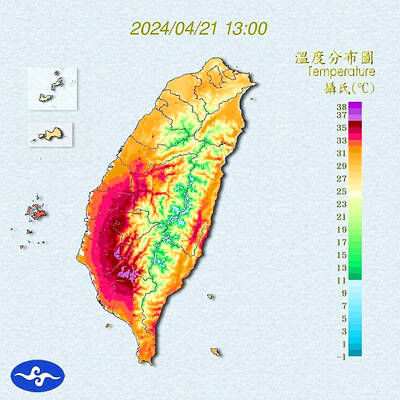
Heat advisories were in effect for nine administrative regions yesterday afternoon as warm southwesterly winds pushed temperatures above 38°C in parts of southern Taiwan, the Central Weather Administration (CWA) said. As of 3:30pm yesterday, Tainan’s Yujing District (玉井) had recorded the day’s highest temperature of 39.7°C, though the measurement will not be included in Taiwan’s official heat records since Yujing is an automatic rather than manually operated weather station, the CWA said. Highs recorded in other areas were 38.7°C in Kaohsiung’s Neimen District (內門), 38.2°C in Chiayi City and 38.1°C in Pingtung’s Sandimen Township (三地門), CWA data showed. The spell of scorching


 RSS
RSS