


The US' top military officer yesterday said that China had built up a "very large" missile arsenal opposite Taiwan and cautioned that Washington was committed to helping the nation defend itself.
"The US is committed to helping Taiwan maintain its ability to resist the use of force or coercion to solve this problem," Chairman of the Joint Chiefs of Staff General Richard Myers told journalists as he wrapped up a two-day visit to China, during which he met the country's top military brass.
"And it is not just a one-sided issue," he said when questioned by Chinese journalists on US arms sales to Taipei.
"In fact, if you look at the build-up on the Chinese mainland side of the [Taiwan] Strait in terms of surface-to-surface missiles, you would see a very large build-up. And China continues to build up its capability opposite Taiwan.
"Our responsibility under the Taiwan Relations Act is to assist Taiwan in its ability to defend itself. Again, so there will be a peaceful resolution to the problem and no temptation to use force," he said.
President Chen Shui-bian (
Chen hopes the referendum will send Beijing a clear message that the nation is unhappy about the hundreds of ballistic missiles deployed against it.
Last month, US President George W. Bush publicly rebuked Chen's plan and Myers repeated the stance yesterday, but also warned China the US would not stand by if it used force.
"President Bush could not have been clearer when he was speaking to Premier Wen [Jiabao (溫家寶)] that the US will resist any attempts to use coercion to solve the problem between China and Taiwan," Myers said.
"Again, I think all three parties in this case understand that very thoroughly," he said.
Meanwhile, State Department deputy spokesman Adam Ereli said on Wednesday that one of the reasons ties between the US and Taiwan were so close was that democracy continued to flourish in Taiwan.
Addressing foreign correspondents at the New York Foreign Press Center, Ereli said the US-Taiwan relationship was marked by a couple of constants, including US "appreciation for and support of Taiwan's democracy and democratic development."
He added that Bush "has been very clear and uncompromising on the issue of Taiwan's security and our commitment to that."
Ereli said the US believes that "the way to solve cross-strait tensions in the Taiwan Strait is through a cross-strait dialogue rather than statements here and statements there."
Stressing that the US government was taking very seriously the commitments made by Chen in his inaugural speech, Ereli said the US opposed any attempt by either Taiwan or China to unilaterally change the status quo.
"In that regard, we would be opposed to any [referendum] that would change Taiwan's status and move toward independence," he added.

Yangmingshan National Park authorities yesterday urged visitors to respect public spaces and obey the law after a couple was caught on a camera livestream having sex at the park’s Qingtiangang (擎天崗) earlier in the day. The Shilin Police Precinct in Taipei said it has identified a suspect and his vehicle registration number, and would summon him for questioning. The case would be handled in accordance with public indecency charges, it added. The couple entered the park at about 11pm on Thursday and began fooling around by 1am yesterday, the police said, adding that the two were unaware of the park’s all-day live

Fast food chain McDonald's is to raise prices by up to NT$5 on some products at its restaurants across Taiwan, starting on Wednesday next week, the company announced today. The prices of all extra value meals and sharing boxes are to increase by NT$5, while breakfast combos and creamy corn soup would go up by NT$3, the company said in a statement. The price of the main items of those meals, if ordered individually, would remain the same. Meanwhile, the price of a medium-sized lemon iced tea and hot cappuccino would rise by NT$3, extra dipping sauces for chicken nuggets would go up
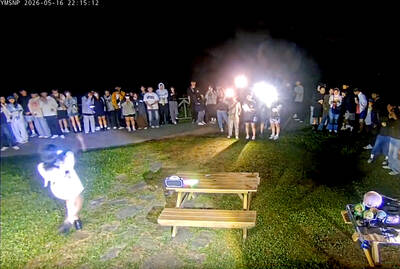
Yangmingshan National Park’s Qingtiangang (擎天崗) nature area has gone viral after a park livestream camera observed a couple in the throes of intimate congress, which was broadcast live on YouTube, drawing large late-night crowds and sparking a backlash over noise, bright lights and disruption to wildlife habitat. The area’s livestream footage appeared to show a couple engaging in sexual activity on a picnic table in the park on Friday last week, with the uncensored footage streamed publicly online. The footage quickly spread across social media, prompting a tide of visitors to travel to the site to “check in” and recreate the

Minister of Digital Affairs Lin Yi-ching (林宜敬) yesterday cited regulatory issues and national security concerns as an expert said that Taiwan is among the few Asian regions without Starlink. Lin made the remarks on Facebook after funP Innovation Group chief executive officer Nathan Chiu (邱繼弘) on Friday said Taiwan and four other countries in Asia — China, North Korea, Afghanistan and Syria — have no access to Starlink. Starlink has become available in 166 countries worldwide, including Ukraine, Malaysia, the Philippines and Vietnam, in the six years since it became commercial, he said. While China and North Korea block Starlink, Syria is not


 RSS
RSS