


Aborigines want their own television station to revise the twisted image of Aborigines portrayed on Taiwanese television, Aboriginal representatives said yesterday.
"I hope the Cabinet's Council of Indigenous Peoples and the Legislative Yuan can set up a task force that would include civil groups to examine the possibility of setting up a television channel and training Aboriginal broadcasting personnel," said Voyu (
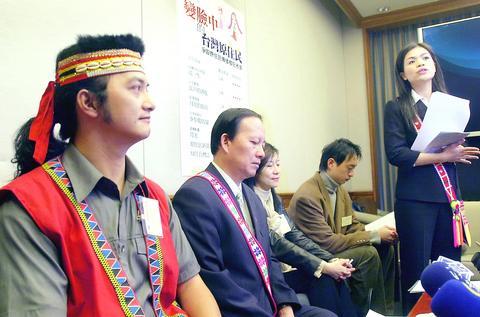
PHOTO: CHU PEI-HSIUNG, TAIPEI TIMES
Taiwan Media Watch recently conducted a review of television programs about Aboriginals that were broadcast in 2002.
"Many television programs have misinterpreted Aboriginal practices and twisted the image of Aboriginals. For instance, the program hosts often refer to Aboriginals as `they,' as if we are some foreign creatures from another world," said Mayaw Biho, the head of Amis Tribe Film Festival Committee (阿美族影展策展小組).
Mayaw pointed out certain common biases and misunderstanding regarding Aboriginals which are often seen on television.
"One major mistake is that Aboriginal holy rituals have often been portrayed as sports events. Another common scene is when Aboriginals are given a chance to talk before a camera, they are usually only asked to echo what the program host has already said and are not able to voice other opinions. We Aboriginals are not tape recorders, we know more than repeating," Mayaw said.
Wei Ti (
"APTN in Canada and TVNZ in New Zealand, which are public television channels dedicated to their respective native populations, receive stable financial resources from government. Furthermore, Aboriginals make up the majority of employees at these channels.
"These channels can be viewed across the nation and aim to promote native languages and cultures, as well as to improve the understanding and interaction among different ethnic groups," Wei said.
Last year, the Council of Indigenous Peoples last year set aside NT$3 billion for the establishment of an Aboriginal television channel.
However, the budget proposal did not clear the Legislative Yuan.
"The budget for a Hakka television channel, which is the same at NT$3 billion, cleared the Legislature Yuan smoothly and the channel has been in operation since last July. So why is the budget proposal for an Aboriginal television station still in difficulties at the Legislature Yuan?" asked Ado Calaw (林佩蓉), a member of ATIPP.
Legislators expressed concerns that a large number of Aborigines would not be able to receive the channel because they live in the mountains where reception is poor, but Ado considers the rejection of the proposal as a more complex issue.
"I feel that legislators might not believe in the ability of Aboriginals in managing a television network on our own and do not trust us with NT$3 billion. Besides, there may be a matter of politics involved as well," Ado said.

A group of Taiwanese-American and Tibetan-American students at Harvard University on Saturday disrupted Chinese Ambassador to the US Xie Feng’s (謝鋒) speech at the school, accusing him of being responsible for numerous human rights violations. Four students — two Taiwanese Americans and two from Tibet — held up banners inside a conference hall where Xie was delivering a speech at the opening ceremony of the Harvard Kennedy School China Conference 2024. In a video clip provided by the Coalition of Students Resisting the CCP (Chinese Communist Party), Taiwanese-American Cosette Wu (吳亭樺) and Tibetan-American Tsering Yangchen are seen holding banners that together read:

UNAWARE: Many people sit for long hours every day and eat unhealthy foods, putting them at greater risk of developing one of the ‘three highs,’ an expert said More than 30 percent of adults aged 40 or older who underwent a government-funded health exam were unaware they had at least one of the “three highs” — high blood pressure, high blood lipids or high blood sugar, the Health Promotion Administration (HPA) said yesterday. Among adults aged 40 or older who said they did not have any of the “three highs” before taking the health exam, more than 30 percent were found to have at least one of them, Adult Preventive Health Examination Service data from 2022 showed. People with long-term medical conditions such as hypertension or diabetes usually do not
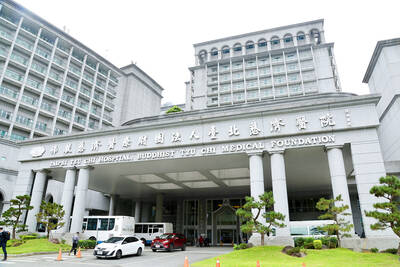
POLICE INVESTIGATING: A man said he quit his job as a nurse at Taipei Tzu Chi Hospital as he had been ‘disgusted’ by the behavior of his colleagues A man yesterday morning wrote online that he had witnessed nurses taking photographs and touching anesthetized patients inappropriately in Taipei Tzu Chi Hospital’s operating theaters. The man surnamed Huang (黃) wrote on the Professional Technology Temple bulletin board that during his six-month stint as a nurse at the hospital, he had seen nurses taking pictures of patients, including of their private parts, after they were anesthetized. Some nurses had also touched patients inappropriately and children were among those photographed, he said. Huang said this “disgusted” him “so much” that “he felt the need to reveal these unethical acts in the operating theater
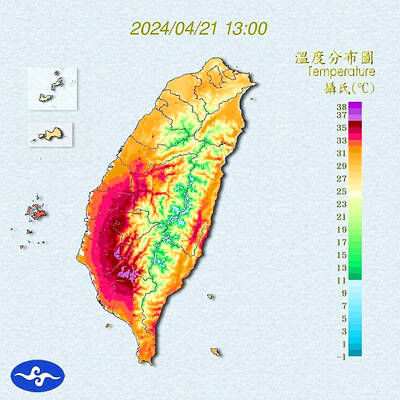
Heat advisories were in effect for nine administrative regions yesterday afternoon as warm southwesterly winds pushed temperatures above 38°C in parts of southern Taiwan, the Central Weather Administration (CWA) said. As of 3:30pm yesterday, Tainan’s Yujing District (玉井) had recorded the day’s highest temperature of 39.7°C, though the measurement will not be included in Taiwan’s official heat records since Yujing is an automatic rather than manually operated weather station, the CWA said. Highs recorded in other areas were 38.7°C in Kaohsiung’s Neimen District (內門), 38.2°C in Chiayi City and 38.1°C in Pingtung’s Sandimen Township (三地門), CWA data showed. The spell of scorching


 RSS
RSS