


The government yesterday launched the National Health Insurance integrated circuit (IC) cards at all hospitals and clinics despite concerns that the electronic medical data storage system could undermine people's privacy.
The Personal Information Protection Alliance yesterday gathered to highlight privacy and data security issues brought about by the compulsory use of the new cards.
The alliance was represented during yesterday's protest by the Taiwan Association for Human Rights, the Taiwan Tongzhi Hotline, Taiwan Gender/Sexuality Rights Association, Persons with HIV/AIDS Rights Advocacy Association of Taiwan and the Taiwan Organization for Victims of Occupational Injury among others.

PHOTO: GEORGE TSORNG, TAIPEI TIMES
Although roughly 90 percent of National Health Insurance-contracted hospitals and clinics had gradually begun using the IC card system last year, the use of IC cards became compulsory across the board yesterday.
"The IC cards are a violation of privacy rights," said Wang Ping (王蘋) secretary-general of the the Taiwan Gender/Sexuality Rights Association. "When all of your medical records are electronically stored on one single card, you're entrusting your personal information to the government."
Wang elaborated on the discriminatory consequences made possible by violations of medical privacy.
"A pregnant woman or an individual with HIV will be ruled out for employment opportunities, for example," Wang said.
"If you are to store personal data, then there need to be laws on how that information can be accessed," said Tim Buckfield, who was present during yesterday's protest.
Wu Jia-zhen (
"The law is structured so that individual privacy rights can be overridden by public interest," Wu said.
Government officials were also busy yesterday morning making stops at National Taiwan University Hospital, Mackay Memorial Hospital and Chang Gung Memorial Hospital to oversee the implementation of the IC card system.
"We will strike a balance between efficient use of medical resources and the protection of privacy rights in implementing the IC card system," said the general manager of the National Health Insurance Bureau, Chang Hong-jen (張鴻仁).
Chang further addressed the concerns of rights activists by stating that the IC card technology was better equipped to protect against privacy encroachment than the previous paper card system.
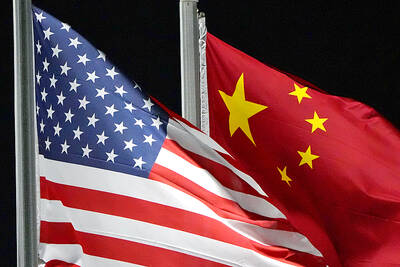
The brilliant blue waters, thick foliage and bucolic atmosphere on this seemingly idyllic archipelago deep in the Pacific Ocean belie the key role it now plays in a titanic geopolitical struggle. Palau is again on the front line as China, and the US and its allies prepare their forces in an intensifying contest for control over the Asia-Pacific region. The democratic nation of just 17,000 people hosts US-controlled airstrips and soon-to-be-completed radar installations that the US military describes as “critical” to monitoring vast swathes of water and airspace. It is also a key piece of the second island chain, a string of
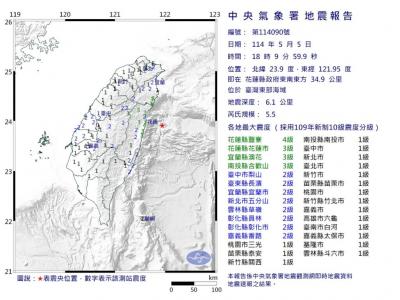
A magnitude 5.9 earthquake that struck about 33km off the coast of Hualien City was the "main shock" in a series of quakes in the area, with aftershocks expected over the next three days, the Central Weather Administration (CWA) said yesterday. Prior to the magnitude 5.9 quake shaking most of Taiwan at 6:53pm yesterday, six other earthquakes stronger than a magnitude of 4, starting with a magnitude 5.5 quake at 6:09pm, occurred in the area. CWA Seismological Center Director Wu Chien-fu (吳健富) confirmed that the quakes were all part of the same series and that the magnitude 5.5 temblor was

Taiwan will now have four additional national holidays after the Legislative Yuan passed an amendment today, which also made Labor Day a national holiday for all sectors. The Chinese Nationalist Party (KMT) and Taiwan People’s Party (TPP) used their majority in the Legislative Yuan to pass the amendment to the Act on Implementing Memorial Days and State Holidays (紀念日及節日實施辦法), which the parties jointly proposed, in its third and final reading today. The legislature passed the bill to amend the act, which is currently enforced administratively, raising it to the legal level. The new legislation recognizes Confucius’ birthday on Sept. 28, the
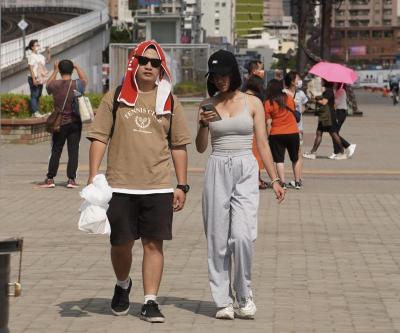
The Central Weather Administration has issued a heat alert for southeastern Taiwan, warning of temperatures as high as 36°C today, while alerting some coastal areas of strong winds later in the day. Kaohsiung’s Neimen District (內門) and Pingtung County’s Neipu Township (內埔) are under an orange heat alert, which warns of temperatures as high as 36°C for three consecutive days, the CWA said, citing southwest winds. The heat would also extend to Tainan’s Nansi (楠西) and Yujing (玉井) districts, as well as Pingtung’s Gaoshu (高樹), Yanpu (鹽埔) and Majia (瑪家) townships, it said, forecasting highs of up to 36°C in those areas


 RSS
RSS