


Tainan is to Taiwan what Kyoto is to Japan.
The first capital of Taiwan, Tainan was the political, cultural and economic center on the island from 1663 to 1885 under Koxinga (
Although much of its glory and luster has faded since the capital was moved to Taipei in 1885, Tainan, which is still packed with a variety of historic sites, has nonetheless earned a reputation as the "Cultural city" (
TAIPEI TIMES FILE PHOTO
A close look at the profiles of the two men that are locked in a two-cornered race to win the upcoming presidential election indicates that Tainan, whose multi-faceted history and rich cultural heritage has been closely intertwined with the development of the country, will again be inextricably linked to the nation's future.
President Chen Shui-bian (
Although the Greater Tainan area, with its approximate 1.3 million eligible voters, is not considered to be the decisive region that will determine the final outcome of the election, it remains an important strategic point for both the pan-green and the pan-blue camps.
TAIPEI TIMES FILE PHOTO
As both Chen and Lien are publicizing it as their hometown, Tainan is the one place the two camps are fighting hard not to lose.
To the pan-green camp, the Greater Tainan area is its stronghold, which it must retain; to the pan-blue camp, Tainan's electoral outcome signifies the Taiwanese pro-localization ideology, which is a concept the blue camp strives to be identified with.
"Tainan could be considered the birth place of Taiwan," said Lin Juei-ming (
Lin attributes much of Tainan's vivid pro-localization image to its rich history and the number of key events that have taken place there.
"Historical events experienced by Tainan have collectively and accumulatively formed a strong sense of democracy which has become profoundly rooted in the consciousness of Tainan's people," Lin said, citing events such as the Hsilaian Incident (
The Hsilaian Incident of 1915 marked the last big stand against Japanese colonization, with enormous casualties on the Taiwanese side.
The 228 Incident refers to a brutal military crackdown in 1947 on dissents protesting the corrupt administration of Chen Yi (
Lin, who has also served as director of the National Museum of Taiwanese Literature (
Prominent figures in Taiwanese literature, such as Yang Kui (
But Tainan has nurtured more than literary talents, Lin said.
On the political front, several well-known figures advocating Taiwanese independence also hail from Tainan.
Among their number are Wang Yu-te (
Chen won the 2000 presidential election with 39 percent of the votes nationwide, People First Party (PFP) Chairman James Soong (
The Choushui River is generally regarded as the dividing line between northern and southern Taiwan, with the latter considered to be a DPP stronghold.
Chen won the 2000 presidential election thanks to the support he garnered from the absolute majority of ballots cast in southern Taiwan. In Tainan City, Chen took 46.6 percent of the votes, while Lien had 25.9 percent and Soong 27.5 percent.
In Tainan County, Chen garnered 53.7 percent of the votes, leaving Lien (24.7 percent) and Soong (21.1 percent) far behind.
This time around, Lien is joining forces with his former foe, Soong, on a single ticket in an attempt to unseat Chen in the upcoming election, which is slated to take place on March 20.
In a bid to chip away at the pan-green camp's support in the Greater Tainan area, Lien's camp purposefully selected Tainan as the spot to kick off Lien's presidential campaign.
To strike a chord with fellow residents of Tainan and seek their support, Lien staged his first campaign rally in Tainan last month, saying "I am truly a Tainan person."
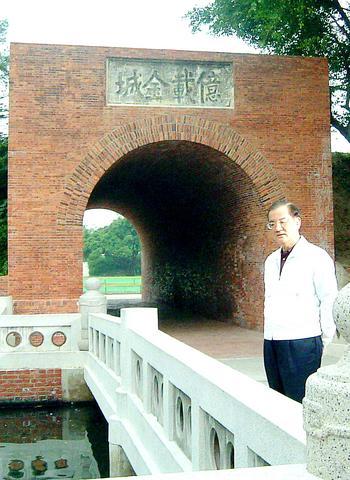
In addition to staging his first big campaign rally in Tainan, Lien, in a bid to bring home to local voters the message that he is bound to Tainan, also chose the Eternal Fortress as the background for his first campaign TV spot.
The fortress, built in 1876, is a popular historic site located in the Anping district of Tainan. Ching dynasty Fujian maritime commissioner Shen Bao-zhen (
The TV spot, which features Lien strolling along a path at the fortress while showing images of old photos, was aimed at emphasizing the close connection between the people and the land. Its goal was also to show that Lien was setting out from his hometown and vying for the support and recognition of his fellow townsfolk.
Some locals argue otherwise, disputing Lien's claim of being a "Tainan person."
"Lien is not a Tainan person," said former DPP legislator Hsieh Chin-chun (謝錦川), who represents a constituency in Tainan County.
Although Lien's grandfather Lien Heng (
Lien was in China until 1946, when he returned to Taiwan with his family after Japan's defeat in World War II. Lien, then aged 10, was schooled in Taipei's Zu-hsin elementary school as a transferred sixth grader and pursued his subsequent education in Taipei. Lien's connections with Tainan, his ancestral home, seem slight to current Tainan residents.
"Not only is Lien not in Tainan personally, but his heart is not with Tainan either," Hsieh said.
"He has served in several high-ranking government positions, as Minister of Transportation, Premier and Vice President, but what significant effort or infrastructure improvements has he contributed to Tainan during all this time?" Hsieh asked.
Lien studied in the US for 10 years, obtained a doctoral degree from the University of Chicago and taught political science at the universities of Wisconsin and Connecticut.
Lien returned to Taiwan and his subsequent rise through the party and government ranks has seemed remarkable and smooth.
"He does not have the common touch like Chen," Hsieh said, adding that the common impression people in Tainan have of Lien is that he is "a rich kid" who does not know much about the plight of the poor.
"Chen, on the other hand, is the true Tainan person who was born in Tainan, grew up in Tainan and received his [secondary school] education in Tainan," Hsieh said.
Born in 1951 to a poverty-stricken family in Tainan County, Chen worked his way through and graduated from the Law School of National Taiwan University in 1974.
He formally launched his political career when he was elected to the Taipei City Council in 1981.
"Unlike places such as Taipei, which has a constant influx of people pouring in from other cities and counties, Tainan is a region in which the residents emigrate to other places," Hsieh said. "People in Tainan therefore share a strong sense of togetherness and identification with fellow townsfolk."
Saying that people in Tainan are susceptible to suggestion, as opposed to Taipei residents, who are in general more rational, Hsieh believes interpersonal relations thus plays a heavy role in the Tainan electorate's voting preferences.
DPP Legislator Lai Ching-te (
"The very fact that Lien sees the need to stress that he is `a true Tainan person' suggested that he harbors a guilty conscience about his ties with Tainan," Lai said.
DPP Legislator Wang Sing-nan (
Lin, speaking from a historical perspective, said "a person is only fit to be recognized as a Tainan person when she or he spends extensive time in Tainan and harbors a great sense of attachment with the place and the people here."
Given that Chen actually grew up and attended school in Tainan, Lin stated that Tainan residents would be more drawn to identify with Chen.
"Besides, Chen speaks Mandarin with a distinct Tainan accent, which is another element that tends to draw the people here to identify with him," Lin added.
Defending Lien's image as a Tainan person, Tsai Shu-ya (
"Just like any other person, when your job demands that you relocate, you have to move. It has nothing to do with you not loving your hometown," Tsai said, adding that Lien's family had contributed to Tainan's welfare by such actions as selling their property to help fend off Japanese aggression.
"To dismiss the public's misconception about Lien and his lack of ties with Tainan, we have bought space in a local daily to print a series of stories about Lien's youth, so that people can understand why he was away from Tainan so much," Tsai said.
With the presidential election less than four months away, Tsai said the blue camp's campaign strategy is to focus on garnering the support of undecided voters, which amounts to about 20 percent of the vote.
In addition to promoting Lien's policies at various spots around the city and staging of large-scale campaign rallies, Tsai said that "we will meanwhile schedule frequent visits for Lien to come back here and mingle with fellow Tainan townsmen."
Tsai said she believes that the more visits Lien makes to Tainan, the deeper the impression will be that he leaves with the city's people. It is hoped that they will eventually agree that he is indeed one of them.
Expressing optimism about Lien's overall electoral outlook in Tainan, Tsai said that KMT Legislative Speaker Wang Jin-pyng (
Wang, a Kaohsiung County native, is regarded by many pan-blue supporters as the key representative of the KMT's pro-localization faction.
Pan-blue legislators said Wang's acceptance of the position was a big boost to the alliance's electoral outlook.
Noting that Wang enjoyed a lot of public support in central and southern Taiwan, KMT legislative leader Lee Chia-chin (
KMT Legislator Wang Yu-ting (
Former legislators To Cheng-jung (
Representing a constituency in Tainan County, KMT Legislator Lee Chuan-chiao (
Shen Jung-feng (
"We will try our best to promote Chen's candidacy and bolster his support in this region," Shen said.
According to its campaign office, the KMT will strengthen its organizational tactics to make up for its disadvantages in Tainan County.
The camp also is contemplating of seeking former Tainan County council speaker Chou Ching-wen (
Countering Lien's strategy, Chen's camp arranged that he would visit Tainan shortly after Lien's rally.
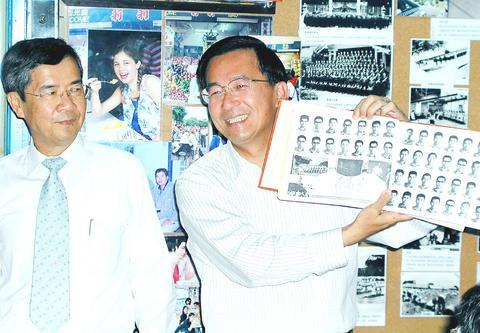
During Chen's visit he invited his old high school classmates and teachers in Tainan to have dessert at the Lili Fruit shop (
With the scene fostering a warm and fragrant atmosphere of Chen sharing dessert with old-time friends, the Chen camp said that this would demonstrate who the real Tainan person is.
Tainan Mayor Hsu Tien-tsai (
Apparently confident, Hsu, who is slated to serve as the party's campaign director in Tainan, said the party will vie for the undecided voters by periodically staging seminars around the city promoting Chen's ideals and policies.
Saying that fellow Tainan County residents have not been quite content with the DPP's Tainan County Commissioner Su Huan-chih (
Noting that Tainan County is an agricultural region whose population consists mainly of farmers, DPP Legislator Cheng Kuo-chung (
However, Cheng said, Chen knows better than to lower his guard and treat his hometown lightly.
To both Chen and Lien, Tainan means more than just an electoral battle. It is also a personal trial for them, testing their identity as "Tainan people" in the eyes of residents of the area. How will the people of Tainan view Chen and Lien? The answer will only be truly revealed on March 20, when they go to the polls and cast their votes.
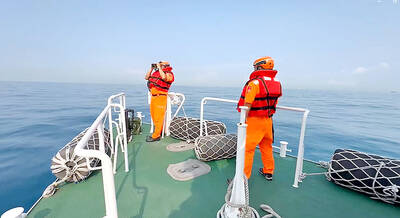
An increase in Taiwanese boats using China-made automatic identification systems (AIS) could confuse coast guards patrolling waters off Taiwan’s southwest coast and become a loophole in the national security system, sources familiar with the matter said yesterday. Taiwan ADIZ, a Facebook page created by enthusiasts who monitor Chinese military activities in airspace and waters off Taiwan’s southwest coast, on Saturday identified what seemed to be a Chinese cargo container ship near Penghu County. The Coast Guard Administration went to the location after receiving the tip and found that it was a Taiwanese yacht, which had a Chinese AIS installed. Similar instances had also

GOOD DIPLOMACY: The KMT has maintained close contact with representative offices in Taiwan and had extended an invitation to Russia as well, the KMT said The Chinese Nationalist Party (KMT) would “appropriately handle” the fallout from an invitation it had extended to Russia’s representative to Taipei to attend its international banquet last month, KMT Chairman Eric Chu (朱立倫) said yesterday. US and EU representatives in Taiwan boycotted the event, and only later agreed to attend after the KMT rescinded its invitation to the Russian representative. The KMT has maintained long-term close contact with all representative offices and embassies in Taiwan, and had extended the invitation as a practice of good diplomacy, Chu said. “Some EU countries have expressed their opinions of Russia, and the KMT respects that,” he
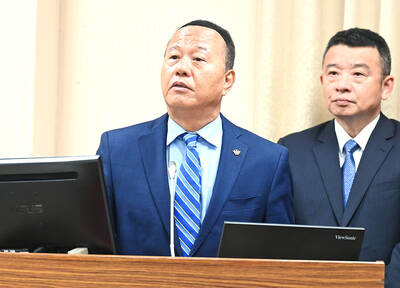
VIGILANCE: The military is paying close attention to actions that might damage peace and stability in the region, the deputy minister of national defense said The People’s Republic of China (PRC) might consider initiating a hack on Taiwanese networks on May 20, the day of the inauguration ceremony of president-elect William Lai (賴清德), sources familiar with cross-strait issues said. While US Secretary of State Anthony Blinken’s statement of the US expectation “that all sides will conduct themselves with restraint and prudence in the period ahead” would prevent military actions by China, Beijing could still try to sabotage Taiwan’s inauguration ceremony, the source said. China might gain access to the video screens outside of the Presidential Office Building and display embarrassing messages from Beijing, such as congratulating Lai
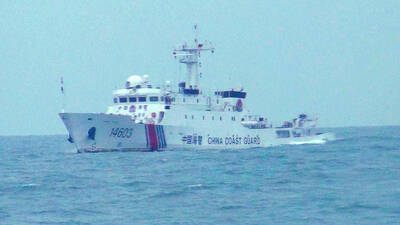
Four China Coast Guard ships briefly sailed through prohibited waters near Kinmen County, Taipei said, urging Beijing to stop actions that endanger navigation safety. The Chinese ships entered waters south of Kinmen, 5km from the Chinese city of Xiamen, at about 3:30pm on Monday, the Coast Guard Administration said in a statement later the same day. The ships “sailed out of our prohibited and restricted waters” about an hour later, the agency said, urging Beijing to immediately stop “behavior that endangers navigation safety.” Ministry of National Defense spokesman Sun Li-fang (孫立方) yesterday told reporters that Taiwan would boost support to the Coast Guard


 RSS
RSS