


The completion of three watertreatment plants in Kaohsiung will ensure millions of residents quality drinking water, ending a decades-long nightmare caused by river pollution, according to the Kaohsiung City Government.
Operation at the three plants, completed last month, will be officially launched next week.
Yesterday, the city's Environmental Protection Bureau Director Chang Feng-teng (張豐藤) sampled water at outlets of the Taiwan Water Supply Corp's Seventh District Management Department. Results suggest that the chloride level in tap water is 0.47ppm, turbidity is 0.02 NTU (Nephelometric Turbidity Units) and hardness, or the amount of calcium carbonate, is 143 ppm. The test on trihalomethanes was negative.
Comparing to statistics pertaining to water quality monitored in the last nine months, officials said, the quality has improved. Past statistics suggest that average turbidity was 0.21 NTU, while the average level of trihalomethanes was 0.036ppm.
Chang said the unsatisfactory quality of tap water in the past could be attributed to excessive chloride added to disinfect raw water. This measure made tap water in Kaohsiung hard. Past records show that the chloride level in tap water stood at 0.9ppm and hardness between 150ppm and 293ppm.
To convince residents of the improved water quality, Chang and other officials yesterday drank tap water after boiling it in advance.
The bureau's random inspection of tap water at 59 sampling points will be carried out continuously. Chang said that this was necessary to provide residents with details about where their water comes from, what it contains and how it compares to national standards.
The quality of tap water in Kaohsiung now meets national regulations.
Because of illegal dumping and pig farms upstream along the Kaoping River, which supply water to millions of residents in Kaohsiung city and county, poor water quality had been a threat to their health for decades.
Especially since the discovery in July 2000 that toxic solvents were illegally being dumped in the Chishan River, which flows into Kaoping River, most residents had complained about the water's chemical odor and used it only for rinsing.
Most residents buy cleaner spring water, which is transferred by vendors from mountains in neighboring Pingtung County, for drinking and cooking.
In the past three years, the Environmental Protection Administration (EPA) relocated 470,000 pigs raised on farms along the Kaoping River, effectively cutting excrement pollutants discharged from farms.
Meanwhile, in order to ensure the quality of raw water, the central government budgeted NT$15 billion to have intake points moved upstream and build three advanced treatment plants.
The improvement in the quality of tap water in Kaohsiung paid off, President Chen Shui-bian (
On Tuesday, Chen tried a cup of water, which was brought by Kaohsiung Mayor Frank Hsieh (謝長廷) from Kaohsiung, in front of the media to show his confidence in the achievement.
However, city environmental officials yesterday called for regular cleanups of standpipes every three to six months to avoid possible contamination or quality deterioration.

A group of Taiwanese-American and Tibetan-American students at Harvard University on Saturday disrupted Chinese Ambassador to the US Xie Feng’s (謝鋒) speech at the school, accusing him of being responsible for numerous human rights violations. Four students — two Taiwanese Americans and two from Tibet — held up banners inside a conference hall where Xie was delivering a speech at the opening ceremony of the Harvard Kennedy School China Conference 2024. In a video clip provided by the Coalition of Students Resisting the CCP (Chinese Communist Party), Taiwanese-American Cosette Wu (吳亭樺) and Tibetan-American Tsering Yangchen are seen holding banners that together read:

UNAWARE: Many people sit for long hours every day and eat unhealthy foods, putting them at greater risk of developing one of the ‘three highs,’ an expert said More than 30 percent of adults aged 40 or older who underwent a government-funded health exam were unaware they had at least one of the “three highs” — high blood pressure, high blood lipids or high blood sugar, the Health Promotion Administration (HPA) said yesterday. Among adults aged 40 or older who said they did not have any of the “three highs” before taking the health exam, more than 30 percent were found to have at least one of them, Adult Preventive Health Examination Service data from 2022 showed. People with long-term medical conditions such as hypertension or diabetes usually do not
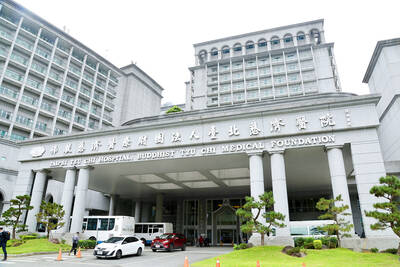
POLICE INVESTIGATING: A man said he quit his job as a nurse at Taipei Tzu Chi Hospital as he had been ‘disgusted’ by the behavior of his colleagues A man yesterday morning wrote online that he had witnessed nurses taking photographs and touching anesthetized patients inappropriately in Taipei Tzu Chi Hospital’s operating theaters. The man surnamed Huang (黃) wrote on the Professional Technology Temple bulletin board that during his six-month stint as a nurse at the hospital, he had seen nurses taking pictures of patients, including of their private parts, after they were anesthetized. Some nurses had also touched patients inappropriately and children were among those photographed, he said. Huang said this “disgusted” him “so much” that “he felt the need to reveal these unethical acts in the operating theater
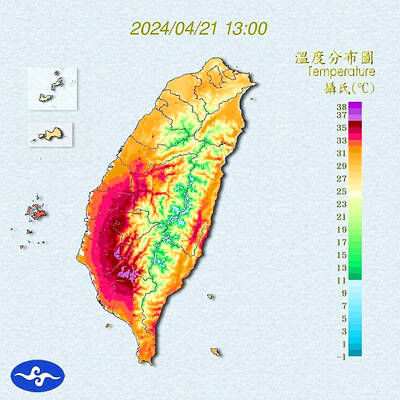
Heat advisories were in effect for nine administrative regions yesterday afternoon as warm southwesterly winds pushed temperatures above 38°C in parts of southern Taiwan, the Central Weather Administration (CWA) said. As of 3:30pm yesterday, Tainan’s Yujing District (玉井) had recorded the day’s highest temperature of 39.7°C, though the measurement will not be included in Taiwan’s official heat records since Yujing is an automatic rather than manually operated weather station, the CWA said. Highs recorded in other areas were 38.7°C in Kaohsiung’s Neimen District (內門), 38.2°C in Chiayi City and 38.1°C in Pingtung’s Sandimen Township (三地門), CWA data showed. The spell of scorching


 RSS
RSS