


New York-based political commentator Cao Chang-ching (曹長青) stands out among Chinese dissidents for his support of Taiwan's right to decide its own future.
Unlike many dissidents who call for democratic reforms in China yet appear hesitant when it comes to the issue of Taiwan independence, Cao supports the right to self-determination.
"Many overseas Chinese disagree with my argument that people in Taiwan should have the right to choose," Cao said.

PHOTO: RICK CHU, TAIPEI TIMES
Cao was cast into the limelight last week after being attacked, allegedly by members of the pro-unification Patriot Association (愛國同心會).
Disapproving of and apparently enraged by Cao's pro-Taiwan independence rhetoric at a conference last Sunday, four members of the group allegedly physically and verbally assaulted Cao that night in the lobby of the Grand Hotel.
Cao, who left Taiwan yesterday, was visiting the country last week at the invitation of the think tank Taiwan Advocates and the Northern Taiwan Society.
The assault made a celebrity of Cao and police were called upon to stand guard at his subsequent events.
"This is the first time in my life that I feel as if I am some big-name celebrity where there is the need to call the police to protect my presence," he said, making light of the assault.
Cao said that he would never compromise in the face of violence.
But his outspokenness in support of Taiwan's right to self-determination doesn't sit well with many overseas Chinese democracy activists.
While noting that he has not encountered such assaults in the past, Cao said he is well aware that many pro-unification overseas Chinese don't welcome his views.
"When you go on-line, you can see much criticism against me, lambasting my support for people in Taiwan to have the right to self-determination," he said.
Born in Heilongjiang Province, Cao, 50, received a bachelor of arts degree in Chinese from the University of Heilongjiang.
Cao is a former deputy editor in chief of the communist Shenzhen Youth News.
He was ousted from his job in 1986 -- the newspaper was dissolved shortly thereafter -- for daring to suggest in an editorial that then Chinese leader Deng Xiaoping (鄧小平) was too old to hang on to power and that he should retire.
Arriving in the US in 1988, Cao founded the Press Freedom Guardian (新聞自由導報) the following year and is now a political commentator for Radio Free Asia out of the US, Hong Kong's Open magazine and the Taipei Times.
Cao was a visiting fellow at Columbia University in 1996.
He said he has been developing ideas on democracy since his time in China.
Cao said books such as Animal Farm and Twenty Letters to a Friend were among the books -- banned by the Chinese authorities -- that have helped shape his concept of democracy.
It was not until he came to the US in the late 1980s that he started to take note of issues regarding Taiwan.
"It was only after coming to the US that I started to come across articles about Taiwan and meet people. I began to become aware of the reality of Taiwan's situation and understand the truth about Taiwan," he said.
Cao said that he supports former president Lee Teng-hui's (李登輝) "two states" theory and President Chen Shui-bian's (陳水扁) "one country on each side" of the Taiwan Strait dictum because both men truthfully describe Taiwan's reality.
The same can be said for his support for Tibet's and Xinjiang's self-determination, he added.
Author of Tibet Through Dissident Chinese Eyes: Essays on Self-Determination, Cao has written hundreds of articles for leading journals in the US, Taiwan and Hong Kong pushing the cause of independence for Tibet, Taiwan and Xinjiang and endorsing democratic reforms in China.
In 1997, Cao, assisted by another Chinese democracy activist, Harry Wu (
Cao was arrested by the Chinese police while taking clandestine photographs. He was later released because he holds a US passport.
A Cao aide, who wished not to be named, said that overseas Chinese dissidents can be divided into two groups: those who support Cao's pro-Taiwan independence stance and those who do not.
"What impresses me most is the fact that he, although Chinese, dares to stand up for Taiwan's right to self-determination when speaking with other overseas Chinese," said the aide, a US-based Taiwanese.
As an example, the aide cited a gathering of overseas Chinese democracy activists in Los Angeles in July. At the meeting, the issue of Taiwan came up and the activists concluded that the matter should be decided by China's 1.3 billion people.
After listening to their remarks, the aide said, Cao stood up and rebutted their comments, saying that Taiwan's future should be decided only by Taiwanese themselves.
"Unlike many of these overseas Chinese democracy activists who think of democracy from the mind-set of `greater China,' Cao perceives the values of democracy from the starting point of an individual, whose rights need to be respected," the aide said.
Cao doesn't let opposition from other overseas Chinese sway him.
"The massive criticism against me on this issue will not shake my belief in Taiwan's right to self-determination," he said.
Cao said he feels regret that these overseas Chinese so-called democracy activists have not grasped the true meaning of democracy.
"Democracy is not about a mere giving of freedom to a big group or a nation, it is about respecting a person's value, freedom and rights," Cao said.
"It is blasphemy against the true values of democracy that, on the one hand, Chinese democracy activists insist on democracy and freedom for China, yet, on the other hand, they do not respect Taiwanese people's right to self-determination," he added.
Stressing that he is not an overseas Chinese democracy activist as he has never taken part in democratic movements in China, Cao said he likes to position himself as a "dissident writer."
Levin Liao (廖立文), editor in chief of Locus magazine and who has known Cao for the past seven years, said Cao has a better understanding of the value of democracy than some groups in Taiwan do.
Lin Yuan-hui (林元輝), a professor at the National Chengchi University Graduate School of Journalism, said, "Cao's rhetoric is very meaningful to people in Taiwan because he is from China, yet he supports the right of Taiwanese to decide the future of Taiwan."
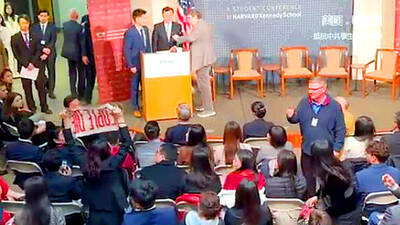
A group of Taiwanese-American and Tibetan-American students at Harvard University on Saturday disrupted Chinese Ambassador to the US Xie Feng’s (謝鋒) speech at the school, accusing him of being responsible for numerous human rights violations. Four students — two Taiwanese Americans and two from Tibet — held up banners inside a conference hall where Xie was delivering a speech at the opening ceremony of the Harvard Kennedy School China Conference 2024. In a video clip provided by the Coalition of Students Resisting the CCP (Chinese Communist Party), Taiwanese-American Cosette Wu (吳亭樺) and Tibetan-American Tsering Yangchen are seen holding banners that together read:

UNAWARE: Many people sit for long hours every day and eat unhealthy foods, putting them at greater risk of developing one of the ‘three highs,’ an expert said More than 30 percent of adults aged 40 or older who underwent a government-funded health exam were unaware they had at least one of the “three highs” — high blood pressure, high blood lipids or high blood sugar, the Health Promotion Administration (HPA) said yesterday. Among adults aged 40 or older who said they did not have any of the “three highs” before taking the health exam, more than 30 percent were found to have at least one of them, Adult Preventive Health Examination Service data from 2022 showed. People with long-term medical conditions such as hypertension or diabetes usually do not
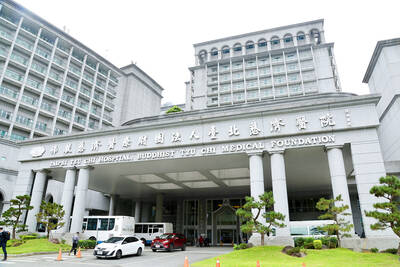
POLICE INVESTIGATING: A man said he quit his job as a nurse at Taipei Tzu Chi Hospital as he had been ‘disgusted’ by the behavior of his colleagues A man yesterday morning wrote online that he had witnessed nurses taking photographs and touching anesthetized patients inappropriately in Taipei Tzu Chi Hospital’s operating theaters. The man surnamed Huang (黃) wrote on the Professional Technology Temple bulletin board that during his six-month stint as a nurse at the hospital, he had seen nurses taking pictures of patients, including of their private parts, after they were anesthetized. Some nurses had also touched patients inappropriately and children were among those photographed, he said. Huang said this “disgusted” him “so much” that “he felt the need to reveal these unethical acts in the operating theater
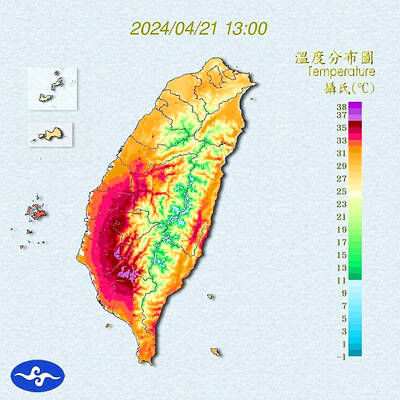
Heat advisories were in effect for nine administrative regions yesterday afternoon as warm southwesterly winds pushed temperatures above 38°C in parts of southern Taiwan, the Central Weather Administration (CWA) said. As of 3:30pm yesterday, Tainan’s Yujing District (玉井) had recorded the day’s highest temperature of 39.7°C, though the measurement will not be included in Taiwan’s official heat records since Yujing is an automatic rather than manually operated weather station, the CWA said. Highs recorded in other areas were 38.7°C in Kaohsiung’s Neimen District (內門), 38.2°C in Chiayi City and 38.1°C in Pingtung’s Sandimen Township (三地門), CWA data showed. The spell of scorching


 RSS
RSS