


Chinese Nationalist Party (KMT) Chairman Lien Chan (連戰) has urged the resumption of cross-strait dialogue based on the so-called "1992 consensus," but in a Washington speech apparently made an important shift in the definition of that formula to make it more palatable to Democratic Progressive Party (DPP) supporters and others.
Lien said that the dialogue should be resumed with both sides agreeing on a "one China" formula based on the presumption that "`one China' for us is the Republic of China, while `one China' for the mainland is the People's Republic of China."
"With this different understanding or interpretation, or respective interpretation, we could resume our dialogue based on the principle of `one China,' which is something on which we agree to disagree," Lien said at a luncheon hosted by the US-China Policy Foundation at the National Press Club in Washington on Tuesday.
It was the second time in two days that Lien made the argument to press for a resumption of cross-strait dialogue based on the "1992 consensus," in which the talks were based on the "one China" principle with each side deciding on its own definition of "one China."
On Monday, he said the resumption of dialogue would be "acceptable to Taiwan only when China said that `one China' is the Republic of China."
The "1992 consensus" must be the "minimum common denominator for the resumption of dialogue," he said.
Lien complained about DPP charges that the KMT is selling out to China when it urges the resumption of dialogue.
"When you start with [the consensus], many people, including our ruling party, the DPP, begin to put a dunce's cap on your head. You would be accused of selling out Taiwan because you started with the principle of `one China,'" he said.
"So what we need to say today is that we reverse the order," with the differing definition of one China being the basis of any new cross-strait dialogue, he said.
Lien also made an appeal to his American audience by implying that President Chen Shui-bian (
"Being a good friend of the United States, we should consider not only the ROC's special interests, but also the national interests of the United States. At this particular moment, the United States already has its hands full with problems like Iraq, North Korea and international terrorism," he said.
"It does not need another crisis. It is also important for us, for Taiwan, not to add another crisis to its already full agenda.," Lien said.
In a clear reference to Chen's recently announced plans for a series of referendums and a new constitution, as well as his earlier "one country on each side" of the Taiwan Strait pronouncement, Lien said, "It make no sense to needle or provoke unnecessarily the PRC, which possibly may draw the United States into a conflict in the Taiwan Strait region.
"We have no intention to create problems for the United States or for anybody else. We are pro-peace but we are not pro-PRC," he said.
"So it is not our plan to play the role of the spoiler or a troublemaker. We want to be a genuine responsible friend and partner to our most valued friend, the United States," he said.
Later, Lien spent more than half and hour with the chairwoman of the American Institute in Taiwan, Therese Shaheen, discussing a wide variety of issues.
"We just talked about a wide range of views," Shaheen told reporters afterward.
"It was a very nice discussion." We talked about a lot of things, what was going on, the globalization of Taiwan," she said, giving no details.
Steven Chen (陳錫蕃), a former top representative of Taiwan in Washington, who is traveling with Lien, told the Taipei Times that Lien and Shaheen discussed "our whole spectrum of relationships, cultural, trade, economics, educational."
But he said, "They did not touch on any sensitive subjects," including a Saturday US State Department statement committing Washington to neutrality in the upcoming Taiwan presidential election.
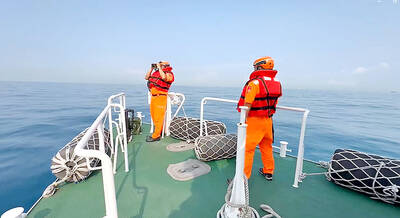
An increase in Taiwanese boats using China-made automatic identification systems (AIS) could confuse coast guards patrolling waters off Taiwan’s southwest coast and become a loophole in the national security system, sources familiar with the matter said yesterday. Taiwan ADIZ, a Facebook page created by enthusiasts who monitor Chinese military activities in airspace and waters off Taiwan’s southwest coast, on Saturday identified what seemed to be a Chinese cargo container ship near Penghu County. The Coast Guard Administration went to the location after receiving the tip and found that it was a Taiwanese yacht, which had a Chinese AIS installed. Similar instances had also

GOOD DIPLOMACY: The KMT has maintained close contact with representative offices in Taiwan and had extended an invitation to Russia as well, the KMT said The Chinese Nationalist Party (KMT) would “appropriately handle” the fallout from an invitation it had extended to Russia’s representative to Taipei to attend its international banquet last month, KMT Chairman Eric Chu (朱立倫) said yesterday. US and EU representatives in Taiwan boycotted the event, and only later agreed to attend after the KMT rescinded its invitation to the Russian representative. The KMT has maintained long-term close contact with all representative offices and embassies in Taiwan, and had extended the invitation as a practice of good diplomacy, Chu said. “Some EU countries have expressed their opinions of Russia, and the KMT respects that,” he
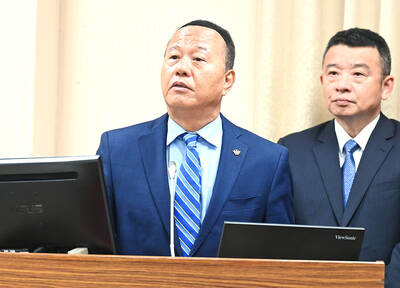
VIGILANCE: The military is paying close attention to actions that might damage peace and stability in the region, the deputy minister of national defense said The People’s Republic of China (PRC) might consider initiating a hack on Taiwanese networks on May 20, the day of the inauguration ceremony of president-elect William Lai (賴清德), sources familiar with cross-strait issues said. While US Secretary of State Anthony Blinken’s statement of the US expectation “that all sides will conduct themselves with restraint and prudence in the period ahead” would prevent military actions by China, Beijing could still try to sabotage Taiwan’s inauguration ceremony, the source said. China might gain access to the video screens outside of the Presidential Office Building and display embarrassing messages from Beijing, such as congratulating Lai
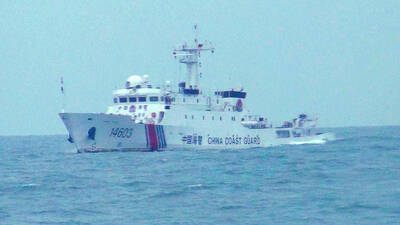
Four China Coast Guard ships briefly sailed through prohibited waters near Kinmen County, Taipei said, urging Beijing to stop actions that endanger navigation safety. The Chinese ships entered waters south of Kinmen, 5km from the Chinese city of Xiamen, at about 3:30pm on Monday, the Coast Guard Administration said in a statement later the same day. The ships “sailed out of our prohibited and restricted waters” about an hour later, the agency said, urging Beijing to immediately stop “behavior that endangers navigation safety.” Ministry of National Defense spokesman Sun Li-fang (孫立方) yesterday told reporters that Taiwan would boost support to the Coast Guard


 RSS
RSS