


Taiwan Solidarity Union (TSU) lawmakers yesterday said Mainland Affairs Council Chairwoman Tsai Ing-wen (蔡英文) should step down because of lax cross-strait regulations.
One day after the Legislative Yuan passed amendments to the Statute Governing the Relations between the People of Taiwan Area and the Mainland Area (兩岸人民關係條例), TSU members blamed Tsai for the fact that more than 80,000 Chinese nationals married to Taiwanese have obtained legal residence status since the Democratic Progressive Party (DPP) government was elected in 2000.
TSU whip Liao Pen-yen (
"Tsai is the one who should step down for making these wrong Chinese policies," Liao said.
According to Liao, these policies include granting residence to the great number of Chinese nationals immigrating to Taiwan on the grounds of marriages to Taiwanese citizens and allowing Taiwanese investors to set up an eight-inch wafer plant in China.
He added that the lifting of the ban on Chinese colleges recruiting students in Taiwan could deprive the nation of potential benefits, since Taiwan and China have not yet reached a consensus on recognizing each other's educational records.
Despite a promise from Tsai to implement stricter surveillance and management of naturalization applications by Chinese spouses, Legislator Chen Chien-ming (
According to Chen, more than 110,000 Chinese spouses would qualify for Taiwanese citizenship by the end of this year.
"And at least 40 percent of them had faked marriages with Taiwanese citizens in order to stay here," Chen said.
The TSU caucus members apologized for failing to safeguard the interests of the Taiwanese people, since they were a minority in the legislative review on Thursday where it was agreed to leave the waiting period at eight years. The 12 members of the TSU, backed by 17 DPP legislators and one independent lawmaker, voted in vain against the eight-year rule for Chinese spouses.
Lawmakers also decided on Thursday to allow Chinese universities to recruit students in Taiwan and to give the government 18 months to complete negotiations with China on direct cross-strait transportation links.
The TSU and some DPP lawmakers opposed this, vowing to defend Taiwan's interests and sovereignty by maintaining rigid rules on cross-strait exchanges.
"The TSU caucus will petition for a legislative reconsideration of the cross-strait statute on Tuesday. In the meantime, we have decided to close the door to further negotiations with the three major parties after they abandoned the TSU and the real interests of the Taiwanese people by passing the amendments," Lo Chih-ming (
DPP whip Ker Chien-ming (
"The revised statute, in fact, realizes the goal of imposing more stringent regulations on granting Chinese spouses ID cards. The number of Chinese immigrants could be managed by setting up quotas in the different phases of the application procedure.... The old law was loose and incapable of stemming the influx of Chinese immigrants," Ker said yesterday.
"It is therefore unnecessary to file for a review of the approved amendments, especially considering that the only proposal the TSU presented in opposition to the eight-year rule was an extended 11-year application period. Extending the waiting period would not necessarily lead to a reduction in the number of Chinese immigrants in Taiwan 10 years later," Ker said.
"It is normal that each party would safeguard its stance on certain political issues, but the way that the TSU suddenly withdrew from the last-minute multiparty negotiations on the amendments is debatable," the DPP whip said.
He added that this trend "has set a bad example for legislative cooperation."
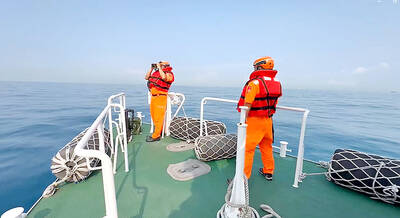
An increase in Taiwanese boats using China-made automatic identification systems (AIS) could confuse coast guards patrolling waters off Taiwan’s southwest coast and become a loophole in the national security system, sources familiar with the matter said yesterday. Taiwan ADIZ, a Facebook page created by enthusiasts who monitor Chinese military activities in airspace and waters off Taiwan’s southwest coast, on Saturday identified what seemed to be a Chinese cargo container ship near Penghu County. The Coast Guard Administration went to the location after receiving the tip and found that it was a Taiwanese yacht, which had a Chinese AIS installed. Similar instances had also

GOOD DIPLOMACY: The KMT has maintained close contact with representative offices in Taiwan and had extended an invitation to Russia as well, the KMT said The Chinese Nationalist Party (KMT) would “appropriately handle” the fallout from an invitation it had extended to Russia’s representative to Taipei to attend its international banquet last month, KMT Chairman Eric Chu (朱立倫) said yesterday. US and EU representatives in Taiwan boycotted the event, and only later agreed to attend after the KMT rescinded its invitation to the Russian representative. The KMT has maintained long-term close contact with all representative offices and embassies in Taiwan, and had extended the invitation as a practice of good diplomacy, Chu said. “Some EU countries have expressed their opinions of Russia, and the KMT respects that,” he

VIGILANCE: The military is paying close attention to actions that might damage peace and stability in the region, the deputy minister of national defense said The People’s Republic of China (PRC) might consider initiating a hack on Taiwanese networks on May 20, the day of the inauguration ceremony of president-elect William Lai (賴清德), sources familiar with cross-strait issues said. While US Secretary of State Anthony Blinken’s statement of the US expectation “that all sides will conduct themselves with restraint and prudence in the period ahead” would prevent military actions by China, Beijing could still try to sabotage Taiwan’s inauguration ceremony, the source said. China might gain access to the video screens outside of the Presidential Office Building and display embarrassing messages from Beijing, such as congratulating Lai
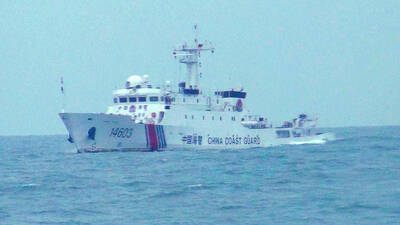
Four China Coast Guard ships briefly sailed through prohibited waters near Kinmen County, Taipei said, urging Beijing to stop actions that endanger navigation safety. The Chinese ships entered waters south of Kinmen, 5km from the Chinese city of Xiamen, at about 3:30pm on Monday, the Coast Guard Administration said in a statement later the same day. The ships “sailed out of our prohibited and restricted waters” about an hour later, the agency said, urging Beijing to immediately stop “behavior that endangers navigation safety.” Ministry of National Defense spokesman Sun Li-fang (孫立方) yesterday told reporters that Taiwan would boost support to the Coast Guard


 RSS
RSS