


Chinese Nationalist Party (KMT) Chairman Lien Chan's (連戰) TV spots for his presidential bid will focus on his love for Taiwan, party spokesman Justin Chou (周守訓) said.
The advertisements will feature the nation's prominent scenic spots.
"By bringing these prominent local sites into view with Lien, we want to highlight Lien's connection with people, his care and love for them, and his determination to develop Taiwan," Chou said.
Running on a joint ticket with People First Party (PFP) Chairman James Soong (宋楚瑜) in next March's presidential election, Lien filmed his first campaign spot on Sunday in his hometown of Tainan.
The piece was filmed at the Eternal Fortress, a popular historic site.
The fortress, located in the Anping district of Tainan, was built in 1876 on the order of Ching dynasty Fujian maritime commissioner, Shen Bao-zhen (沈葆禎) to bolster Tainan's costal defenses against Japanese aggression.
Against the backdrop of the site, Lien said Tainan is a historic city.
"If necessary, I want to take the filming to other parts of Taiwan for retrospection ? to let people know the past, present as well as future prospects of the place," he said.
According to the KMT, choosing Tainan as the first location for Lien's campaign spots "puts an emphasis on the close connection between the people and the land as well as symbolizes that Lien is setting out from his hometown vying for voters' support and recognition."
According to the party's Cultural and Communications Affairs Committee, the TV ad is slated to air on Oct. 25, Retrocession Day. Retrocession Day marks Taiwan's handover to Chinese rule in 1945 after half a century of Japanese occupation.
The committee was tight-lipped other filming locations.
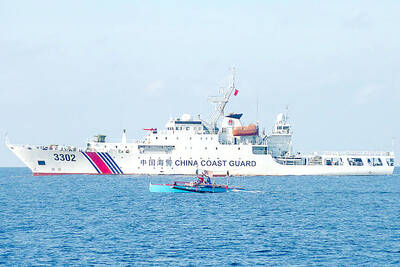
EXPANSIONIST: China deploys an average of 40 to 50 warships and coast guard vessels daily in the South China Sea, despite pledges not to militarize the region, an official said China is attempting to expand its influence across the First Island Chain and increase pressure on Japan by sending coast guard vessels into waters off of Taiwan under the pretext of maritime negotiations with Japan and the Philippines, a national security official said yesterday. China’s recent actions in the waters east of Taiwan and Japan and the Philippines’ exclusive economic zones (EEZ) are attempts to establish dominance in First Island Chain waters, said the official who declined to be named, adding that this is “expansion disguised as law enforcement.” Framing China’s actions solely as a cross-strait issue is a serious misjudgment that
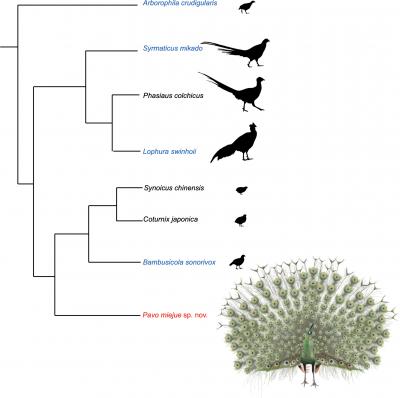
Through analyzing fossil evidence, a research team at National Taiwan University (NTU) discovered the largest endemic bird to have lived in Taiwan, naming it Pavo miejue, or extinct peafowl (滅絕孔雀). The Mikado pheasant, which is printed on the back of the NT$1,000 bank note, was previously believed to be the biggest endemic bird to Taiwan. The research team’s findings suggest that Pavo miejue lived during the Pleistocene epoch tens of thousands of years ago. It is the first endemic extinct bird species discovered and formally named in Taiwan. The study was coauthored by NTU Institute of Ecology and Evolutionary Biology professor Tsai Cheng-hsiu (蔡政修),
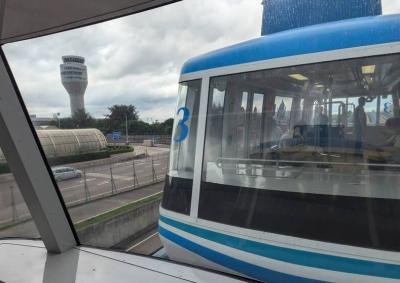
Taiwan Taoyuan International Airport is to suspend its automated Skytrain service connecting Terminal 1 and Terminal 2 starting on July 1 to facilitate connection works for the upcoming Terminal 3, the airport operator said today. Passengers and staff who need to travel between the two terminals after the suspension can instead use the Taoyuan MRT or the airport's 24-hour shuttle bus service, Taoyuan International Airport Corp said. The Taoyuan MRT Airport Line directly links the two terminals, while the shuttle buses are to operate around the clock, the company added. The Skytrain provides free transportation between the airport’s two terminals for travelers and
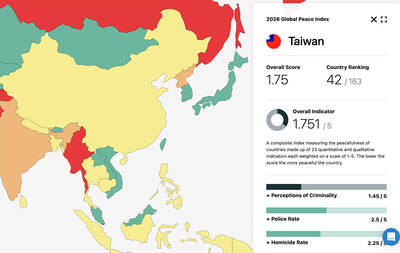
Taiwan ranked 42nd in terms of peacefulness among 163 countries, down five places from last year, according to this year’s Global Peace Index. With an overall score of 1.751, Taiwan dropped from 37th last year, the report published by the global Institute for Economics and Peace showed. The overall score measures a country’s level of peacefulness using 23 quantitative and qualitative indicators across three domains — ongoing domestic and international conflict, societal safety and security, and militarization. While Taiwan ranked 42nd worldwide, it was listed in ninth place among the 19 Asian-Pacific countries in the report, after New Zealand, Singapore, Japan, Malaysia,


 RSS
RSS