


The final 20 percent of funding needed to build a proposed US$400 million Guggenheim Museum in Taichung may be approved this week, said Thomas Krens, director of the Solomon Guggenheim Foundation in New York.
"We're expecting approval of the final 20 percent from the city council by the end of this week," Krens said during a symposium of the Business Committee for the Arts, a New York-based nonprofit organization.
"This project actually could be under construction as early as the end of 2004,'' he said.
The museum in Taichung would expand the Guggenheim's international scope. In addition to Bilbao, the Guggenheim Foundation has created satellite museums in Las Vegas, Nevada, Venice, Italy and Berlin, Germany.
The museum, designed by Zaha Hadid, an Iraqi-born architect based in London, would be 119,600m2.
That is the same siz as the Guggenheim Bilbao, a stainless-steel structure by architect Frank Gehry that is a tourist attraction in the Basque region of Spain.
"It's like nothing I've ever seen," Krens said of Hadid's design. "It's a brand new vocabulary for museum architecture."
Premier Yu Shyi-kun said last month that his government would fund 80 percent of the project to as much as NT$5 billion.
Plans for the Taiwanese museum are in the preliminary stages, Anthony Calnek, a Guggenheim spokesman, said.
"We're in the middle of the feasibility study period still," he said. "And the next step is a negotiation between the two parties."
The Guggenheim Foundation also has plans to build a branch in Rio de Janeiro, Brazil.
In April, Mayor Cesar Maia agreed to pay the foundation US$32.7 million to develop a US$250 million museum on Rio's waterfront designed by French architect Jean Nouvel.
However, in June, a Brazilian court blocked construction of the museum after opponents filed a lawsuit.
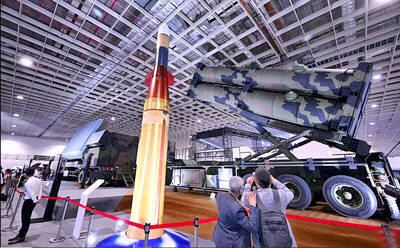
Taiwan is to commence mass production of the Tien Kung (天弓, “Sky Bow”) III, IV and V missiles by the second quarter of this year if the legislature approves the government’s NT$1.25 trillion (US$39.78 billion) special defense budget, an official said yesterday. Commenting on condition of anonymity, a defense official with knowledge of the matter said that the advanced systems are expected to provide crucial capabilities against ballistic and cruise missiles for the proposed “T-Dome,” an advanced, multi-layered air defense network. The Tien Kung III is an air defense missile with a maximum interception altitude of 35km. The Tien Kung IV and V
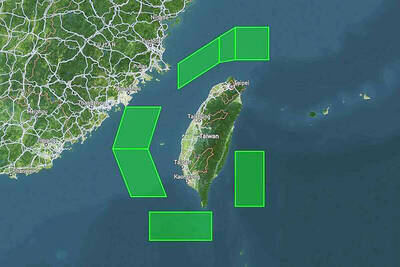
The disruption of 941 flights in and out of Taiwan due to China’s large-scale military exercises was no accident, but rather the result of a “quasi-blockade” used to simulate creating the air and sea routes needed for an amphibious landing, a military expert said. The disruptions occurred on Tuesday and lasted about 10 hours as China conducted live-fire drills in the Taiwan Strait. The Civil Aviation Administration (CAA) said the exercises affected 857 international flights and 84 domestic flights, affecting more than 100,000 travelers. Su Tzu-yun (蘇紫雲), a research fellow at the government-sponsored Institute for National Defense and Security Research, said the air
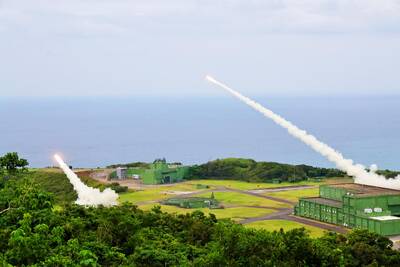
Taiwan lacks effective and cost-efficient armaments to intercept rockets, making the planned “T-Dome” interception system necessary, two experts said on Tuesday. The concerns were raised after China’s military fired two waves of rockets during live-fire drills around Taiwan on Tuesday, part of two-day exercises code-named “Justice Mission 2025.” The first wave involved 17 rockets launched at 9am from Pingtan in China’s Fujian Province, according to Lieutenant General Hsieh Jih-sheng (謝日升) of the Office of the Deputy Chief of the General Staff for Intelligence at the Ministry of National Defense. Those rockets landed 70 nautical miles (129.6km) northeast of Keelung without flying over Taiwan,
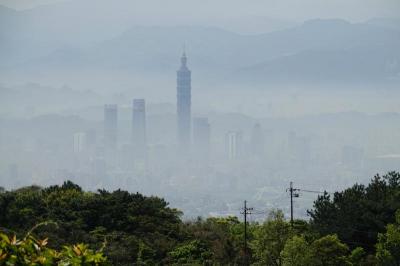
A strong continental cold air mass is to bring pollutants to Taiwan from tomorrow, the Ministry of Environment said today, as it issued an “orange” air quality alert for most of the country. All of Taiwan except for Hualien and Taitung counties is to be under an “orange” air quality alert tomorrow, indicating air quality that is unhealthy for sensitive groups. In China, areas from Shandong to Shanghai have been enveloped in haze since Saturday, the ministry said in a news release. Yesterday, hourly concentrations of PM2.5 in these areas ranged from 65 to 160 micrograms per cubic meter (mg/m³), and pollutants were


 RSS
RSS