


Judy Linton, the sole survivor of a murderous attack on the family of former Democratic Progressive Party (DPP) chairman Lin I-hsiung (
The album, You Are My Most Beloved, depicts her love for her family and how the Christian Gospels healed her traumatized heart after surviving the attack which took the lives of her twin sisters and her grandmother on the night of Feb. 28, 1980.
The murders are believed to have been instigated by the then-ruling Chinese Nationalist Party (KMT).

PHOTO: SEAN CHAO, TAIPEI TIMES
The attacks took place shortly after Lin had been arrested for participating in a human-rights rally that KMT thugs turned into a riot, which came to be known as the Kaoshiung Incident.
The murders remain unsolved but are widely believed to have been punishment for Lin's lack of cooperation with the martial law regime.
"Some of you may know of what happened to me when I was only eight years old. On Feb. 28, 1980, a murderer broke into my home. I was stabbed several times and left to die. My younger sisters were killed. My grandmother died while calling out my name. It was a time of grieving and I know that people around the world grieved with us," Linton, 32, said at a press conference yesterday held to mark the release of her album.
Linton, whose Chinese name is Lin Huan-chun (林奐均), was sent to the US in 1981 where she received a musical education and later became a pianist and gospel singer. She entered Indiana University in 1990 and later earned a masters degree in teaching English as a second language from Columbia University's Teacher's College in 1995.
She spoke yesterday of the process in which she found her heart gradually healing through her religion.
"In was there [the US] that I began attending church. Sometime in high school, God began to work on my bitter heart ? God has healed me and enabled me to forgive the murderer. He has given me true meaning in life and a hope for the future. I sing about God because I wish for everyone to know how wonderful he is," she said.
"Now when people mention the word `victim,' I no longer feel they are talking about me. I've been given so much love ..." she said.
Lin, who attended the press conference with his wife, Fang Su-min (
"I am very proud of my daughter and what she has achieved in her life. All these years, as she grew up, she never worried me as she got love from the people around her. I hope she could do better and better as she spreads the warmth of love to people," Lin said.
Now married to Joel Linton, an American Presbyterian missionary, Judy Linton is the mother of two children and is seven-months pregnant with her third child.
She lives in Taipei with her family and conducts ministering work.

Eight Chinese naval vessels and 24 military aircraft were detected crossing the median line of the Taiwan Strait between 6am yesterday and 6am today, the Ministry of National Defense said this morning. The aircraft entered Taiwan’s northern, central, southwestern and eastern air defense identification zones, the ministry said. The armed forces responded with mission aircraft, naval vessels and shore-based missile systems to closely monitor the situation, it added. Eight naval vessels, one official ship and 36 aircraft sorties were spotted in total, the ministry said.
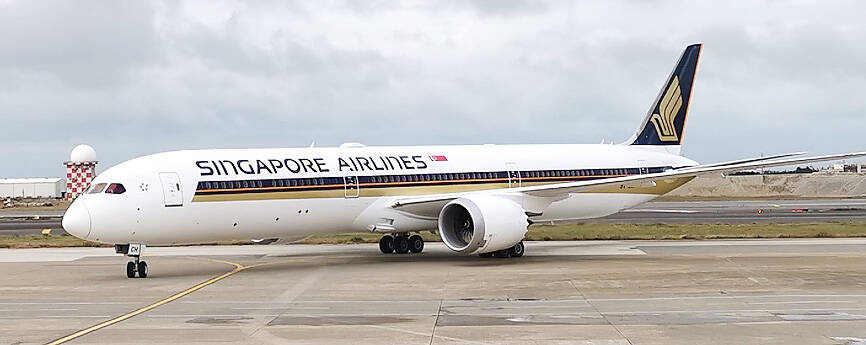
INCREASED CAPACITY: The flights on Mondays, Wednesdays, Fridays and Sundays would leave Singapore in the morning and Taipei in the afternoon Singapore Airlines is adding four supplementary flights to Taipei per week until May to meet increased tourist and business travel demand, the carrier said on Friday. The addition would raise the number of weekly flights it operates to Taipei to 18, Singapore Airlines Taiwan general manager Timothy Ouyang (歐陽漢源) said. The airline has recorded a steady rise in tourist and business travel to and from Taipei, and aims to provide more flexible travel arrangements for passengers, said Ouyang, who assumed the post in July last year. From now until Saturday next week, four additional flights would depart from Singapore on Monday, Wednesday, Friday
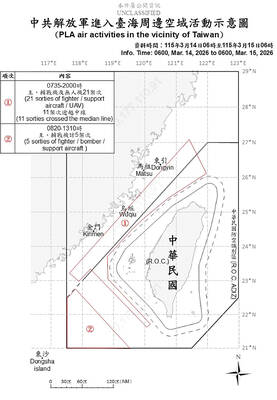
The Ministry of National Defense yesterday reported the return of large-scale Chinese air force activities after their unexplained absence for more than two weeks, which had prompted speculation regarding Beijing’s motives. China usually sends fighter jets, drones and other military aircraft around the nation on a daily basis. Interruptions to such routine are generally caused by bad weather. The Ministry of National Defense said it had detected 26 Chinese military aircraft in the Taiwan Strait over the previous 24 hours. It last reported that many aircraft on Feb. 25, when it spotted 30 aircraft, saying Beijing was carrying out another “joint combat

Taiwan successfully defended its women’s 540 kilogram title and won its first-ever men’s 640 kg title at the 2026 World Indoor Tug of War Championships in Taipei yesterday. In the women’s event, Taiwan’s eight-person squad reached the final following a round-robin preliminary round and semifinals featuring teams from Ukraine, Japan, Thailand, Vietnam, the Basque Country and South Korea. In the finals, they swept the Basque team 2-0, giving the team composed mainly of National Taiwan Normal University students and graduates its second championship in a row, and its fourth in five years. Team captain


 RSS
RSS