

The Council for Cultural Affairs (文建會) yesterday said that the Cabinet's support for a Guggenheim Museum in Taichung had not wavered despite rumors it would back away from the project, an official said.
The official also said the Cabinet would need more information before making a decision on whether to allocate the project an additional NT$2 billion as requested by Taichung Mayor Jason Hu (
The Cabinet had originally promised to give NT$3.2 billion toward the planned museum, with Taichung City Government stumping up the rest. The total project is estimated to cost NT$6.4 billion.
"If the Cabinet grants NT$5.2 billion then the nature of the Guggenheim project will be quite different from the original plan," said Chung Chia-pin (
Chung said that a larger share of the costs means more responsibilities and so far the Council for Cultural Affairs had not received a complete evaluation report from Taichung City Government.
"The central government and the local government should cooperate with each other in this project. I think it is necessary to work out further details about the plan together," Chung said. "If the Cabinet is to become the main backer of this project, then we need to know more about the project. We don't want to cancel it."
Taichung City Government accused the Cabinet of not inviting it to a conference held in late August discussing the possibly economic impacts of the museum.
"We did not invite any Taichung government officials to the conference because the conference focused on cultural issues and many academics from Taichung City were present," Chung said.
Chung said the cultural affairs council is happy to see the establishment of the Guggenheim Museum in Taichung, however the plans need to be reviewed carefully.
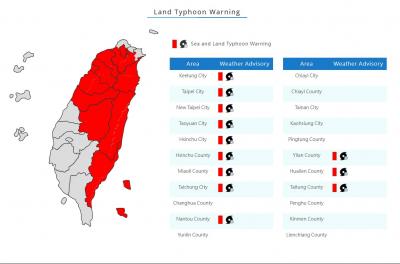
The Central Weather Administration at 5:30am today issued a land warning for Typhoon Bavi, which is expected to have its greatest impact on Taiwan from this evening through tomorrow. As of 8am, the eye of Bavi was about 700km east of Oluanpi (鵝鑾鼻), Taiwan's southernmost point, and was moving northwest at 25kph, the CWA said. The storm was packing maximum sustained winds of 162kph, with gusts of up to 198kph, the weather agency said, adding that Bavi had a storm radius of about 380km. Rainfall is expected to increase in mountainous areas of northern, central and southern Taiwan later today, with the heaviest
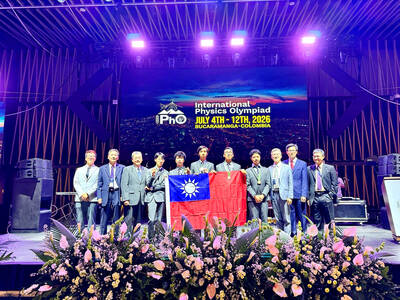
Taiwan tied for first with five golds at the 56th International Physics Olympiad (IPhO) held in Colombia this year, showcasing high school physics prowess. The team, led by National Taiwan Normal University physics professor Chen Chuan-Ren (陳傳仁), was represented by five students, who were chosen from 2,361 students nationwide via multiple selections to receive pre-competition training. Competing with 381 participants from 91 countries, all five students won a gold medal for Taiwan. Other countries earning five golds included China, India, Kazakhstan, South Korea and Russia. One of the five Taiwanese, Chien Kuo High School (CKHS) student Wu Ssu-chien (吳思謙) said he has enjoyed studying
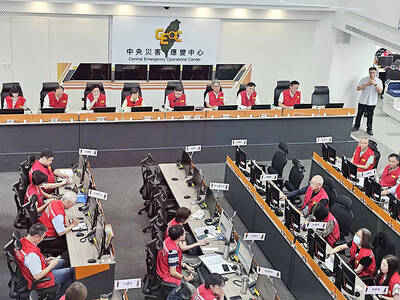
WIDESPREAD CANCELATIONS: Airline and ferry operators have canceled a number of journeys following the issue of a sea warning, with a land warning also expected today Airlines and ferry operators yesterday announced widespread service changes as Typhoon Bavi approaches Taiwan, with authorities urging travelers to monitor updates and avoid nonessential trips to outlying islands. The Central Weather Administration issued a sea warning for Bavi at 2:30pm yesterday and is expected to issue a land warning early today if the typhoon maintains its projected path and speed. AIR TRAVEL Starlux Airlines said flights scheduled from yesterday through Sunday could be rescheduled or canceled, and urged passengers to check the latest flight information before heading to the airport. Tigerair Taiwan said due to safety concerns, yesterday’s IT232 Taoyuan-Naha and IT289 Naha-Kaohsiung flights

Beijing has been offering subsidized trips to China’s Xinjiang region for Taiwanese teachers as part of efforts to influence teachers and, indirectly, students, a government official said yesterday. With China subsidizing the trips, the teachers only need to pay a NT$4,000 registration fee for an eight-day, seven-night tour that includes accommodation and meals, the official said, speaking on condition of anonymity. Participants risk having their personal information collected and their social networks monitored by Chinese authorities, the official said. Chinese authorities are offering separate summer exchange programs targeting Taiwanese teachers and students, with the student program including study-related activities, they


 RSS
RSS