


Pushing forward the DPP administration's pledge to build a nuclear-free nation, the Executive Yuan yesterday announced that it will earmark NT$3 billion every year to develop renewable energy and boost the energy-conservation industry.
According to a press release made available by the Cabinet's Committee for the Establishment of a Nuclear Free Home, which met yesterday afternoon, the decision was part of the action plan mapped out by the committee yesterday in the wake of the anti-nuclear convention held in June.
At the conference, discussion topics included strategies to phase-out nuclear energy, the decommissioning of existing nuclear plants, the adoption of renewable energy and the disposal of nuclear waste. The experiences of the US, Japan and Sweden were also presented.
In addition to research and development funds, the committee yesterday decided to ease legislation regulating land acquisition for wind power plants to boost the development of renewable energy.
To encourage the public to make use of solar power, the committee decided to earmark NT$166 million next year to subsidize solar systems in the nation's townships and schools. The fund would also be made available to those families interested in using solar heating systems. The committee hopes to see the number of families using solar heat increase from the current 12,000 to 20,000.
The committee also planned to complete the draft measure regarding the power generated by nuclear power plants and the supervision of such facilities by the end of the year.
To strengthen its research projects on energy technology, the Energy Commission under the Ministry of Economic Affairs will also increase its annual budget of next year by 12.47 percent.
Government agencies responsible for executing energy policies will expand to include the Environmental Protection Administration, the Ministry of Transportation and the Communication and Council of Agriculture.
Currently, Ministry of Economic Affairs, Ministry of the Interior and National Science Council are responsible for implementing the government's energy policies.

US President Donald Trump said "it’s up to" Chinese President Xi Jinping (習近平) what China does on Taiwan, but that he would be "very unhappy" with a change in the "status quo," the New York Times said in an interview published yesterday. Xi "considers it to be a part of China, and that’s up to him what he’s going to be doing," Trump told the newspaper on Wednesday. "But I’ve expressed to him that I would be very unhappy if he did that, and I don’t think he’ll do that," he added. "I hope he doesn’t do that." Trump made the comments in

NOT AN OPENING: Trump’s violation of international law does not affect China’s consideration in attacking Taiwan; Beijing lacks capability, not precedent, an official said Taiwanese officials see the US’ capture of the president of Venezuela as a powerful deterrent to Beijing’s aggression and a timely reminder of the US’ ability to defeat militaries equipped with Chinese-made weapons. The strikes that toppled Venezuelan President Nicolas Maduro signaled to authoritarian leaders, including Chinese President Xi Jinping (習近平), US President Donald Trump’s willingness to use military might for international affairs core to US interests, one senior official in Taipei’s security circle said. That reassured Taiwan, the person said. Taipei has also dismissed the idea that Trump’s apparent violation of international law could embolden Beijing, said the official, who was not
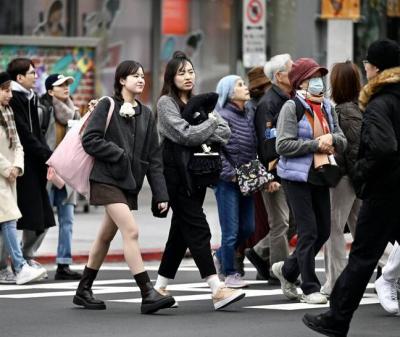
A cold surge advisory was today issued for 18 cities and counties across Taiwan, with temperatures of below 10°C forecast during the day and into tonight, the Central Weather Administration (CWA) said. New Taipei City, Taipei, Taoyuan and Hsinchu, Miaoli and Yilan counties are expected to experience sustained temperatures of 10°C or lower, the CWA said. Temperatures are likely to temporarily drop below 10°C in most other areas, except Taitung, Pingtung, Penghu and Lienchiang (Matsu) counties, CWA data showed. The cold weather is being caused by a strong continental cold air mass, combined with radiative cooling, a process in which heat escapes from
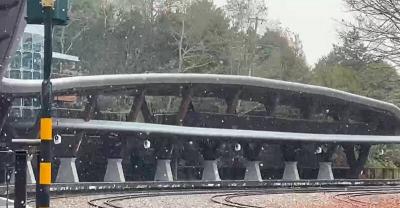
Snow this morning fell on Alishan for the first time in seven years, as a strong continental cold air mass sent temperatures plunging across Taiwan, the Central Weather Administration (CWA) said. The Alishan weather station, located at an elevation of about 2,200m in central Taiwan, recorded snowfall from 8:55am to 9:15am, when the temperature dropped to about 1°C, the CWA said. With increased moisture and low temperatures in the high-altitude Alishan area, the conditions were favorable for snow, CWA forecaster Tsai Yi-chi (蔡伊其) said. The last time snow fell at the Alishan weather station was on Jan. 10, 2018, while graupel fell there


 RSS
RSS