


After the pan-blue camp's landslide victory in the Hualien County Commissioner by-election, the Minister of the Interior Yu Chen-hsien (
People -- from his comrades in DPP to the members of the opposition KMT and PFP parties -- believe that because of intensive crackdown on bribery, Yu should be responsible for the result.
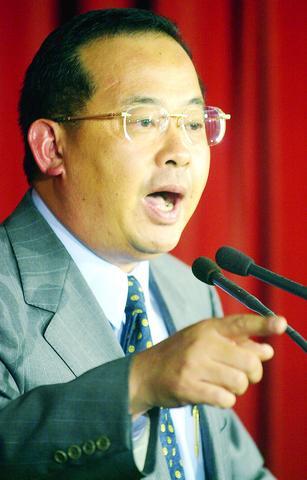
TAIPEI TIMES FILE PHOTO
"The DPP campaign tactics in the by-election were too crude, especially the bribery crackdown ordered by Yu," said TSU Legislator Chen Chien-ming (
"We have to thank Minister Yu. He helped us win the election," said commissioner-elect Hsieh Shen-shan (謝深山).
Yu has been a man of controversy since he began his political career at the age of 28 as a lawmaker from Kaohsiung County, where his family, one of the largest political factions there, has dominated for decades.
As the grandson of Yu Teng-fa (余登發), a major figure in the fight for Taiwanese democracy, Yu was destined to be deeply connected with the DPP. After his seven-year legislative career, Yu was elected Kaohsiung County Magistrate, succeeding his mother Yu Chen Yueh-ying (余陳月瑛).
After President Chen Shui-bian (陳水扁) was elected in 2000, Yu was appointed interior minister with other consecutive appointments for a slew of his family members: His mother obtained the post of senior presidential advisor and his sister, Yu Ling-ya, became Taiwan Provincial Consultative Council Speaker. His wife Cheng Kui-lien (鄭貴蓮) and his brother Yu Jan-daw (余政道) were nominated by the DPP to run for the legislature. Both succeeded.
Some claimed that his family achieved their political goals with presidential guanxi, not by what they have done for this nation.
After he was named to manage Taiwan's interior affairs, Yu made numerous promises, drawing a lot of fire -- and he was not hesitant to return his own volley of invective.
His promise to bring the nation's growing crime rate to a dead stop was called a "bluff" by some lawmakers. To Yu's discredit, the rate continued on its upward slope.
In March, Yu touted his idea that the government provide illegal Chinese female immigrants with abortions, and idea which drew strong objections from religious groups.
When it was discovered that Yu made use of a police car to pick up his elementary school children earlier this year, declaring that he just wanted "to protect his children."
Yu is also a sports fanatic, and maybe the most renowned baseball fan in the Cabinet. The minister never forgets to assist baseball players with their problems and does whatever he can to make baseball in Taiwan prosper.
But his "sportsmanship" has also caused him strike out several times.
In November last year, the minister was absent from a Legislative Yuan hearing and was later found to be attending a baseball series in South Korea. Lawmakers, angered by what they viewed as dereliction of duty, showed a live TV broadcast of Yu attending one game of the series to the public.
Some of his subordinates think their boss is a responsible man with guts on a quest for efficient government, but some think otherwise.
"He is an idiot minister, doing stupid things," said a civil servant contemptuously who asked not to be identified.
The DPP Standing Committee will have a meeting today to review the Hualien by-election results and name winners and sinners. Yu may not be the only scapegoat named in the interest of party solidarity, but his leadership style and track record is bound to result in him being cast as a disputatious politician in the history books.

Fast food chain McDonald's is to raise prices by up to NT$5 on some products at its restaurants across Taiwan, starting on Wednesday next week, the company announced today. The prices of all extra value meals and sharing boxes are to increase by NT$5, while breakfast combos and creamy corn soup would go up by NT$3, the company said in a statement. The price of the main items of those meals, if ordered individually, would remain the same. Meanwhile, the price of a medium-sized lemon iced tea and hot cappuccino would rise by NT$3, extra dipping sauces for chicken nuggets would go up

Yangmingshan National Park’s Qingtiangang (擎天崗) nature area has gone viral after a park livestream camera observed a couple in the throes of intimate congress, which was broadcast live on YouTube, drawing large late-night crowds and sparking a backlash over noise, bright lights and disruption to wildlife habitat. The area’s livestream footage appeared to show a couple engaging in sexual activity on a picnic table in the park on Friday last week, with the uncensored footage streamed publicly online. The footage quickly spread across social media, prompting a tide of visitors to travel to the site to “check in” and recreate the

Minister of Digital Affairs Lin Yi-ching (林宜敬) yesterday cited regulatory issues and national security concerns as an expert said that Taiwan is among the few Asian regions without Starlink. Lin made the remarks on Facebook after funP Innovation Group chief executive officer Nathan Chiu (邱繼弘) on Friday said Taiwan and four other countries in Asia — China, North Korea, Afghanistan and Syria — have no access to Starlink. Starlink has become available in 166 countries worldwide, including Ukraine, Malaysia, the Philippines and Vietnam, in the six years since it became commercial, he said. While China and North Korea block Starlink, Syria is not

GROUNDED: A KMT lawmaker proposed eliminating drone development programs and freezing funding for counterdrone systems, despite China’s adoption of the technology China has deployed attack drones at air bases near the Taiwan Strait in a strategy aimed at overwhelming Taiwan’s air defense systems through saturation attacks, the Mainland Affairs Council (MAC) said. The council’s latest quarterly report on China said that satellite imagery and open-source intelligence indicate that the Chinese People’s Liberation Army (PLA) had converted retired J-6 fighter jets into J-6W drones, which the PLA has stationed at six air bases near Taiwan, five in China’s Fujian Province and one in Guangdong Province. The report cited J. Michael Dahm, a senior fellow at the US-based Mitchell Institute, as saying that China has


 RSS
RSS