


Decades ago, when the 32-year-old Provincial Ilan Hospital Superintendent Kuo Chang-yuan (
Kuo was executed hours after the military police arrested him on March 18, 1947, without a public trial or tangible evidence of the charges against him. He was another victim of the 228 Incident that occurred on Feb. 28, 1947.
Kuo's body was one of the few of those executed that was secured by his family for proper burial. Most victims of the month-long ethnic conflict remained missing until the government issued their death certificates many years later.
In an investigation that took place 56 years later, Kuo's untimely death was recognized by Control Yuan members as mismanagement by the KMT authorities, led at the time by the provincial governor Chen Yi (陳儀), after the offspring of some 228 victims demanded that censors review the former administration's handling of the 228 Incident.
"No evidence was found in government documents or memos to prove that any of the eight victims, including Kuo, were guilty. They should not have been shot dead, especially without any appropriate legal proceedings. No explanation was presented in these papers at to why the military personnel arrested and executed them," stated the Control Yuan report released on March 31.
Representing a civil organization based in California for remembering 228 victims, the group sought proof of the victims' innocence.
They also asked the government to restore the victims' reputation if the investigation showed them to be innocent, since they had been previously labeled "rebels" by the KMT regime
An eight-member subcommittee engaged in the investigation completed the probe in March. Yesterday, President Chen Shui-bian (陳水扁) presided over a ceremony at the Presidential Office to honor the incident's victims and presented official certificates to family members of the victims to reverse the government's miscarriage of justice.
Investigators found that the mass arrests of dissidents overlooked legal proceedings and that the KMT administration possessed insufficient evidence or explanations for the detention of eight individuals, the report said.
Apart from Kuo, Li Lui-fong (
"The elder Lee, who chaired the Taipei Lawyer Association at the time, stressed the importance of advancing judicial reform and recruiting the local elite to improve local judiciary systems since the KMT provincial administrator publicly said that he would welcome any professional advice to a planned "reform" which the KMT administration touted," the Control Yuan paper said.
Chen Yi, however, later identified the elder Lee as one of the investigators behind the 228 events.
Control Yuan members found that the brothers were listed on an intelligence-bureau roster of executed rioters kept in classified files of the National Security Bureau.
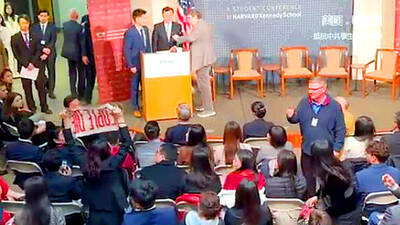
A group of Taiwanese-American and Tibetan-American students at Harvard University on Saturday disrupted Chinese Ambassador to the US Xie Feng’s (謝鋒) speech at the school, accusing him of being responsible for numerous human rights violations. Four students — two Taiwanese Americans and two from Tibet — held up banners inside a conference hall where Xie was delivering a speech at the opening ceremony of the Harvard Kennedy School China Conference 2024. In a video clip provided by the Coalition of Students Resisting the CCP (Chinese Communist Party), Taiwanese-American Cosette Wu (吳亭樺) and Tibetan-American Tsering Yangchen are seen holding banners that together read:

UNAWARE: Many people sit for long hours every day and eat unhealthy foods, putting them at greater risk of developing one of the ‘three highs,’ an expert said More than 30 percent of adults aged 40 or older who underwent a government-funded health exam were unaware they had at least one of the “three highs” — high blood pressure, high blood lipids or high blood sugar, the Health Promotion Administration (HPA) said yesterday. Among adults aged 40 or older who said they did not have any of the “three highs” before taking the health exam, more than 30 percent were found to have at least one of them, Adult Preventive Health Examination Service data from 2022 showed. People with long-term medical conditions such as hypertension or diabetes usually do not
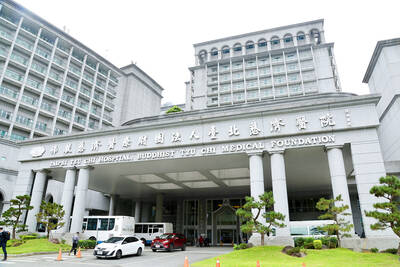
POLICE INVESTIGATING: A man said he quit his job as a nurse at Taipei Tzu Chi Hospital as he had been ‘disgusted’ by the behavior of his colleagues A man yesterday morning wrote online that he had witnessed nurses taking photographs and touching anesthetized patients inappropriately in Taipei Tzu Chi Hospital’s operating theaters. The man surnamed Huang (黃) wrote on the Professional Technology Temple bulletin board that during his six-month stint as a nurse at the hospital, he had seen nurses taking pictures of patients, including of their private parts, after they were anesthetized. Some nurses had also touched patients inappropriately and children were among those photographed, he said. Huang said this “disgusted” him “so much” that “he felt the need to reveal these unethical acts in the operating theater
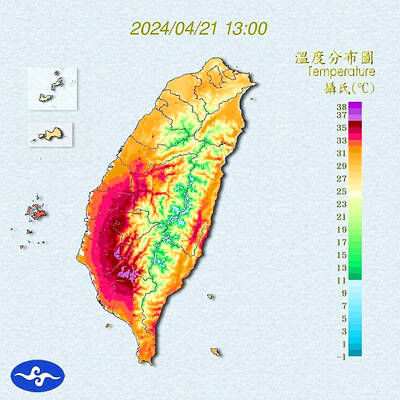
Heat advisories were in effect for nine administrative regions yesterday afternoon as warm southwesterly winds pushed temperatures above 38°C in parts of southern Taiwan, the Central Weather Administration (CWA) said. As of 3:30pm yesterday, Tainan’s Yujing District (玉井) had recorded the day’s highest temperature of 39.7°C, though the measurement will not be included in Taiwan’s official heat records since Yujing is an automatic rather than manually operated weather station, the CWA said. Highs recorded in other areas were 38.7°C in Kaohsiung’s Neimen District (內門), 38.2°C in Chiayi City and 38.1°C in Pingtung’s Sandimen Township (三地門), CWA data showed. The spell of scorching


 RSS
RSS