


When local media reported last week that Straits Exchange Foundation Chairman Koo Chen-fu (辜振甫) had intended to resign from his post for health reasons, the news drew not only the public's concerned gaze upon Koo's feeble health state, but also led the public to realize how 86-year old Koo, with every year passing by, has been racing against time hoping to meet with his 89-year old Chinese counterpart Wang Daohan (汪道涵), president of China's Association of Relations Across the Taiwan Straits (ARATS).
Koo was never shy expressing his wish of wanting to meet with his old friend -- as Koo likes to address Wang. Given the present cross-strait situation however, one wonders as to when the meet between the two elderly men could be realized and thus marking another break-through in cross-strait relations.
Presidential Office spokesman James Huang (
Koo, courtly and soft-spoken, was re-elected last Dec. 2 as the foundation's chairman, a post he has held since 1991.
"President Chen met with Koo, who is also a senior advisor to the president, at the Presidential Office on July 3 and asked for his advice on cross-strait relations and the international situation," Huang said.
"The president was very concerned about Koo's health," Huang added, "saying that the government needs his incomparable experience in cross-strait communication. The president asked him to attach importance to national affairs to therefore continue to lead the foundation."
Koo accepted Chen's opinion, Huang said.
Koo's reported intention to resign had also drawn media speculation that Legislator Chang Chun-hung (
Dismissed the rumor, Chang said he is in full support behind Koo's leading of the foundation.
Koo went to the US earlier this year for a routine kidney check-up though his health has reportedly not improved significantly.
In addition to concern over his health, family business is reportedly another issue that prompted Koo's intention to resign.
Koo, aside from his role as a veteran cross-strait negotiator, is also the head of his family's powerful business empire, the Koo's Group
Koo may face a challenge ahead in cleaning up the mess left behind by his deceased eldest son, Chester Koo (辜啟允) -- who died of gall-bladder cancer at the age of 48 in 2001 -- at Taiwan Cement, which has a liability of NT$50 billion.
The Koo family business recently split into two groups, one headed by Koo himself and the other by his 69-year-old nephew Jeffrey Koo (
Financial expert Hsieh Chin-ho (
Hsieh added that the family appears to have retained a good working relationship among its members, though Jeffrey Koo's business outperformed Koo Chen-fu's ill-performing China Life Insurance in December 2001.
Koo is known for his passion in Beijing opera. During his visit to china Shanghais in 1998, Koo's hosts catered to his love of Beijing opera by arranging the Shanghai Beijing Opera Troupe and others to perform, during which Koo joined in at one point.
Although a tycoon, Koo has also been active in diplomatic circles. He has represented former president Lee Teng-hui (
The first meeting between Koo and Wang officially took place in Singapore in April, 1993, marking the first official contact of top-level personages across the strait since the founding of the People's Republic of China in 1949 and a historic breakthrough in the development of cross-strait relations.
In commemoration of the 10th anniversary of the first Koo-Wang talks this year, the East Asian Institute of the National University of Singapore (NUS) invited both Koo and Wang to participate in its sponsored symposium slated earlier this April, which seemly boosted chances of a meeting between Koo and Wang.
While Koo replied to the NUS's invitation with a positive answer and expressed a wish to meet with Wang via the venue; Wang has not replied, Chen Yunlin (
The symposium eventually was called off in the face of concern over the growing SARS threat.
In his statement marking the 10th anniversary of the first Koo-Wang talk this April, Koo stressed that, in view of political differences between Taiwan and China, it is now necessary for both sides of the Strait to resume talks.
"We sincerely hope that the two sides can adopt a tolerant spirit ... and restart dialogue, opening a new chapter in cross-strait interactions through consultations ... and together building new hope for peaceful development in the Taiwan Strait," Koo said.
In view of political realities in cross-strait relations, one can only hope the door to cross-strait dialogue would soon reopen before both Koo and Wang wait for too long.
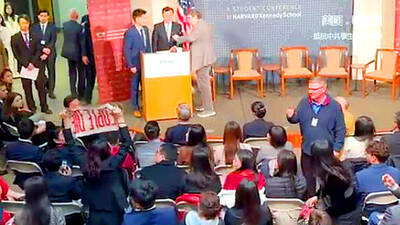
A group of Taiwanese-American and Tibetan-American students at Harvard University on Saturday disrupted Chinese Ambassador to the US Xie Feng’s (謝鋒) speech at the school, accusing him of being responsible for numerous human rights violations. Four students — two Taiwanese Americans and two from Tibet — held up banners inside a conference hall where Xie was delivering a speech at the opening ceremony of the Harvard Kennedy School China Conference 2024. In a video clip provided by the Coalition of Students Resisting the CCP (Chinese Communist Party), Taiwanese-American Cosette Wu (吳亭樺) and Tibetan-American Tsering Yangchen are seen holding banners that together read:

UNAWARE: Many people sit for long hours every day and eat unhealthy foods, putting them at greater risk of developing one of the ‘three highs,’ an expert said More than 30 percent of adults aged 40 or older who underwent a government-funded health exam were unaware they had at least one of the “three highs” — high blood pressure, high blood lipids or high blood sugar, the Health Promotion Administration (HPA) said yesterday. Among adults aged 40 or older who said they did not have any of the “three highs” before taking the health exam, more than 30 percent were found to have at least one of them, Adult Preventive Health Examination Service data from 2022 showed. People with long-term medical conditions such as hypertension or diabetes usually do not
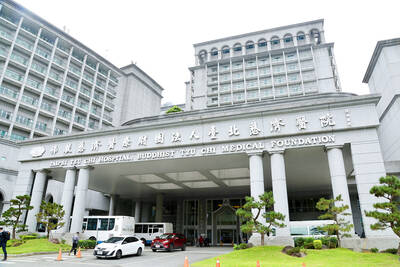
POLICE INVESTIGATING: A man said he quit his job as a nurse at Taipei Tzu Chi Hospital as he had been ‘disgusted’ by the behavior of his colleagues A man yesterday morning wrote online that he had witnessed nurses taking photographs and touching anesthetized patients inappropriately in Taipei Tzu Chi Hospital’s operating theaters. The man surnamed Huang (黃) wrote on the Professional Technology Temple bulletin board that during his six-month stint as a nurse at the hospital, he had seen nurses taking pictures of patients, including of their private parts, after they were anesthetized. Some nurses had also touched patients inappropriately and children were among those photographed, he said. Huang said this “disgusted” him “so much” that “he felt the need to reveal these unethical acts in the operating theater
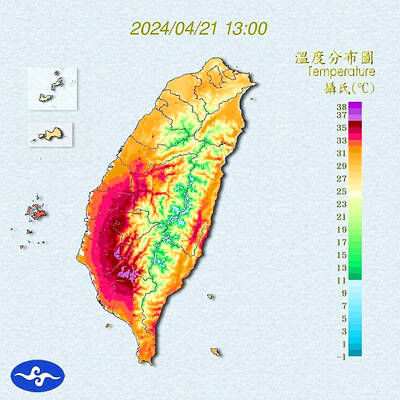
Heat advisories were in effect for nine administrative regions yesterday afternoon as warm southwesterly winds pushed temperatures above 38°C in parts of southern Taiwan, the Central Weather Administration (CWA) said. As of 3:30pm yesterday, Tainan’s Yujing District (玉井) had recorded the day’s highest temperature of 39.7°C, though the measurement will not be included in Taiwan’s official heat records since Yujing is an automatic rather than manually operated weather station, the CWA said. Highs recorded in other areas were 38.7°C in Kaohsiung’s Neimen District (內門), 38.2°C in Chiayi City and 38.1°C in Pingtung’s Sandimen Township (三地門), CWA data showed. The spell of scorching


 RSS
RSS