


■ Education
NTU holds online ceremony
National Taiwan University held an unprecedented online graduation ceremony yesterday following concerns about SARS. University President Chen Wei-chao (陳維昭) said in his opening remarks that the trend-setting online commencement ceremony was a forced choice out of health concerns. "Despite the absence of a traditional-style ceremony, the school faculty and junior students want to offer no less best wishes to all the new graduates through the online ceremony," Chen said in a scaled-down ceremony held at the school's largest conference room which was broadcast on the Internet. The deans of various university colleges and 31 representatives of graduating students were present at the ceremony, which was available online at the university's Web site at http://www.ntu.edu.tw. "I'm hopeful that all the new graduates will never be daunted by any adversities in pursuit of their career or life goals in the future," Chen said.
■ Liberia
Embassy staff safe
With the conflict in Liberia intensifying, the Ministry of Foreign Affairs said yesterday that the staff of the Taiwan embassy in the west African nation is safe and sound and that the US Embassy has agreed to help evacuate Taiwan diplomatic personnel and nationals in an emergency. Associated Press wire reports said that fighting raged Friday in a northern suburb of Monrovia, the capital of civil-war torn Liberia, and that terrified civilians were fleeing by the thousands as rebels took control of refugee camps around the city. The officials said that the ministry has kept in close contact with the Taiwan embassy and learned that the embassy has completed contingency plans. Ambassador Chen Yung-chuo (陳永綽) and his wife, as well as three diplomatic personnel, two Taiwan technical experts, and two Taiwan nationals are all safe and sound, they said.
■ HEalth
US lends hand to fight
The US Centers for Disease Control and Prevention (USCDC) has sent nearly 20 medical experts to Taiwan since late March to help with the island's battle against SARS. The experts, including in-hospital infection control specialists, virologists, epidemiologists and physicians, have won the respect and admiration of local health care providers with their professional expertise and devotion to their work. Many of them can speak fluent Mandarin Chinese and even the Taiwanese dialect. Their good command of the Chinese language has greatly facilitated their communication with local patients and hospital staff. However, they have generally kept a low profile, probably because of their official capacity. Taiwan and the US do not maintain formal diplomatic relations despite their close substantive ties. CDC Deputy Director Hsu Kuo-hsiung (許國雄) said several of the USCDC staff in Taiwan are ethnic Chinese, some of whom were born here.
■ United States
Foundation donates money
The Taiwanese American Foundation in San Diego, California, on Friday donated US$500,000 to the University of California at Santa Barbara for promoting a program of lectures on the literature, history, sand culture of Taiwan. After accepting the donation, Henry Yang, president of the university, said the program will help promote the university's academic studies on East Asian culture and languages.

NATIONAL SECURITY: Authorities are working to confirm the identities of the military personnel involved and investigating possible illegal conduct and regulatory violations Authorities are probing possible national security implications after Kinmen police and immigration officers on Sunday found a Chinese woman allegedly posing as a tourist while engaging in prostitution involving more than 10 military personnel. The woman, surnamed Chen (陳), has since been deported, authorities said, adding that investigators are still working to confirm the identities of those implicated, as the records only listed code names and aliases. The case stemmed from a report received by the Kinmen District Prosecutors’ Office on Friday last week from the Jinhu Precinct of the Kinmen County Police Bureau. On Sunday, police, along with the National Immigration

GLOBALGIVING: ‘ Caving to external pressure is not acceptable for an organization that has cultivated justice reform and human rights for 30 years,’ one NGO said A slew of non-government organizations (NGOs) have withdrawn from the GlobalGiving fundraising platform after it announced it would use “Chinese Taipei” instead of “Taiwan” from next month. The Taiwan Good Rice Association wrote on Facebook on Friday that it was informed on April 28 via a teleconference call of the change, which was made because the platform wanted to operate in China. Taiwan Good Rice is to terminate all cooperative relationships with GlobalGiving in response to the platform’s “unilateral and non-negotiable” decision to remove references to Taiwan, the NGO said. “Taiwan is in the official name of Taiwan Good Rice Association and the

HEAVY WEATHER: Typhoon Jangmi is due to crash straight into the Ryukyus as airlines look to shift flights to larger aircraft or cancel flights to Okinawa entirely Taiwan’s international air carriers announced flight adjustments over the weekend as Typhoon Jangmi is forecast to hit the Ryukyu Islands today and tomorrow. The Central Weather Administration (CWA) upgraded Jangmi from a tropical storm to a typhoon at 8am yesterday, with the eye located 580km south of Naha city. It was moving north at 19kph. Today, China Airlines’ CI-120, CI-121, CI-122 and CI-123 flights between Taoyuan and Naha, Okinawa, have been canceled as well as CI-132 and CI-133 between Kaohsiung and Naha. EVA Air’s BR-112, BR-113, BR-186 and BR-185 flights between Taoyuan and Naha are also canceled. Low-cost carrier Tigerair Taiwan canceled IT-230,
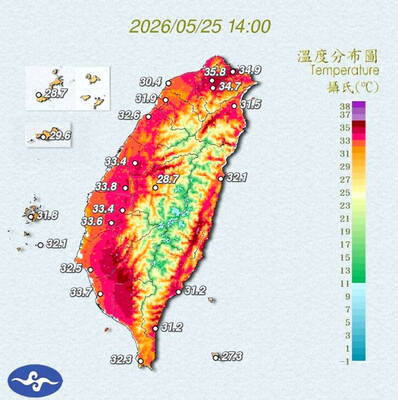
STAY COOL: The HPA recommended that people stay hydrated, use air-conditioning or fans while indoors, wear loose-fitting clothes and walk in the shade while outdoors Employers must implement measures such as installing cooling equipment, and providing drinking water and rest breaks for outdoor workers starting from Monday next week, the Taipei Department of Labor said on Sunday. Employers who fail to comply could face fines of NT$30,000 to NT$300,000 under the Occupational Safety and Health Act (職業安全衛生法), the department said. Businesses in Taipei employing fewer than 100 workers, as well as registered self-employed workers with labor insurance coverage, could receive on-site assessments and guidance from occupational safety consultants to help them apply for central government subsidies to implement or improve heat-protection measures, it said. Under the Ministry of


 RSS
RSS