


Premier Yu Shyi-kun seems to have played a marginal role in recent government policy-making and some say his poor performance has eroded President Chen Shui-bian's (
Opposition KMT and PFP legislative caucuses yesterday even ridiculed Yu's influence as the nation's highest administrative officer as "evaporating from this veil of tears."
"What President Chen has done recently clearly encroaches on the constitutional authority of the Executive Yuan and causes administrative disorder," said KMT legislative caucus Secretary-General Liu Cheng-hung (
DPP legislative caucus Secretary-General Chen Chi-mai (陳其邁), however, retorted by saying that Liu was clueless about the situation.
"His remarks simply demonstrated his ignorance because what the premier did in the fight against SARS has been well documented by the media," Chen Chi-mai said.
Jumping to Yu's defense, Cabinet Spokesman Lin Chia-lung (林佳龍) said yesterday that the relationship between the premier and the president has never been stronger.
"The talk about the relationship turning sour is totally groundless and it's unfair to the premier," Lin said. "I hope opposition lawmakers will offer more encouragement and constructive opinions than irrational criticism."
Lin said that recent government policies to deal with the SARS crisis -- including extending the deadline for some tax returns, leave restrictions on military personnel and nationwide temperature checks -- were first proposed by the premier and then approved by the president.
Although Chen Shui-bian does not have the constitutional authority to interfere in certain domestic affairs, he did -- during a videoconference with Yu on Monday -- instruct the Cabinet to study the possibility of extending by one month the June 2 deadline for filing last year's tax returns.
Chen Shui-bian also asked the Ministry of National Defense to loosen restrictions on military leave, which have been in place since May 13 to help prevent the spread of SARS.
The leave restrictions had created discontent within the military because Chen Shui-bian's son, Chen Chih-chung (
Responding to the proposal made by Academia Sinica President Lee Yuan-tseh (
In yet another surprising move, Chen on May 20 asked the Cabinet to push for a referendum on the country's entry into the World Health Organization following the nation's failed bid to join the World Health Assembly.
The Cabinet was once again caught off guard on May 24 when Chen Shui-bian announced that the government would spend approximately NT$120 billion to build three separate rail links to CKS International Airport, in an effort to boost local economies affected by SARS.
The decision shelved an earlier six-year effort to have private contractors construct the build-operate-transfer (BOT) project.
A day earlier, Chen announced that he had invited KMT Vice Chairman Vincent Siew (
Political observers have construed the string of moves as Chen's dissatisfaction with the Cabinet's performance in dealing with economic problems, as the economy will be the most important issue in next year's presidential election campaign.
A political blunder made by the education ministry also irked the president.
On May 23, Minister of Education Huang Jong-tsun (
The ministry had said one day earlier that this year's exam would not include the essay section and would consist only of a multiple-choice section in both the Chinese and English sections of the exam. The multiple choice portions of the exam are graded by computer.
The next day, the ministry announced that the essays would be included after all.
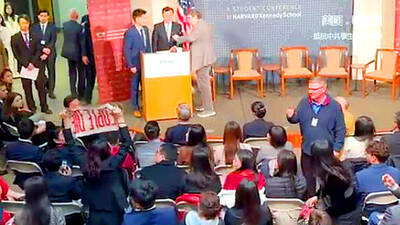
A group of Taiwanese-American and Tibetan-American students at Harvard University on Saturday disrupted Chinese Ambassador to the US Xie Feng’s (謝鋒) speech at the school, accusing him of being responsible for numerous human rights violations. Four students — two Taiwanese Americans and two from Tibet — held up banners inside a conference hall where Xie was delivering a speech at the opening ceremony of the Harvard Kennedy School China Conference 2024. In a video clip provided by the Coalition of Students Resisting the CCP (Chinese Communist Party), Taiwanese-American Cosette Wu (吳亭樺) and Tibetan-American Tsering Yangchen are seen holding banners that together read:

UNAWARE: Many people sit for long hours every day and eat unhealthy foods, putting them at greater risk of developing one of the ‘three highs,’ an expert said More than 30 percent of adults aged 40 or older who underwent a government-funded health exam were unaware they had at least one of the “three highs” — high blood pressure, high blood lipids or high blood sugar, the Health Promotion Administration (HPA) said yesterday. Among adults aged 40 or older who said they did not have any of the “three highs” before taking the health exam, more than 30 percent were found to have at least one of them, Adult Preventive Health Examination Service data from 2022 showed. People with long-term medical conditions such as hypertension or diabetes usually do not
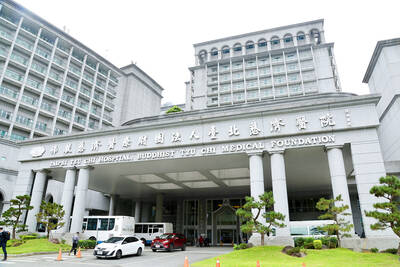
POLICE INVESTIGATING: A man said he quit his job as a nurse at Taipei Tzu Chi Hospital as he had been ‘disgusted’ by the behavior of his colleagues A man yesterday morning wrote online that he had witnessed nurses taking photographs and touching anesthetized patients inappropriately in Taipei Tzu Chi Hospital’s operating theaters. The man surnamed Huang (黃) wrote on the Professional Technology Temple bulletin board that during his six-month stint as a nurse at the hospital, he had seen nurses taking pictures of patients, including of their private parts, after they were anesthetized. Some nurses had also touched patients inappropriately and children were among those photographed, he said. Huang said this “disgusted” him “so much” that “he felt the need to reveal these unethical acts in the operating theater
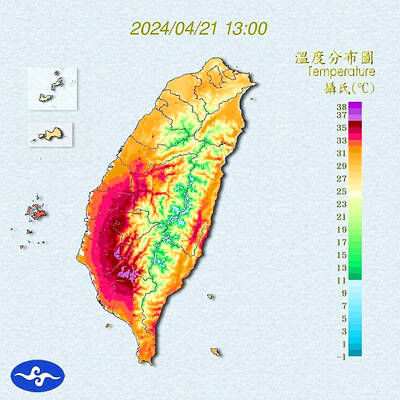
Heat advisories were in effect for nine administrative regions yesterday afternoon as warm southwesterly winds pushed temperatures above 38°C in parts of southern Taiwan, the Central Weather Administration (CWA) said. As of 3:30pm yesterday, Tainan’s Yujing District (玉井) had recorded the day’s highest temperature of 39.7°C, though the measurement will not be included in Taiwan’s official heat records since Yujing is an automatic rather than manually operated weather station, the CWA said. Highs recorded in other areas were 38.7°C in Kaohsiung’s Neimen District (內門), 38.2°C in Chiayi City and 38.1°C in Pingtung’s Sandimen Township (三地門), CWA data showed. The spell of scorching


 RSS
RSS