


The once-suspended construction of a wharf built for the Fourth Nuclear Power Plant resumed in early May, making it possible for Taiwan Power Company (Taipower) to import a nuclear reactor from Japan next month, the company said yesterday.
In order not to delay the scheduled completion of the nuclear power plant in July 2006, Taipower would transfer one of two nuclear reactors currently being built in Japan to Kungliao at the end of next month, officials said.
"It means that we have to have the wharf working by then," said Huang Huei-yu (黃惠予), the head of Taipower's public affairs department.
The shipment of the reactor was originally scheduled for late this month, Huang said.
"We don't think the delay will have any effect on the plant's scheduled date of completion," Huang said.
Huang said that Public Construction Commission Vice Chairman Kuo Ching-chiang (
The construction of the wharf had been halted in mid-January, when Premier Yu Shyi-kun decided to launch an investigation into the relation between coastal erosion and construction of the wharf.
Last month, the investigation report suggested that the loss of sand at the nearby Fulung Beach could be attributed to stresses on the environment caused by construction of the wharf.
However, ministers without portfolio Lin Sheng-feng (
On Thursday, Liu Chao-hsiung (劉照雄), Taipower's site manager for the Lungmen Construction Office (龍門施工處) in Kungliao, convened a meeting with local residents.
According to Liu, on May 1 the Cabinet's Ministry of Economic Affairs ordered Taipower to resume construction of the wharf, further deepening the dock.
Local residents and anti-nuclear environmentalists, however, vigorously expressed their opposition to the decision, and angrily left the meeting.
"It looks like the Cabinet failed to coordinate its subordinate agencies on the issue," Wu Wen-tung (吳文通), spokesman for the Kungliao-based Yenliao Anti-Nuclear Self-Help Association, said yesterday.
Both Wu and environmentalists called for a new, comprehensive evaluation to be conducted by the Environmental Protection Administration.
When the Environmental Impact Assessment Act (環境影響評估法) was enacted in 1994, environmentalists began highlighting what they said were questionable aspects of the assessment conducted by the Atomic Energy Commission.
Lai Wei-chieh (賴偉傑), secretary-general of the Green Citizen Action Alliance, said yesterday that resumption of construction revealed that the Cabinet's investigation into coastal erosion had no substantial influence.
Lai said that the Cabinet's performance in the matter demonstrates that promoting sustainable development had never been the government's priority.
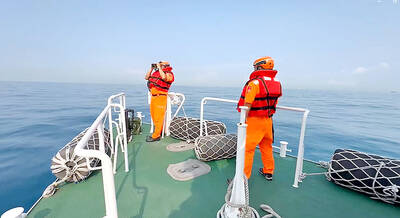
An increase in Taiwanese boats using China-made automatic identification systems (AIS) could confuse coast guards patrolling waters off Taiwan’s southwest coast and become a loophole in the national security system, sources familiar with the matter said yesterday. Taiwan ADIZ, a Facebook page created by enthusiasts who monitor Chinese military activities in airspace and waters off Taiwan’s southwest coast, on Saturday identified what seemed to be a Chinese cargo container ship near Penghu County. The Coast Guard Administration went to the location after receiving the tip and found that it was a Taiwanese yacht, which had a Chinese AIS installed. Similar instances had also

GOOD DIPLOMACY: The KMT has maintained close contact with representative offices in Taiwan and had extended an invitation to Russia as well, the KMT said The Chinese Nationalist Party (KMT) would “appropriately handle” the fallout from an invitation it had extended to Russia’s representative to Taipei to attend its international banquet last month, KMT Chairman Eric Chu (朱立倫) said yesterday. US and EU representatives in Taiwan boycotted the event, and only later agreed to attend after the KMT rescinded its invitation to the Russian representative. The KMT has maintained long-term close contact with all representative offices and embassies in Taiwan, and had extended the invitation as a practice of good diplomacy, Chu said. “Some EU countries have expressed their opinions of Russia, and the KMT respects that,” he

AMENDMENT: Contact with certain individuals in China, Hong Kong and Macau must be reported, and failure to comply could result in a prison sentence, the proposal stated The Chinese Nationalist Party (KMT) and the Taiwan People’s Party (TPP) yesterday voted against a proposed bill by Democratic Progressive Party (DPP) lawmakers that would require elected officials to seek approval before visiting China. DPP Legislator Puma Shen’s (沈伯洋) proposed amendments to the Act Governing Relations Between the People of the Taiwan Area and the Mainland Area (臺灣地區與大陸地區人民關係條例), stipulate that contact with certain individuals in China, Hong Kong and Macau should be reported, while failure to comply would be punishable by prison sentences of up to three years, alongside a fine of NT$10 million (US$309,041). Fifty-six voted with the TPP in opposition
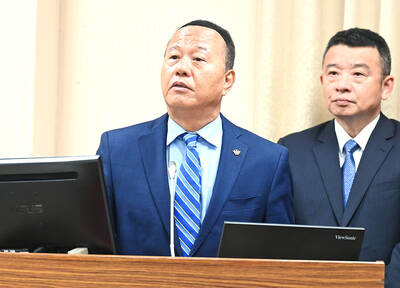
VIGILANCE: The military is paying close attention to actions that might damage peace and stability in the region, the deputy minister of national defense said The People’s Republic of China (PRC) might consider initiating a hack on Taiwanese networks on May 20, the day of the inauguration ceremony of president-elect William Lai (賴清德), sources familiar with cross-strait issues said. While US Secretary of State Anthony Blinken’s statement of the US expectation “that all sides will conduct themselves with restraint and prudence in the period ahead” would prevent military actions by China, Beijing could still try to sabotage Taiwan’s inauguration ceremony, the source said. China might gain access to the video screens outside of the Presidential Office Building and display embarrassing messages from Beijing, such as congratulating Lai


 RSS
RSS