


The latest installment payment for US-made Harpoon missiles will be made following more political wrangling in the Legislative Yuan over the use of domestic missiles versus American-made ones.
The legislature's National Defense Committee lifted its freeze on the NT$300 million budget for Harpoon-missile procurement after the air force promised to purchase Hsiungfeng II air-to-sea missiles to equip its IDF planes.
The Harpoon missiles will be installed on its F-16 jet fighters.
While screening the air force's budget for this year during the last legislative session, some lawmakers questioned why the military chose the Harpoons instead of the Hsiungfeng II missiles developed by the military-run Chungshan Institute of Science and Technology (CIST).
The lawmakers demanded that the air force give the committee an explanation before it could use the funds appropriated for the current fiscal year.
Speaking at the committee meeting yesterday, air force Commander-in-Chief General Lee Tian-yu (
"We still owe the US contractor some NT$800 million, including NT$300 million to be paid this year. If we default on the payment, our reputation will be at stake," he said.
Air force chief of staff General Ke Kuang-yeh (
"It would take a great deal of time and money to refit the F-16s for the Hsiungfeng II missiles," Ke said.
Moreover, he said, the military cannot modify the F-16 systems without prior US approval.
CIST director Liu Chin-ling
Liu said that installing Hsiungfeng IIs on the IDF jets would not cause weaponry systems integration problems.
"But it would be costly and difficult to install Hsiungfeng IIs on F-16s," he said.
According to Liu, the military once tried to equip F-16s with CIST-developed Tienchien II air-to-air missiles. The US supplier asked for US$400 million for integration.
"After a cost-efficiency study, we dropped the plan," he said.
After the committee gave a green light to the Harpoon budget, the military promised to test-fire Hsiungfeng II missiles from IDF planes in the near future to speed up the air force's procurement of the missiles for its IDF fleet.
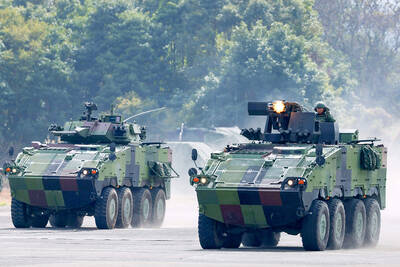
Taiwan must first strengthen its own national defense to deter a potential invasion by China as cross-strait tensions continue to rise, multiple European lawmakers said on Friday. In a media interview in Taipei marking the conclusion of an eight-member European parliamentary delegation’s six-day visit to Taiwan, the lawmakers urged Taipei to remain vigilant and increase defense spending. “All those who claim they want to protect you actually want to conquer you,” Ukrainian lawmaker Serhii Soboliev said when asked what lessons Taiwan could draw from Russia’s invasion of Ukraine. Soboliev described the Kremlin as a “new fascist Nazi regime” that justified

The US House of Representatives yesterday passed the PROTECT Taiwan Act, which stipulates that Washington would exclude China from participating in major global financial organizations if its actions directly threaten Taiwan’s security. The bill, proposed by Republican US Representative Frank Lucas, passed with 395 votes in favor and two against. It stipulates that if China’s actions pose any threat to Taiwan’s security, economic or social systems, the US would, “to the maximum extent practicable,” exclude China from international financial institutions, including the G20, the Bank for International Settlements and the Financial Stability Board. The bill makes it clear that China
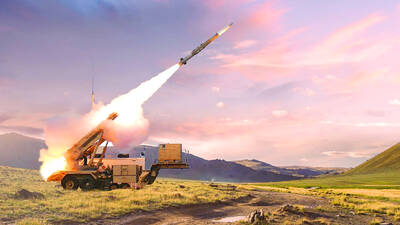
‘T-DOME’: IBCS would increase Taiwan’s defense capabilities, enabling air defense units to use data from any sensor system and cut reaction time, a defense official said A defense official yesterday said that a purported new arms sale the US is assembling for Taiwan likely includes Integrated Battle Command Systems (IBCS). The anonymous official’s comments came hours after the Financial Times (FT) reported that Washington is preparing a US$20 billion arms sale encompassing “Patriot missiles and other weapons,” citing eight sources. The Taiwanese official said the IBCS is an advanced command and control system that would play a key role in President William Lai’s (賴清德) flagship defense program, the “T-Dome,” an integrated air defense network to counter ballistic missiles and other threats. The IBCS would increase Taiwan’s

NOMINAL NEWLYWEDS: A man’s family and his wife — his long-term caregiver — are engaged in a legal dogfight over the propriety and validity of the recent union A centenarian’s marriage to his caregiver unbeknownst to his children has prompted legal action, as the caregiver accuses the man’s children of violating her personal liberty and damaging her reputation, while the children have sought a legal option to have the marriage annulled. According to sources, the 102-year-old man surnamed Wang (王) lives in Taipei’s Zhongshan District (中山) and previously worked as a land registration agent. Wang reportedly owns multiple properties and parcels of land worth several hundred million New Taiwan dollars and has ten children. His caregiver, a 69-year-old surnamed Lai (賴), has been caring for him since about 1999,


 RSS
RSS