


Fifty years ago, when daily necessities were scarce, Hsinchuang was northern Taiwan's manufacturing center for local food such as traditional pastries, tofu and barley sugar.
At its peak, there were about 90 bakeries in town, producing cookies and pastries for local and national retailers.
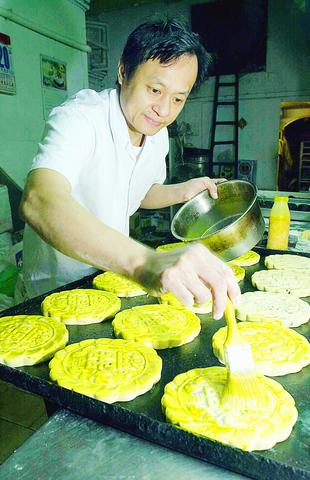
PHOTO: CHIANG YING-YING, TAIPEI TIMES
In the 1960s, however, Western bakeries arrived in the country and began taking business away from the traditional ones.
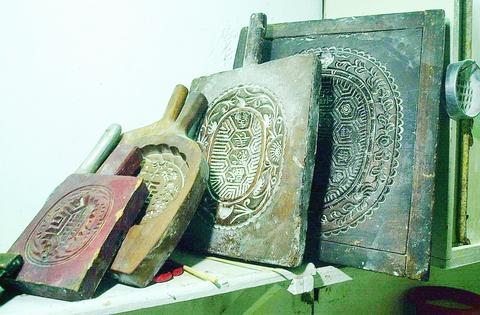
PHOTO: CHIANG YING-YING, TAIPEI TIMES
Now only two of the traditional bakeries are left on Hsinchuang Street. But this thoroughfare, which runs between Shulin Road and Chungcheng Road, has become a tourism area as part of a Hsinchuang City Government project to offer visitors a taste of the good old days.
Nestled among the some 200 shops on the 800m street, the Laoshoonhsiung Bakery (
With the economy in the doldrums, Wang Ming-chao (王明朝), the fourth-generation owner of the 120-year-old bakery, said that his shop is still enjoying brisk business.
"Take yesterday, for example, I sold about 200 pingan cakes (pastry in the shape of turtle symbolizing longevity), 2,000 birthday shoutao (pastry in the shape of peach, also symbolizing longevity) and 120kg of birthday noodles," he said.
The 19th day of the second month of the Chinese lunar calendar, which fell on Friday, marks the birthday of Kuanyin, the goddess of mercy.
Other seasonal orders include stuffed sweet dumplings for the Lantern Festival, sticky rice cakes for the Lunar New Year, moon cakes for the Mid-Autumn Festival and spring-roll dough for Tomb Sweeping Day.
According to Wang, orders for traditional engagement cakes can reach 500 boxes a week.
In addition to offering traditional pastries, Wang's store also offers western pastries such as birthday cakes and buns.
Each week Wang sells an average of 15 birthday cakes and 100 month-old birth cakes costing between NT$350 and NT$700 each.
Quality traditional engagement cakes should have a crispy crust and an aromatic stuffing, sweet or salty, Wang said.
"While most people prefer traditional stuffing such as red bean paste, white sesame paste and minced pork, we also offer innovative flavors such as green tea, Chinese yam and sticky rice cake," he said.
Uninterested in school, the 45-year-old Wang became an apprentice at a local bakery at the age of 17.
Over the past 28 years, Wang said that he has seen the local pastry industry gradually decline.
"Not many people are interested in traditional pastry any more because there are way more choices of snacks and cakes out there," Wang said. "As old bakers disappear and fewer young people are interested in learning the skills, bakeries in this town are closing down one by one," he said.
Lin Chih-ming (
Lin, who now runs a retail store on Chunghua Road in Hsinchuang, closed his bakery in 1987 after some 40 years in business.
"It took a lot of time and effort to make the pastry and sell them at the same time," said Lin, 70. "Besides, my son is not at all interested in taking over the business."
Lin's grandfather started the family business some 120 years ago, and Lin began learning how to make traditional Taiwanese pastry when he was eight or nine, he said.
"It isn't easy to make quality pastries," Lin said. "You need different quantities of ingredients for different weather."
At peak times, Lin said, all 10 of the family's adults plus five apprentices had to work 22 hours a day to meet demand.
Lin's grandfather had four sons, who had a total of 18 children. This family of 25 lived in a house where the King Ho-ho Bakery (
King Ho-ho is now run by the son of Lin's late younger brother.
Lin moved out of the family home to open a bakery of his own at the age of 42, three years after the death of his father.
"The first eight or nine years were the heyday of my career when I had to work around the clock to make pastries out of five or six bags of flour," Lin said. "However, business has gone downhill the past three or four years."
Now he reminds himself of better days by making food on special occasions such as Mid-Autumn Festival, when he makes moon cakes for his family.
Situated at the very end of the Hsinchuang Street, the King Ho-ho Bakery has seen the rise and fall of the town's traditional pastry industry.
One of the shop's specialties is the famous hsiankuang cake (
Lin Shih-wei (
"Like yesterday, we had an order of 400 boxes of engagement cakes and today we're baking 30kg of hsiankuang cakes ordered by a local school teacher," the 39-year-old said.
As well as traditional pastries such as sticky rice cakes and turtle-shaped pastry, Lin said that his shop also carried a small selection of Western pastries such as toast, buns and birthday cakes.
Lin took over the family business in 1992 at the age of 28 when his father passed away. He attributed the decline of his family business to the location of the store and falling interest in traditional pastries.
"Our store used to be in one of the best locations in town because there was a ferry wharf at the back of the house," Lin said.
The wharf, however, became unusable after silt accumulated in the Tahan River.
"While there is a night market down the street, things are quiet here, especially after sunset," said Lin's 62-year-old mother.
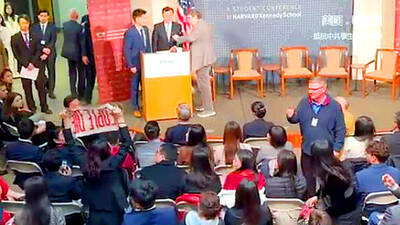
A group of Taiwanese-American and Tibetan-American students at Harvard University on Saturday disrupted Chinese Ambassador to the US Xie Feng’s (謝鋒) speech at the school, accusing him of being responsible for numerous human rights violations. Four students — two Taiwanese Americans and two from Tibet — held up banners inside a conference hall where Xie was delivering a speech at the opening ceremony of the Harvard Kennedy School China Conference 2024. In a video clip provided by the Coalition of Students Resisting the CCP (Chinese Communist Party), Taiwanese-American Cosette Wu (吳亭樺) and Tibetan-American Tsering Yangchen are seen holding banners that together read:

UNAWARE: Many people sit for long hours every day and eat unhealthy foods, putting them at greater risk of developing one of the ‘three highs,’ an expert said More than 30 percent of adults aged 40 or older who underwent a government-funded health exam were unaware they had at least one of the “three highs” — high blood pressure, high blood lipids or high blood sugar, the Health Promotion Administration (HPA) said yesterday. Among adults aged 40 or older who said they did not have any of the “three highs” before taking the health exam, more than 30 percent were found to have at least one of them, Adult Preventive Health Examination Service data from 2022 showed. People with long-term medical conditions such as hypertension or diabetes usually do not
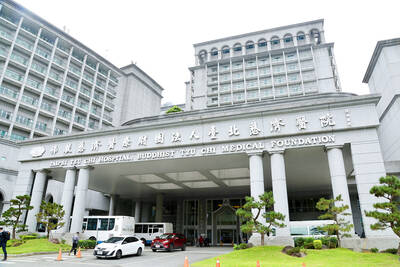
POLICE INVESTIGATING: A man said he quit his job as a nurse at Taipei Tzu Chi Hospital as he had been ‘disgusted’ by the behavior of his colleagues A man yesterday morning wrote online that he had witnessed nurses taking photographs and touching anesthetized patients inappropriately in Taipei Tzu Chi Hospital’s operating theaters. The man surnamed Huang (黃) wrote on the Professional Technology Temple bulletin board that during his six-month stint as a nurse at the hospital, he had seen nurses taking pictures of patients, including of their private parts, after they were anesthetized. Some nurses had also touched patients inappropriately and children were among those photographed, he said. Huang said this “disgusted” him “so much” that “he felt the need to reveal these unethical acts in the operating theater
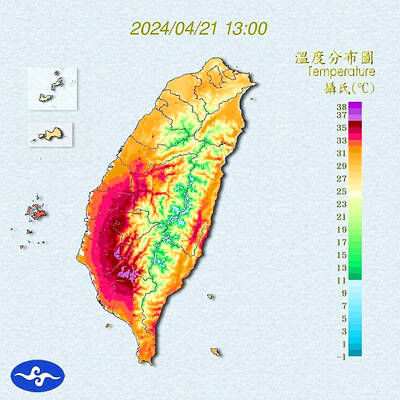
Heat advisories were in effect for nine administrative regions yesterday afternoon as warm southwesterly winds pushed temperatures above 38°C in parts of southern Taiwan, the Central Weather Administration (CWA) said. As of 3:30pm yesterday, Tainan’s Yujing District (玉井) had recorded the day’s highest temperature of 39.7°C, though the measurement will not be included in Taiwan’s official heat records since Yujing is an automatic rather than manually operated weather station, the CWA said. Highs recorded in other areas were 38.7°C in Kaohsiung’s Neimen District (內門), 38.2°C in Chiayi City and 38.1°C in Pingtung’s Sandimen Township (三地門), CWA data showed. The spell of scorching


 RSS
RSS