


Rather than bow to pressure, Chin Heng-wei (
Chin, a political observer and editor in chief of Contemporary Monthly magazine, was attacked by a man thought to be in his 60s, whom Chin said may have been a military veteran, while on his way home with his wife.
On Wednesday, KMT Legislator Hung Hsiu-chu (
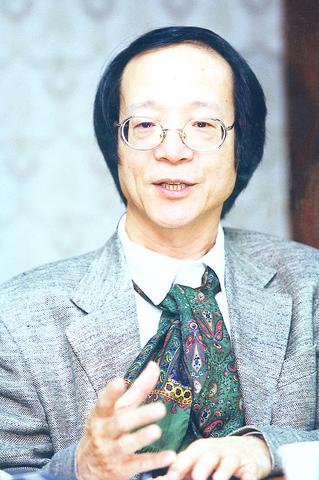
TAIPEI TIMES FILE PHOTO
"The KMT wants to block me from taking part in talk shows. To thwart this attack, I am accepting all invitations from the media," Chin said.
"I don't deserve a political party using its all force to attack me," he said, adding that the KMT's attacks served to upgrade his status.
"Accusing me of being a manipulator on behalf of the DPP is just a pathetic gimmick that the KMT has played to combat intellectuals in Taiwan," he said.
Reacting to the two incidents, Chin reiterated that he has no reason to compromise, especially since he has fought for freedom of speech since the martial law era.
In 1983, Chin, as editor of the China Times, challenged the authorities by publishing controversial social criticism, including Lung Ying-tai's (
Lung is a former director of the Taipei City Government's Cultural Affairs Bureau.
Many social historians now mark Wild Fire as one of the starting points of the cascade of events that transformed Taiwan into one of the most democratic countries in Asia.
"Without the China Times insistence, there would have been no Wild Fires," Lung said.
"Chin asked me to write freely and not to consider the [pressure from] Taiwan Garrison Command. He always said that he would take care of the censorship issue," she said, adding that her father once had nightmares about her columns.
Ironically, Chin was replaced by the China Times due to pressure from the Taiwan Garrison Command.
In June 1986, Chin founded Contemporary Monthly, which is considered one of Taiwan's few liberal and intellectual magazines.
The magazine has published stories on issues such as Marxism, literature, film, history, liberalism and the environment in its 187 editions.
As a political observer, Chin has written columns for Liberty Times and the Taiwan Daily News since 1988.
"He is one of the few people capable of writing a good column everyday. Aside from that, he even has time to attend TV call-in shows," said Lu Shih-xiang (盧世祥), founder of the Foundation for the Advancement of Media Excellence (新聞公害防治基金會) and a retired editor in chief of the Eco-nomic Daily News. Lu has known Chin since the 1980s.
Chin, whose ancestors came from Zheijiang Province in China, has been one of the few mainlanders to publicly support Taiwan independence, through his columns and his appearances on TV call-in shows.
Chang Mau-kuei (
Chang said Chin's ethnicity would make it difficult for him to mix with Taiwan independence supporters, while his beliefs also alienate him from most mainlanders.
Ku Chung-hwa (
"I think he is brave by taking those risks to express what he really thinks," Ku said.
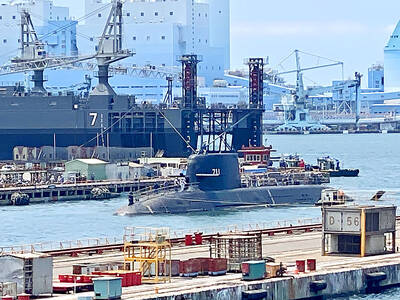
AGING: While Japan has 22 submarines, Taiwan only operates four, two of which were commissioned by the US in 1945 and 1946, and transferred to Taiwan in 1973 Taiwan would need at least 12 submarines to reach modern fleet capabilities, CSBC Corp, Taiwan chairman Chen Cheng-hung (陳政宏) said in an interview broadcast on Friday, citing a US assessment. CSBC is testing the nation’s first indigenous defense submarine, the Hai Kun (海鯤, Narwhal), which is scheduled to be delivered to the navy next month or in July. The Hai Kun has completed torpedo-firing tests and is scheduled to undergo overnight sea trials, Chen said on an SET TV military affairs program. Taiwan would require at least 12 submarines to establish a modern submarine force after assessing the nation’s operational environment and defense

A white king snake that frightened passengers and caused a stir on a Taipei MRT train on Friday evening has been claimed by its owner, who would be fined, Taipei Rapid Transit Corp (TRTC) said yesterday. A person on Threads posted that he thought he was lucky to find an empty row of seats on Friday after boarding a train on the Bannan (Blue) Line, only to spot a white snake with black stripes after sitting down. Startled, he jumped up, he wrote, describing the encounter as “terrifying.” “Taipei’s rat control plan: Release snakes on the metro,” one person wrote in reply, referring
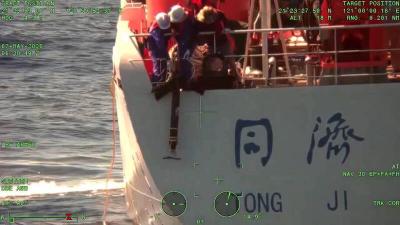
The coast guard today said that it had disrupted "illegal" operations by a Chinese research ship in waters close to the nation and driven it away, part of what Taipei sees a provocative pattern of China's stepped up maritime activities. The coast guard said that it on Thursday last week detected the Chinese ship Tongji (同濟號), which was commissioned only last year, 29 nautical miles (54km) southeast of the southern tip of Taiwan, although just outside restricted waters. The ship was observed lowering ropes into the water, suspected to be the deployment of scientific instruments for "illegal" survey operations, and the coast
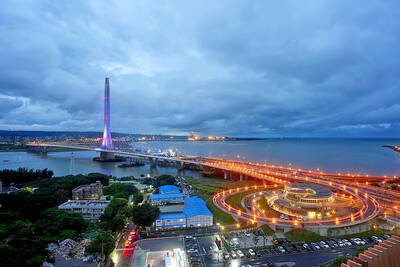
An inauguration ceremony was held yesterday for the Danjiang Bridge, the world’s longest single-mast asymmetric cable-stayed bridge, ahead of its official opening to traffic on Tuesday, marking a major milestone after nearly three decades of planning and construction. At the ceremony in New Taipei City attended by President William Lai (賴清德), Premier Cho Jung-tai (卓榮泰), Minister of Transportation and Communications Chen Shih-kai (陳世凱) and New Taipei City Mayor Hou Yu-ih (侯友宜), the bridge was hailed as both an engineering landmark and a long-awaited regional transport link connecting Tamsui (淡水) and Bali (八里)


 RSS
RSS