


■ Environment
Two spoonbills return to wild
Two black-faced spoonbills suffering from botulism at the Chiku Wetland in Tainan early this year were set free yesterday by the Tainan County Government after recovering. The two were among 17 sick birds that were found at the Chiku conservation area early this year, county government sources said, adding that another 15 of the endangered birds were set free Feb. 18 after receiving treatment. Seventy-three black-faced spoonbills that migrated from the Korean Peninsula and northeastern China between early December and early February to spend the winter at the Chiku Wetland have died of botulism. Tainan County Magistrate Su Huan-chih (蘇煥智), who presided over a ceremony to set the two birds free, said Tainan County Hall will organize an international seminar on black-faced spoonbills in April. Su vowed to strengthen the management of the main habitat of black-faced spoonbills.
■ Shipping
Chinese vessels collide
Two Chinese cargo ships have collided near an outlying Taiwanese island, causing one vessel to sink and killing at least three of its crewmen, Taiwanese police said yesterday. The Haugang 508 sank after colliding with the Runda 402 Saturday night in rough waters near Tungyin island, which is close to China's southeastern coast, police said. Taiwanese patrol boats rescued four sailors and were still searching for three missing sailors from the sunken ship, they said. A Chinese patrol boat has also joined the rescue effort, they said.
■ Transportation
Gods say no to rail line
The nation's high-speed railway has hit a snag. The obstacle? A temple and its 300-year-old camphor tree. Rail engineers had planned for the line from Taipei in the north to Kaohsiung in the south to cross three temples. Railway officials may have informed those at the temple of the coming demolition, but they forgot to ask the most important figures -- the temple gods. The railway appeared to be in the good graces of the first two temple gods -- Taoist monks threw divination blocks to ask the gods whether the temple could be relocated. The gods assented. Unfortunately, the last temple god proved to be more stubborn. The divination blocks gave a resounding "no" to the idea of relocation. Unable to trump the temple god, and in their desire to maintain cultural relics, the rail officials conceded defeat and agreed to have the line skirt the temple and its venerable tree.
■ Nuclear power
Former DPP head to fast
Former DPP chairman Lin I-hsiung (林義雄) will stage an hours-long fast in front of the Executive Yuan today to protest the government's failure to hold a referendum on the fate of the Fourth Nuclear Power Plant. Lin, along with a group of anti-nuclear activists, plan to stage the fast from afternoon through late night. Premier Yu Shyi-kun has designated Cabinet Secretary-General Liu Shih-fang (劉世芳) to receive the petitioners and discuss the issue with Lin. Reiterating that a nation without nuclear power has been a common goal for the DPP and opposition parties, Cabinet spokesman Lin Chia-lung (林佳龍) said the timing of a referendum on the fate of the plant needs further study and that the government will not rule out the possibility of holding a"consultative referendum" before laws governing a vote on the nuclear issue are enacted.
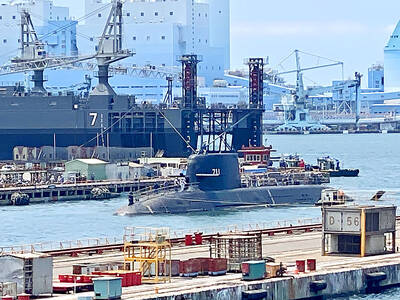
AGING: While Japan has 22 submarines, Taiwan only operates four, two of which were commissioned by the US in 1945 and 1946, and transferred to Taiwan in 1973 Taiwan would need at least 12 submarines to reach modern fleet capabilities, CSBC Corp, Taiwan chairman Chen Cheng-hung (陳政宏) said in an interview broadcast on Friday, citing a US assessment. CSBC is testing the nation’s first indigenous defense submarine, the Hai Kun (海鯤, Narwhal), which is scheduled to be delivered to the navy next month or in July. The Hai Kun has completed torpedo-firing tests and is scheduled to undergo overnight sea trials, Chen said on an SET TV military affairs program. Taiwan would require at least 12 submarines to establish a modern submarine force after assessing the nation’s operational environment and defense

Yangmingshan National Park authorities yesterday urged visitors to respect public spaces and obey the law after a couple was caught on a camera livestream having sex at the park’s Qingtiangang (擎天崗) earlier in the day. The Shilin Police Precinct in Taipei said it has identified a suspect and his vehicle registration number, and would summon him for questioning. The case would be handled in accordance with public indecency charges, it added. The couple entered the park at about 11pm on Thursday and began fooling around by 1am yesterday, the police said, adding that the two were unaware of the park’s all-day live
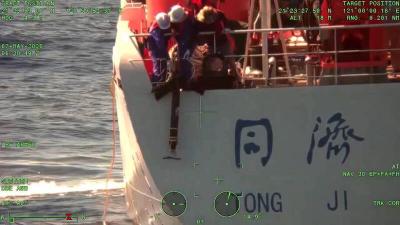
The coast guard today said that it had disrupted "illegal" operations by a Chinese research ship in waters close to the nation and driven it away, part of what Taipei sees a provocative pattern of China's stepped up maritime activities. The coast guard said that it on Thursday last week detected the Chinese ship Tongji (同濟號), which was commissioned only last year, 29 nautical miles (54km) southeast of the southern tip of Taiwan, although just outside restricted waters. The ship was observed lowering ropes into the water, suspected to be the deployment of scientific instruments for "illegal" survey operations, and the coast

A former soldier and an active-duty army officer were yesterday indicted for allegedly selling classified military training materials to a Chinese intelligence operative for a total of NT$79,440. The Taipei District Prosecutors’ Office indicted Chen Tai-yin (陳泰尹) and Lee Chun-ta (李俊達) for contravening the National Security Act (國家安全法) and the Anti-Corruption Act (貪污治罪條例). Chen left the military in September 2013 after serving alongside then-staff sergeant Lee, now an army lieutenant, at the 21st Artillery Command of the army’s Sixth Corps from 2011 to 2013, according to the indictment. Chen met a Chinese intelligence operative identified as “Wang” (王) through a friend in November


 RSS
RSS