


Minister of Foreign Affairs Eugene Chien (
"I took the initiative to report to the Control Yuan," Chien said, adding the move was aimed at clarifying details concerning the ministry's handling of the issue to the four-member investigation team at the government watchdog agency.
Chien's offer came while the investigation team was debating whether to summon the foreign minister to report on the controversial issue.
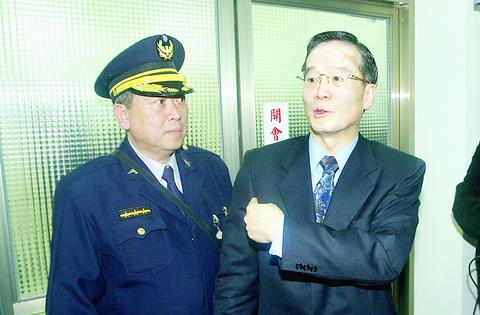
PHOTO: GEORGE TSORNG, TAIPEI TIMES
The minister said he explained the procedures surrounding the issuing of the notarization of power of attorney to Wang through the representative office in Geneva in July 2001 and the London office just last month.
The paper was to notarize the appointment of a lawyer to act on Wang's behalf when the court in Taiwan handles a libel lawsuit he filed against national policy adviser Hsieh Tsung-min (
The minister said he endeavored to help the Control Yuan team reconstruct the facts surrounding the issue, while clarifying related questions from the team.
The ministry has already handed a related report to an evaluation team under the Executive Yuan earlier this week before the minister approached the Control Yuan.
Chien said the ministry has handled the case in accordance with related laws and regulations, while reiterating that he hasn't maintained any friendship or long-term relationship with Wang.
Meanwhile, Chan Hsien-ching (詹憲卿) yesterday morning handed over his post as the director-general of the ministry's Bureau of Consular Affairs to Chan's successor Yang Sheng-chung (楊勝宗) after his resignation over the notarization issue.
Chan also accompanied Chien during the Control Yuan meeting.
The Control Yuan team has already summoned Chan twice since the Geneva office issued the paper to Wang in July 2001 as part of the investigation into the causes and procedures surrounding the issuance by the two representative offices.
The ministry announced last week that it decided to revoke the issuance claiming the move might put Taiwan's national interests in jeopardy, one day after officials claimed the issuance was legally justifiable.
Wang, a former arms dealer, has been wanted since September 2000 in connection with the death of navy Captain Yin Ching-feng (
Chan yesterday morning also apologized to the foreign minister after he stepped down from his post.
"A purely consular affair has triggered a political storm," he said.
Chan said he has no complaints about how he had been treated.
Chien said although the ministry deemed the handling of the issue as legally justifiable, the process has been less than ideal.
The Geneva office issued the paper after consulting the ministry by two telegrams and two telephone calls, while the London office issued the paper after an internal meeting without any prior consultation with Taipei, officials said.
Chien also said he understood the "pain" Chan has experienced after the issue prompted criticism from all sides.
Chan has insisted that even a fugitive is entitled to application for power of attorney.
Chan will serve as a senior adviser at the ministry, while his successor, before taking up the new post, was the head of the ministry's Foreign Service Institute.

NATIONAL SECURITY: Authorities are working to confirm the identities of the military personnel involved and investigating possible illegal conduct and regulatory violations Authorities are probing possible national security implications after Kinmen police and immigration officers on Sunday found a Chinese woman allegedly posing as a tourist while engaging in prostitution involving more than 10 military personnel. The woman, surnamed Chen (陳), has since been deported, authorities said, adding that investigators are still working to confirm the identities of those implicated, as the records only listed code names and aliases. The case stemmed from a report received by the Kinmen District Prosecutors’ Office on Friday last week from the Jinhu Precinct of the Kinmen County Police Bureau. On Sunday, police, along with the National Immigration

GLOBALGIVING: ‘ Caving to external pressure is not acceptable for an organization that has cultivated justice reform and human rights for 30 years,’ one NGO said A slew of non-government organizations (NGOs) have withdrawn from the GlobalGiving fundraising platform after it announced it would use “Chinese Taipei” instead of “Taiwan” from next month. The Taiwan Good Rice Association wrote on Facebook on Friday that it was informed on April 28 via a teleconference call of the change, which was made because the platform wanted to operate in China. Taiwan Good Rice is to terminate all cooperative relationships with GlobalGiving in response to the platform’s “unilateral and non-negotiable” decision to remove references to Taiwan, the NGO said. “Taiwan is in the official name of Taiwan Good Rice Association and the
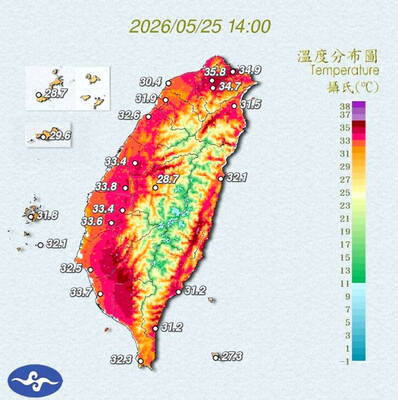
STAY COOL: The HPA recommended that people stay hydrated, use air-conditioning or fans while indoors, wear loose-fitting clothes and walk in the shade while outdoors Employers must implement measures such as installing cooling equipment, and providing drinking water and rest breaks for outdoor workers starting from Monday next week, the Taipei Department of Labor said on Sunday. Employers who fail to comply could face fines of NT$30,000 to NT$300,000 under the Occupational Safety and Health Act (職業安全衛生法), the department said. Businesses in Taipei employing fewer than 100 workers, as well as registered self-employed workers with labor insurance coverage, could receive on-site assessments and guidance from occupational safety consultants to help them apply for central government subsidies to implement or improve heat-protection measures, it said. Under the Ministry of

Chinese Nationalist Party (KMT) Chairwoman Cheng Li-wun (鄭麗文) yesterday briefed her party’s Central Standing Committee regarding her scheduled visit to the US between Monday next week and June 16, saying that her purpose would be to persuade the US that the Republic of China (ROC) Constitution was a “one China” constitution that would foster stable and peaceful cross-strait relations. The ROC Constitution is the most important defense for all Taiwanese citizens, as it upholds our democracy and has contributed to our robust economy, which aligns with international and US interests, she said. “We would not be troublemakers and drag the US under,”


 RSS
RSS