


Hsieh Fan-fan (
The appointment as police chief for Ilan County makes Hsieh the top female police officer in the country as well as the highest-ranking DPP policewoman.
There are 23 county and city police headquarters under the National Police Administration (NPA). Deputy directors-general and directors-general of the NPA are drawn from their ranks.
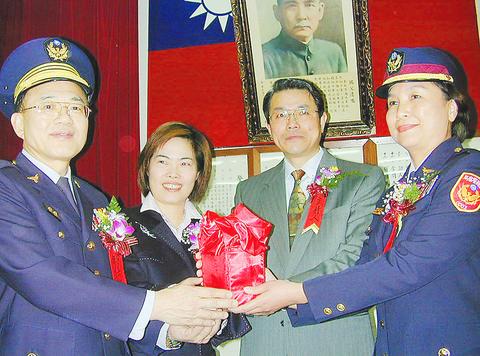
PHOTO: CHIANG CHIH-MING, TAIPEI TIMES
Hsieh, 53, who has a son and a daughter, decided to dedicate herself to the force after her husband died of cancer in 1981. It was also the year she passed the entrance exam for the Central Police Col-lege's two-year program. Two years later, she graduated with an associate degree and began her first job as an assistant to the Taipei City Police's Personnel Department.
She started her police career at the system's lowest possible level.
The two-year program was cancelled in 1996, when the Central Police College became the Central Police University.
Prior to her promotion last Wednesday, Hsieh was the chief of the security department at the Presidential Office. She was in charge of security for both the Presidential Office and the presidential residence in Taipei. She was also the first female presidential bodyguard and the first female chief of the president's security guards.
NPA Senior Inspector Lee Chiu-ming (
Lee was President Chen Shui-bian's (
Both Hsieh and Lee joined the DPP on Jan. 21.
Hsieh's relationship with the president became closer when Chen, as Taipei mayor, promoted her from director of the Women's Police Division to the director of the city police's Juvenile Affairs Division.
The position at the Juvenile Affairs Division was seen as important because officers who have served in that role have all became inspectors. Hsieh was the first female head of the division.
Hsieh has declined requests for media interviews since taking up her new job last week.
Throughout her police career, Hsieh has kept a low profile. This may explain why she has been able to earn promotions while her classmates in the academy are still serving as middle-ranking officers.
Ilan's KMT and PFP county councilors cried foul over Hsieh's latest appointment.
"There are many officers qualified for this post. Hsieh is definitely not the best candidate. But she was chosen because she is one of the few high-ranking DPP police officers," said Ilan County Council Speaker Chang Jian-rong (
Most officers of Hsieh's rank, three stripes with two stars, graduated from the Central Police University between 1969 and 1979. Hsieh graduated in 1983.
Former Ilan County police chief Wu Hsing-jen (吳幸仁) also complained about Hsieh's promotion.
"She is too young for this. It is very difficult to convince people that her promotion has nothing to do with DPP favoritism," Wu said.
Wu was made the new head of the NPA's business section.
In a press release distributed on the same day as Hsieh assumed her new job, the NPA denied that favoritism played a part in Hsieh's selection.
The release said that her promotion followed a meeting between the director-general and Ilan County Commissioner Liu Shou-cheng (劉守成) on Jan. 24, which was confirmed by the commissioner.
"On Jan. 24, Wang came to visit me with a list of three candidates' names. He said that these three officers were all qualified for the job and asked me to pick one. Hsieh was the one we chose during the meeting. It has nothing to do with politics," Liu said.
Hsieh said at her welcoming party at the Ilan County Police Station that the allegations of favoritism will not faze her.
"I have always reminded myself to do my job well. That is my motto. In addition, a police officer's job is to serve the people and maintain public order instead of getting involved in politics, isn't it?" she said.

The military has spotted two Chinese warships operating in waters near Penghu County in the Taiwan Strait and sent its own naval and air forces to monitor the vessels, the Ministry of National Defense (MND) said. Beijing sends warships and warplanes into the waters and skies around Taiwan on an almost daily basis, drawing condemnation from Taipei. While the ministry offers daily updates on the locations of Chinese military aircraft, it only rarely gives details of where Chinese warships are operating, generally only when it detects aircraft carriers, as happened last week. A Chinese destroyer and a frigate entered waters to the southwest

The eastern extension of the Taipei MRT Red Line could begin operations as early as late June, the Taipei Department of Rapid Transit Systems said yesterday. Taipei Rapid Transit Corp said it is considering offering one month of free rides on the new section to mark its opening. Construction progress on the 1.4km extension, which is to run from the current terminal Xiangshan Station to a new eastern terminal, Guangci/Fengtian Temple Station, was 90.6 percent complete by the end of last month, the department said in a report to the Taipei City Council's Transportation Committee. While construction began in October 2016 with an

NON-RED SUPPLY: Boosting the nation’s drone industry is becoming increasingly urgent as China’s UAV dominance could become an issue in a crisis, an analyst said Taiwan’s drone exports to Europe grew 41.7-fold from 2024 to last year, with demand from Ukraine’s fight against Russian aggression the most likely driver of growth, a study showed. The Institute for Democracy, Society and Emerging Technology (DSET) in a statement on Wednesday said it found that many of Taiwan’s uncrewed aerial vehicle (UAV) sales were from Poland and the Czech Republic. These countries likely transferred the drones to Ukraine to aid it in its fight against the Russian invasion that started in 2022, it said. Despite the gains, Taiwan is not the dominant drone exporter to these markets, ranking second and fourth

Japanese Prime Minister Sanae Takaichi’s comment last year on Tokyo’s potential reaction to a Taiwan-China conflict has forced Beijing to rewrite its invasion plans, a retired Japanese general said. Takaichi told the Diet on Nov. 7 last year that a Chinese naval blockade or military attack on Taiwan could constitute a “survival-threatening situation” for Japan, potentially allowing Tokyo to exercise its right to collective self-defense. Former Japan Ground Self-Defense Force general Kiyofumi Ogawa said in a recent speech that the remark has been interpreted as meaning Japan could intervene in the early stages of a Taiwan Strait conflict, undermining China’s previous assumptions


 RSS
RSS