


Taipei's chance of gaining improved trade status with the US has suffered an apparent setback with a report by the White House to Congress on global trade issues that finds Taiwan deficient in several areas of bilateral trade relations, including intellectual piracy, telecommunications, agriculture and pharmaceuticals.
The report, an annual discussion of trade agreements which the US is engaged in, is considered as reflecting the basis for the administration's decision, due at the end of April, on whether to remove Taiwan from its "Priority Watch List" under its Special 301 law regarding intellectual property rights violations.
It is also seen as an important barometer of when and whether the US will enter into a Free Trade Agreement with Taipei, an agreement that would have tremendous symbolic value as a measure of overall bilateral ties, including political relations.
"The level of intellectual property [IP] piracy in Taiwan remains at a very high level," says the report, prepared by the US Trade Representative's office. "Minimal progress was made in strengthening its intellectual property rights protection regime during the past year," the report noted.
While the report cited Taiwan's efforts to modify its copyright laws in response to US requests, it says "the latest drafts of these amendments may not adequately protect IPR in Taiwan if the authorities exempt some infringements from `public offense' status."
Although the government declared last year an "action year" against piracy, "continued pirating of optical media, failure to shut down counterfeit and IPR-infringing facilities and the export of pirated and counterfeit goods overseas led the US to urge the Taiwanese government to further improve its enforcement and legal framework for IPR protection," the report noted.
On telecommunications, while Taipei committed itself under its WTO accession agreement to fully open the telecommunications service market, it "has not implemented the legal regime or licensing criteria to provide new licenses for local, domestic long distance, and international services" despite repeated US requests, the report says.
It also faults Taipei's action on the direct sale of fiber-optic submarine cable and the development of new criteria regarding issuing of new fixed-line telecommunications licenses.
On agriculture, the USTR takes Taiwan to task for being late in implementing its tariff-rate and market access quotas on rice, chicken, pork, and other products specified in the WTO commitments. The rice import system was "particularly troublesome," the report says. As part of its WTO commitment, Taiwan agreed to consult with Washington on rice imports.
Market entry for new pharmaceuticals also came in for criticism in the US report.
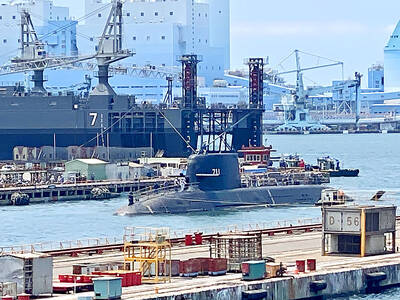
AGING: While Japan has 22 submarines, Taiwan only operates four, two of which were commissioned by the US in 1945 and 1946, and transferred to Taiwan in 1973 Taiwan would need at least 12 submarines to reach modern fleet capabilities, CSBC Corp, Taiwan chairman Chen Cheng-hung (陳政宏) said in an interview broadcast on Friday, citing a US assessment. CSBC is testing the nation’s first indigenous defense submarine, the Hai Kun (海鯤, Narwhal), which is scheduled to be delivered to the navy next month or in July. The Hai Kun has completed torpedo-firing tests and is scheduled to undergo overnight sea trials, Chen said on an SET TV military affairs program. Taiwan would require at least 12 submarines to establish a modern submarine force after assessing the nation’s operational environment and defense

A white king snake that frightened passengers and caused a stir on a Taipei MRT train on Friday evening has been claimed by its owner, who would be fined, Taipei Rapid Transit Corp (TRTC) said yesterday. A person on Threads posted that he thought he was lucky to find an empty row of seats on Friday after boarding a train on the Bannan (Blue) Line, only to spot a white snake with black stripes after sitting down. Startled, he jumped up, he wrote, describing the encounter as “terrifying.” “Taipei’s rat control plan: Release snakes on the metro,” one person wrote in reply, referring
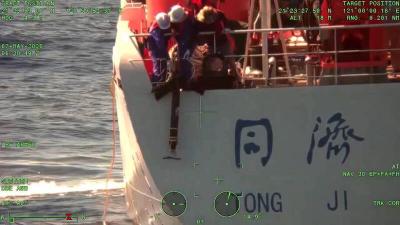
The coast guard today said that it had disrupted "illegal" operations by a Chinese research ship in waters close to the nation and driven it away, part of what Taipei sees a provocative pattern of China's stepped up maritime activities. The coast guard said that it on Thursday last week detected the Chinese ship Tongji (同濟號), which was commissioned only last year, 29 nautical miles (54km) southeast of the southern tip of Taiwan, although just outside restricted waters. The ship was observed lowering ropes into the water, suspected to be the deployment of scientific instruments for "illegal" survey operations, and the coast
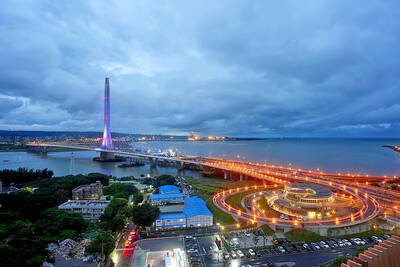
An inauguration ceremony was held yesterday for the Danjiang Bridge, the world’s longest single-mast asymmetric cable-stayed bridge, ahead of its official opening to traffic on Tuesday, marking a major milestone after nearly three decades of planning and construction. At the ceremony in New Taipei City attended by President William Lai (賴清德), Premier Cho Jung-tai (卓榮泰), Minister of Transportation and Communications Chen Shih-kai (陳世凱) and New Taipei City Mayor Hou Yu-ih (侯友宜), the bridge was hailed as both an engineering landmark and a long-awaited regional transport link connecting Tamsui (淡水) and Bali (八里)


 RSS
RSS