


At a time when ethnic issues are a source of tension, the death of Fei Hsi-ping (
A chapter of history that is unknown to most of the younger generation, the public's memories of contributions made by mainland Chinese dating back to the 1960s and 1970s came flooding back after Fei passed away on Feb 21. He was 86.
During the period when criticism of the government often led to threats of political suppression, a group of mainlander political thinkers such as Lei Chen (
Their political views provided the theoretical foundation necessary for establishing a constitutional democracy and evolved into a moving force of reform in the 1980s.
Fu Cheng (傅正) and Fei Hsi-ping went even further to become founding members of the DPP, the nation's first opposition party, established in 1986.
After Fei's death, DPP officials recalled a chapter of history that is seldom mentioned -- when they cooperated with Fei to push for the birth of the party.
National Security Council Secretary-General Kang Ning-hsiung (
Former DPP legislator Lin Cheng-chieh (
The KMT considered mainlanders joining the movement a provocation. It detested the group of mainlander liberals more than other opposition activists, and was particularly tough on them.
Democracy activist Lei Chen was charged with sedition and sentenced to 10 years in prison for publishing the opposition Free China Fortnightly (
A former KMT political worker, Fu Cheng went over to the opposition movement in 1953 by contributing articles to Lei's magazine. He served a jail-term of more than six years for his role as a co-founder of the China Democratic Party.
Born in China's Liaoning Province, Fei graduated from Beijing University and was elected as legislator in 1948. He maintained the position for 42 years until 1990 when he retired.
A KMT member, his party membership was revoked in 1960 when he spoke in defense of Lei Chen.
After then, Fei gradually became connected with the Taiwanese-dominated tang wai movement and became one of the movement's leaders. When the DPP was founded, he was a candidate for the party's founding chairman, but lost the post to Chiang Peng-chien (
Fei was once a popular campaign stumper for the tang wai movement. His speeches in Mandarin with a strong Liaoning accent were in sharp contrast to other addresses in Taiwanese.
President Chen Shui-bian (
Party members regarded Fei's role in the DPP "a must" on the grounds that his support diluted the perception that DPP was a party only for Taiwanese.
But the lawmaker came under criticism from party radicals for his moderate political stance. Fei sought reform from "within the system," called for peaceful co-existence with the KMT and strongly opposed Taiwan independence.
What further strained his relationship with the DPP was his reluctance to forgo his seat as a senior legislator.
The only DPP senior legislator in the "permanent parliament" -- under which the KMT claimed its members could only be re-elected if they recovered China, Fei became an immediate target when the DPP demanded parliamentary reform.
The DPP refused to accept Fei's proposals, in which he maintained that he would only give up his post if the party agreed to keep certain Chinese representatives in the legislature -- an idea designed to keep the parliament from being controlled by Taiwanese.
The incident prompted Fei to break away from the party in 1988. He decided to abandon his seat two years later and faded from the political scene after moving to the US.
In retrospect, his four-decades in politics appear to have been a lonely journey.
Outspoken and strong-minded, Fei did not make many friends for he had often been sandwiched by his KMT comrades and his new Taiwanese DPP friends. Kang Ning-hsiang was one of his few political allies.

FUKUOKA SITUATION: Japanese media reported that the pathogen is expected to be identified by the summer, while the CDC downplayed the idea that it was hMPV A “mysterious cold-like illness” reported in Japan’s Fukuoka Prefecture does not seem to be a new disease, but Japanese authorities have been asked about the situation, the Centers for Disease Control (CDC) said yesterday. The Fukuoka Prefectural Medical Association on Wednesday told a news conference that a “mystery cold” that has become a hot topic on social media is “highly likely to be caused by some kind of viral infection,” Japan’s KBC News reported. “Many people are experiencing symptoms starting with a sore throat, followed by a runny nose, phlegm and a severe cough,” KBC News reported, citing association officials. Health authorities are

Nvidia Corp CEO Jensen Huang (黃仁勳) arrived in Taiwan yesterday ahead of upcoming AI and technology events, saying he plans to meet with clients and Taiwan Semiconductor Manufacturing Co Chairman C.C. Wei (魏哲家) during his visit. After landing at Taipei Songshan Airport, Huang posed for photos with fans and handed out Yakult drinks to reporters and supporters waiting at the scene, saying he has “a lot to do” during the trip. Asked about reports that Nvidia’s planned headquarters site in Taipei’s Beitou Shilin Technology Park could break ground on May 27, Huang said that if the company holds an event, he would

The Ministry of Finance this afternoon announced the winning numbers for the March-April uniform invoice lottery. The winning number for the NT$10 million (US$318,060) special prize is 19531471, and the winning number for the NT$2 million grand prize is 85941329. Three numbers were drawn for the NT$200,000 first prize: 07225810, 20231230 and 83518781. Those with receipts matching the last seven digits of any of the first-prize numbers will win the NT$40,000 second prize, while those matching the last six digits will win the NT$10,000 third prize. Those whose receipts match the last five digits of the first-prize numbers can claim the NT$4,000 fourth prize,
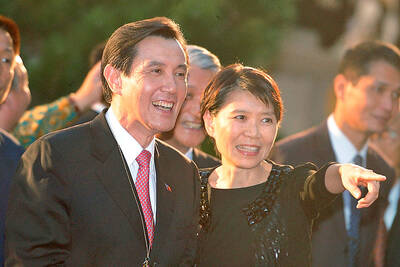
Former president Ma Ying-jeou (馬英九) yesterday expressed “shock and regret” over a statement issued by his wife without his consent, and rejected her assertion that his eldest sister, Ma Yi-nan (馬以南), would manage his medical care or act as his spokesperson amid an ongoing embezzlement probe into his foundation. Ma Ying-jeou in a statement said he was shocked by a statement by his wife, Chou Mei-ching (周美青), regarding his affairs. Ma Yi-nan “must not” be in charge of his healthcare and other personal affairs, nor can she be allowed to represent the Ma family, the former president said. He said he was also


 RSS
RSS