


The deaths of endangered black-faced spoonbills in Chiku Lagoon, Tainan County, exposed the government's inability to handle bird epidemics.
Although conservationists attributed this inability to Taiwan's long-term exclusion from mainstream ecological conservation networks, ecologists said the government's attitude toward conservation and environmental issues was the problem.
For example, the partnership between the Tainan County Government and the central government was too weak to deal with the emergency, said Chao Jung-tai (趙榮台), research scientist at the Division of Forest Protection at the Taiwan Forestry Research Institute.
Chao said that, at the very beginning, the local government refused to take the central government's advice to remove the bodies of the birds -- which can act as factories to produce botulinum toxin, further risking the survivors' lives.
Chao said lax partnership was just one of the problems that demonstrated the insincerity of high-ranking officials' commitment to promoting sustainable development -- such as Chen Shui-bian's (
"Taking sustainable development-related issues as tools to broaden its diplomatic space should not be a motive to promote ecological conservation or environmental protection," Chao said.
Chao said that it was a reality that Taiwan had been politically isolated from international communities. But he added that it does not mean that Taiwan is entirely excluded from conservation circles.
According to Chao, who has attended several conferences at the annual Convention on Biological Diversity as a Taiwanese representative, Taiwan performs actively in such networks, such as the Global Biodiversity Information Facility, which aims to make the world's biodiversity data universally available.
In addition, Chao said, dozens of Taiwanese experts were included in specialist groups of the International Union for the Conservation of Nature and Natural Resources (IUCN).
Ecologists said that performing outstanding research might be a more efficient way to get recognition for Taiwan.
King Hen-biau (
King said that for years the Center for Tropical Forest Science of the Smithsonian Tropical Research Institute has undertaken a series of comparative, long-term studies of tropical forest diversity and change in many countries, including Taiwan.
The center follows research by Taiwanese ecologists working at Nanjenshan Nature Reserve in southern Taiwan, King said.
Taiwan interests biodiversity researchers. It has about 150,000 kinds of organisms, a quarter of which are only found in Taiwan.
"But our government doesn't understand because it doesn't have the funds to spend on long-term ecological research," King said.
Meanwhile, foreign experts focusing on global environmental governance said that when UN systems that address global environmental issues are challenged, the world needs redesigned mechanisms to promote international cooperation among all types of "environmental entities," including Taiwan.
According to John Byrne, director of the Center for Energy and Environmental Policy at the University of Delaware, the island remains a key ecosystem for the planet.
"For example, it provides the nesting grounds for an endangered species, the black-faced spoonbill, which is of great importance to our world," Byrne said.
"We must find a way to welcome efforts by human beings living on the island to exercise stewardship over this globally significant island ecosystem. Politics should not override our responsibility to ensure an ecologically diverse and sustainable future for all living things on Taiwan, and everywhere else," Byrne said.
Journalists who focus on sustainable development issues share Byrne's opinion.
"I certainly believe that the biodiversity of all countries ought to be preserved, whether [the countries are] members of the UN or not," Darryl D'Monte, president of International Federation of Environmental Journalists, said.
Lorna Hahn, executive director of the Washington-based Association on Third World Affairs Inc, said a true world leader would take the lead in finding a way for international organizations concerned with the environment and health to accommodate Taiwan.
"China wishes to be universally respected as a great civilization and a great power. It cannot earn such respect ... by pressuring other countries to isolate Taiwan, thereby depriving them of the important contributions Taiwan could make to improving the world's environment."
Leena Srivastava, director of Regulatory Studies and Governance Division of India-based Tata Energy Research Institute, said that the "new mechanisms of global environmental governance," be it a strengthened UN Environment Program (UNEP) or increased coordination between the secretariats of multilateral environmental agreements (MEAs), would not include Taiwan, based on the fact that it is not party to UNEP or to MEAs.
"However, if a `world environment organization' were to be established, its core agreement could possibly allow the participation of customs territories such as Taiwan by, for example, adopting a provision similar to Article XII of the WTO agreement," Srivastava said.

A group of Taiwanese-American and Tibetan-American students at Harvard University on Saturday disrupted Chinese Ambassador to the US Xie Feng’s (謝鋒) speech at the school, accusing him of being responsible for numerous human rights violations. Four students — two Taiwanese Americans and two from Tibet — held up banners inside a conference hall where Xie was delivering a speech at the opening ceremony of the Harvard Kennedy School China Conference 2024. In a video clip provided by the Coalition of Students Resisting the CCP (Chinese Communist Party), Taiwanese-American Cosette Wu (吳亭樺) and Tibetan-American Tsering Yangchen are seen holding banners that together read:

UNAWARE: Many people sit for long hours every day and eat unhealthy foods, putting them at greater risk of developing one of the ‘three highs,’ an expert said More than 30 percent of adults aged 40 or older who underwent a government-funded health exam were unaware they had at least one of the “three highs” — high blood pressure, high blood lipids or high blood sugar, the Health Promotion Administration (HPA) said yesterday. Among adults aged 40 or older who said they did not have any of the “three highs” before taking the health exam, more than 30 percent were found to have at least one of them, Adult Preventive Health Examination Service data from 2022 showed. People with long-term medical conditions such as hypertension or diabetes usually do not

POLICE INVESTIGATING: A man said he quit his job as a nurse at Taipei Tzu Chi Hospital as he had been ‘disgusted’ by the behavior of his colleagues A man yesterday morning wrote online that he had witnessed nurses taking photographs and touching anesthetized patients inappropriately in Taipei Tzu Chi Hospital’s operating theaters. The man surnamed Huang (黃) wrote on the Professional Technology Temple bulletin board that during his six-month stint as a nurse at the hospital, he had seen nurses taking pictures of patients, including of their private parts, after they were anesthetized. Some nurses had also touched patients inappropriately and children were among those photographed, he said. Huang said this “disgusted” him “so much” that “he felt the need to reveal these unethical acts in the operating theater
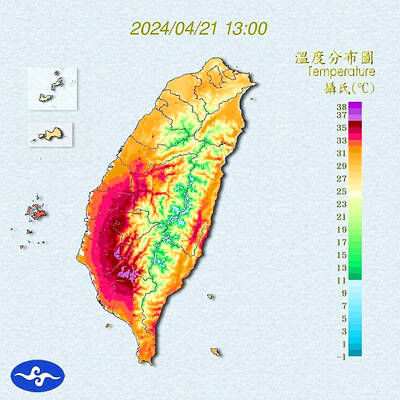
Heat advisories were in effect for nine administrative regions yesterday afternoon as warm southwesterly winds pushed temperatures above 38°C in parts of southern Taiwan, the Central Weather Administration (CWA) said. As of 3:30pm yesterday, Tainan’s Yujing District (玉井) had recorded the day’s highest temperature of 39.7°C, though the measurement will not be included in Taiwan’s official heat records since Yujing is an automatic rather than manually operated weather station, the CWA said. Highs recorded in other areas were 38.7°C in Kaohsiung’s Neimen District (內門), 38.2°C in Chiayi City and 38.1°C in Pingtung’s Sandimen Township (三地門), CWA data showed. The spell of scorching


 RSS
RSS