


In his academic work and his political duties, Presidential Office Deputy Secretary General Joseph Wu (吳釗燮) is constantly embroiled in international affairs and external relations. But the area of expertise he is most proud of is his cooking. Indeed, he mastered the art at some considerable personal cost.
"It was like something out of a movie about overseas students. I was studying in the US and working in a restaurant during the summer and winter vacations. I used to observe what the chef did and practice cutting vegetables in my spare time. That was how I cut off about 1cm of my left index finger," Wu recalled.
"There was blood everywhere. But as a poor student, I couldn't take any days off to recover, as I needed the money to cover tuition and living expenses. So I was back in the restaurant the next day to help out with the deep frying," he said.
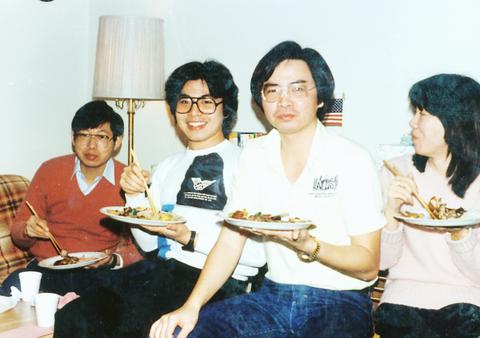
PHOTO: JOSEPH WU
Wu's experience working in a restaurant while studying for a university degree was one shared by many Taiwanese in the US and Europe during the 1970s and 1980s.
Having been brought up in a home where the kitchen was the sole preserve of women, Wu had never done any cooking before he went to Missouri in 1979 to start on a masters degree. But in order to ensure he had enough money for his second year of studies, Wu applied for work at the Yen Ching Chinese Restaurant in May 1980.
"Although it was supposedly a northern Chinese restaurant, the owners and most of the chefs were either from Taiwan or Hong Kong," Wu said. "And in order to cater to the tastes of local Chinese, many of whom were immigrants or students from Taiwan, there were plenty of southern seafood dishes on the menu, so what it offered was actually mixed cuisine."
Wu began by working as a dish-washer, but he also chopped vegetables, cleaned the food and handled deep-fried foods. The menial work stimulated his curiosity about the culinary arts, so he watched the chefs as they worked -- how they selected ingredients, how they prepared and cooked them. He would then put himself to the test in the restaurant.
"In the end I was authorized to prepare meals for all the staff," Wu said. "The chefs, seeing how eager I was to learn how to cook, would sometimes give me tips."
Within a few years, Wu's cooking skills enabled him to stand in for chefs during the lunch shift.
While he was not given the chance to become a full-time chef, he was already pursuing a niche of his own, having discovered that the actual cooking was secondary to the creation of special sauces. Chefs, he said, were happy enough to show one how to cook a dish, but they were seldom willing to teach one how to make the sauce.
"They would do this during their break between lunchtime and dinner, and when finished, they would put the ingredients back into different places, or remove the labels from the bottles or even throw the empty bottles outside the restaurant so no one could find out what they had used," Wu said.
Wu worked in restaurants for nine years. He recalled working through a St. Louis summer when the temperature in the kitchen hit 46?C -- and often working in the kitchen from 10am until 9pm.
"Taiwanese are able to cope with hardship better than other people," Wu said. "So we can deal with such rigorous training. I even came to like cooking."
"By 1983, when I went to Ohio to study for my doctorate, I could already cook a meal for other Tai-wanese students, who often gathered at my place for a meal over the weekends," he said.
Wu also put together a student cookbook featuring dishes that took only 10 minutes to prepare and used simple ingredients from the supermarket.
"There were 30 dishes in the cookbook, including steamed fish, grilled chicken, Ma Po tofu and even sour-and-spicy soup," Wu said.
"It's very easy to make all these dishes," he said, "but the tips in my cookbook helped not only to make quick dishes but also save money."
In 1989, Wu completed his studies and returned to Taiwan. The following Lunar New Year holiday, when he returned to his family home in Changhua County, he herded all his female relatives out of the kitchen and prepared a full Lunar New Year banquet. The meal was a great success and the women all wanted to know how he had managed to create such good food.
"It was the only time I was allowed to cook for Lunar New Year. Everyone else had nothing to do because I was doing all the work," Wu said. "My aunts felt embarrassed since their cooking wasn't as good as mine. So now I am only the consultant."
Although Wu hasn't been active in the kitchen for many years now, he still gets excited talking about his cooking experiences. While many people envy his talent, he still remembers the learning process which cost him a piece of a finger.
"Now I talk about these things like they are all good memories, but at that time it was a nightmare," Wu said. "When the restaurant was full, we were so busy and stressed out. But I am proud that I was able to deal with the pressure."
"In 1995 when I visited the US for a conference, I returned to St. Louis and the Yen Ching Chinese restaurant. Business was better than ever but Chef Lin who had trained me had left and opened his own establishment," Wu said.
"Recalling those experiences is like having wonderful dreams. However, the real feeling of being in a hectic kitchen was a nightmare," he said.
"Whenever I feel a lot of pressure from work, I often dream of those busy days at the Yen Ching and wake up in a cold sweat," he said.
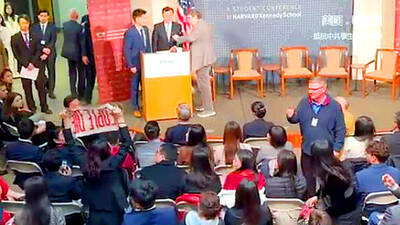
A group of Taiwanese-American and Tibetan-American students at Harvard University on Saturday disrupted Chinese Ambassador to the US Xie Feng’s (謝鋒) speech at the school, accusing him of being responsible for numerous human rights violations. Four students — two Taiwanese Americans and two from Tibet — held up banners inside a conference hall where Xie was delivering a speech at the opening ceremony of the Harvard Kennedy School China Conference 2024. In a video clip provided by the Coalition of Students Resisting the CCP (Chinese Communist Party), Taiwanese-American Cosette Wu (吳亭樺) and Tibetan-American Tsering Yangchen are seen holding banners that together read:

UNAWARE: Many people sit for long hours every day and eat unhealthy foods, putting them at greater risk of developing one of the ‘three highs,’ an expert said More than 30 percent of adults aged 40 or older who underwent a government-funded health exam were unaware they had at least one of the “three highs” — high blood pressure, high blood lipids or high blood sugar, the Health Promotion Administration (HPA) said yesterday. Among adults aged 40 or older who said they did not have any of the “three highs” before taking the health exam, more than 30 percent were found to have at least one of them, Adult Preventive Health Examination Service data from 2022 showed. People with long-term medical conditions such as hypertension or diabetes usually do not
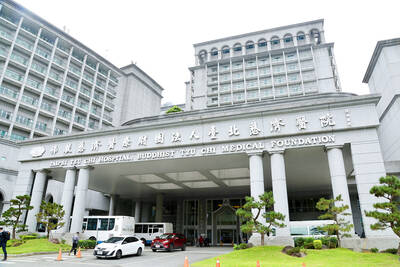
POLICE INVESTIGATING: A man said he quit his job as a nurse at Taipei Tzu Chi Hospital as he had been ‘disgusted’ by the behavior of his colleagues A man yesterday morning wrote online that he had witnessed nurses taking photographs and touching anesthetized patients inappropriately in Taipei Tzu Chi Hospital’s operating theaters. The man surnamed Huang (黃) wrote on the Professional Technology Temple bulletin board that during his six-month stint as a nurse at the hospital, he had seen nurses taking pictures of patients, including of their private parts, after they were anesthetized. Some nurses had also touched patients inappropriately and children were among those photographed, he said. Huang said this “disgusted” him “so much” that “he felt the need to reveal these unethical acts in the operating theater
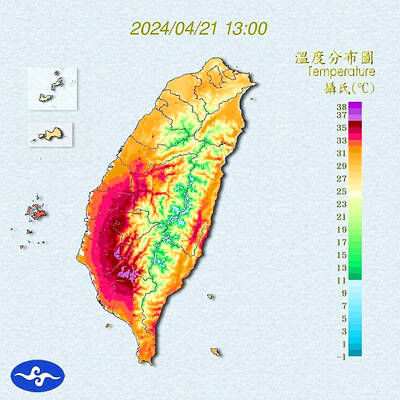
Heat advisories were in effect for nine administrative regions yesterday afternoon as warm southwesterly winds pushed temperatures above 38°C in parts of southern Taiwan, the Central Weather Administration (CWA) said. As of 3:30pm yesterday, Tainan’s Yujing District (玉井) had recorded the day’s highest temperature of 39.7°C, though the measurement will not be included in Taiwan’s official heat records since Yujing is an automatic rather than manually operated weather station, the CWA said. Highs recorded in other areas were 38.7°C in Kaohsiung’s Neimen District (內門), 38.2°C in Chiayi City and 38.1°C in Pingtung’s Sandimen Township (三地門), CWA data showed. The spell of scorching


 RSS
RSS