


Some of the French-built Mirage 2000-5 fighter planes have acquired the ability to counter cruise missiles after of a radar upgrade program provided by the French was completed, defense sources said yesterday.
The radar upgrade program is focused on enhancing the planes' target identification and targeting capabilities.
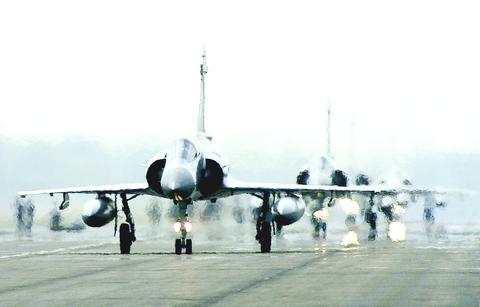
PHOTO: AP
The upgraded radar can lock on a cruise missile at very low altitudes. A cruise missile can be destroyed by any of the air-to-air missiles carried by the Mirages.
Only a few Mirage 2000-5 pilots have received relevant training to qualify for the operation of new counter-cruise missile functions.
Some Mirage 2000-5s have also been equipped with a new ASTAC ELINT electromagnetic emissions detection pod.
The pod can help the Mirage 2000-5s collect data about electromagnetic signals from China, which can contribute to the air force's establishment of a data base about the enemy's electronic operations.
Meanwhile, the air force yesterday opened its Hsinchu base to the press, which is home to the 57 Mirage 2000-5s, to demonstrate the combat readiness of the Mirage combat wing.
Major General Liu Cheng-wu (
Chinese fighter planes started flying into the Strait three years ago after then-president Lee Teng-hui (
A high-ranking air force official, who spoke in private, said it seems that China wanted to retaliate against Lee's "state-to-state" remark.
"China also wanted to test its new fighter planes. In the past, they were no match for ours. We were thus able to send fighter planes to spy on China on a regular basis," the official said.
"In recent years, they have greatly advanced in air strength. Their new fighter planes pose an increasing threat to us," he said.
"They send fighter planes into the Strait partly to test the air defense radars of Taiwan and to collect data about these radars. They have now made it a regular practice."

The Centers for Disease Control (CDC) yesterday reported the first case of a new COVID-19 subvariant — BA.3.2 — in a 10-year-old Singaporean girl who had a fever upon arrival in Taiwan and tested positive for the disease. The girl left Taiwan on March 20 and the case did not have a direct impact on the local community, it said. The WHO added the BA.3.2 strain to its list of Variants Under Monitoring in December last year, but this was the first imported case of the COVID-19 variant in Taiwan, CDC Deputy Director-General Lin Ming-cheng (林明誠) said. The girl arrived in Taiwan on

South Korea is planning to revise its controversial electronic arrival card, a step Taiwanese officials said prompted them to hold off on planned retaliatory measures, a South Korean media report said yesterday. A Yonhap News Agency report said that the South Korean Ministry of Foreign Affairs is planning to remove the “previous departure place” and “next destination” fields from its e-arrival card system. The plan, reached after interagency consultations, is under review and aims to simplify entry procedures and align the electronic form with the paper version, a South Korean ministry official said. The fields — which appeared only on the electronic form

A bipartisan group of US senators has introduced a bill to enhance cooperation with Taiwan on drone development and to reduce reliance on supply chains linked to China. The proposed Blue Skies for Taiwan Act of 2026 was introduced by Republican US senators Ted Cruz and John Curtis, and Democratic US senators Jeff Merkley and Andy Kim. The legislation seeks to ease constraints on Taiwan-US cooperation in uncrewed aerial systems (UAS), including dependence on China-sourced components, limited access to capital and regulatory barriers under US export controls, a news release issued by Cruz on Wednesday said. The bill would establish a "Blue UAS

The Ministry of Foreign Affairs (MOFA) is suspending retaliation measures against South Korea that were set to take effect tomorrow, after Seoul said it is updating its e-arrival system, MOFA said today. The measures were to be a new round of retaliation after Taiwan on March 1 changed South Korea's designation on government-issued alien resident certificates held by South Korean nationals to "South Korea” from the "Republic of Korea," the country’s official name. The move came after months of protests to Seoul over its listing of Taiwan as "China (Taiwan)" in dropdown menus on its new online immigration entry system. MOFA last week


 RSS
RSS