


One year after restoration work began on the 100-year-old Taipei Guest House, built during the Japanese occupation, architects and restoration experts have made an unexpected discovery -- Victorian-era tiles
"These Victorian-style glazed tiles were believed to be imported by the Japanese from England more than 100 years ago," architect Hsu Yu-chien (
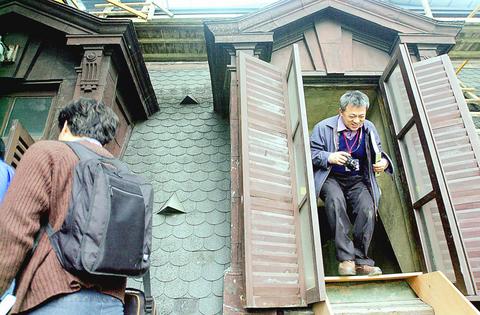
PHOTO: GEORGE TSORNG, TAIPEI TIMES
The subsequent addition of carpets and adhesive glues to the floor had disguised the tiles for decades until restoration work at the historic site, which began in September of last year, uncovered the European tiles.
Hsu, who was in charge of the restoration work at the site, has sent the uncovered tiles to INAX Corporation, a Japanese manufacturer of tiles and wares established in 1924, for further examination.
"The manufacturer said that the Victorian-style tiles are not only unique in Taiwan but also in southeast Asia," Hsu said.
Countless fireplaces decorated with the then expensive marble and various tiles imported from overseas stood out as another prominent European feature of the site.
"Theoretically speaking, people in Taiwan, because the country is sub-tropical, didn't need any fireplaces. So why were there so many fireplaces here? It definitely reflected the architects' original intention to imitate the English way of life," Hsu said.
Hsu said the countless European features found in the Japanese building reflected the ambition of Japanese rulers to shake up influences in Asia while looking to Europe for inspiration.
Despite the architectural treasures found at the site, the team will face difficulties with the rest of their restoration work, Hsu said.
Improper materials added to the building before the mansion was classified as a historic site by the Ministry of Interior in 1998 have created obstacles for the architects involved.
"When we sent the samples of the mortar and coating added to the facade of the building back in 1992 to a German specialist, he asked us `How could you [Taiwanese] add such a material to a historic treasure?'" Hsu said.
Experts from Japan, Belgium and Germany have gathered at the site recently for an international seminar on how to remove the materials without damaging the underlying structure, Hsu said.
The site was originally built as the Japanese governor's residence and was used to entertain guests. Ten years later, in 1911, the building underwent a major restoration after the structure was severely damaged by termites, Hsu said.
The venue, located on Ketagalan Avenue, was given its current title in 1950 by Chiang Kai-shek's (
The property, surrounded by gardens, ponds and dense foliage, also housed foreign ministry officials before the ministry built a new building just opposite the site.
Hsu said he plans to complete the restoration report by the end of this year.
Subsequent restoration will begin early next year after the historic site committee under the interior ministry finishes reviewing the report, said Lee Fang-cheng (
The estimated cost of the restoration work, which is expected to be completed by May 2004, is around NT$300 million, Lee said.

UPGRADE: The Kang Ding-class frigate is replacing its Chaparall missiles with Tien Chien II and Hua Yang VLS, which would provide it with long-range, 360° air defense Taiwan plans to produce 1,200 to 1,376 Hai Chien II missiles (海劍二, Sea Sword II) — also known as TC-2N — to serve as the standard air defense system of the navy’s surface combatant fleet, a source said yesterday. Last week, the Hai Chien II, the naval version of the Tien Kung II missile (天劍二, Sky Sword II), completed a live-fire test in waters off the National Chungshan Institute of Science and Technology’s Jiupeng facility (九鵬) in Pingtung County’s Manjhou Township (滿州). The MIM72 Chaparral and other dated air defense missiles that currently arm Taiwanese ships have inadequate range to combat Chinese
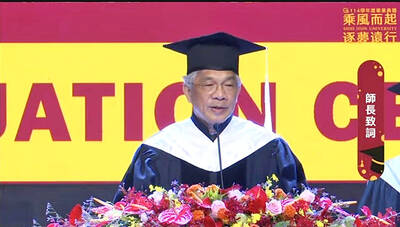
Shih Hsin University President Chen Ching-he (陳清河) yesterday issued a public apology for comments made in his commencement speech last week, stating that he has asked the school to suspend his duties and halt his wages for two months as a show of contrition. At the commencement ceremony on May 30, Chen said, “If you don’t manage your time well, or your own emotions, or your health, then I am telling every one of you — put a quick end to ‘you,’ because the world has no need for ‘you.’” The comments have sparked significant controversy online, and Chen through an open
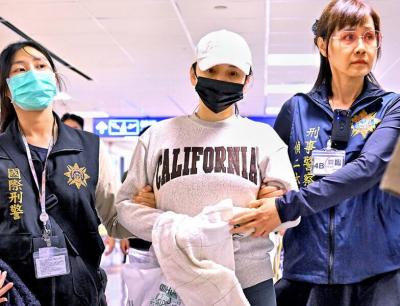
Johanne Liou (劉喬安), a Taiwanese woman who shot to unwanted fame during the Sunflower movement protests in 2014, returned to Taiwan last night after being deported from the US. She is to stand trial in Taiwan for charges involving embezzlement, fraud and drug crimes. The Criminal Investigation Bureau (CIB) said it took her into custody at Taiwan Taoyuan International Airport and would first question her before transferring her to the New Taipei District Prosecutors’ Office. She was arrested upon disembarking a flight from San Francisco that landed shortly before 7pm. Liou absconded to the US in 2019 after jumping bail

In a historic first, Taiwanese officials participated in this year’s Riga Strategic Communications Dialogue in Latvia from Wednesday to Friday last week, which debuted a breakout session focused on Taiwan The event organizer, the NATO Strategic Communications Center of Excellence, displayed Taiwan’s national flag and the officials’ formal titles on their Web site. Taiwanese attendees included National Security Council (NSC) Deputy Secretary-General Lin Fei-fan (林飛帆) and deputy head of the Taipei Representative Office in the UK, Chiang Ya-chi (江雅綺). In addition to the session discussing Taiwan titled “Taiwan: Navigating Strategic Communication in a Tense Environment,” the dialogue also included sessions


 RSS
RSS