


Kaohsiung City Mayor Frank Hsieh (
Kaohsiung officially reported the year's first confirmed case in June.
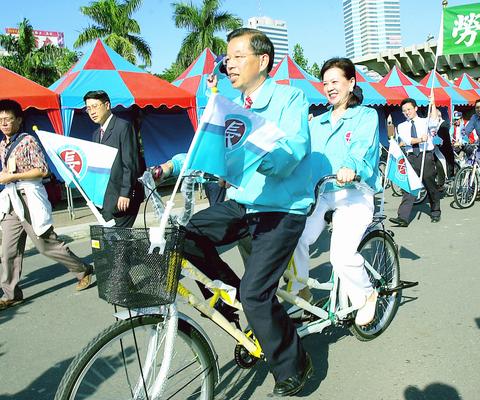
PHOTO: CHANG CHUNG-YI, TAIPEI TIMES
Even now, officials in Hsieh's camp do not think the disease will be a major issue in the campaign.
"The situation is not that bad. At present, less than 10 cases on average are reported from 463 boroughs of the city every week," Lin Yun-chien (
Lin's account, however, conflicts with Cabinet health and environmental officials' assessment of dengue in Kaohsiung.
The outbreak, the most serious in Taiwan in 14 years, is expected by health authorities weeks ago to renew the historical record in November.
According to government statistics, 4,389 Taiwanese people contracted dengue fever in 1988.
According to the Centers for Disease Control, as of Friday, 4,358 confirmed cases, including 2,234 in Kaohsiung City, Taiwan's second-largest city, have been reported.
Meanwhile, there have been 118 confirmed cases of dengue hemorrhagic fever, resulting in 13 confirmed deaths.
Dengue fever broke out in Taiwan island-wide in 1915, 1931, and 1942. The infection did not reappear until the early 80s. Symptoms of the infection, which is seldom deadly, are similar to a severe case of influenza, but dengue hemorrhagic fever is a potentially fatal complication.
This year, 98 percent of confirmed cases are from three jurisdictions in southern Taiwan. In Kaohsiung's adjacent jurisdictions, Kaohsiung County and Pingtung County, 1,799 cases and 217 cases have been reported respectively as of Friday.
To assess the disease's progress, acting head of the Department of Health (DOH), Twu Shiing-jer (涂醒哲), inspected southern Taiwan Thursday.
Twu said that the situation in Kaohsiung County was under control, while that in Kaohsiung City and Pingtung County remained troublesome.
Lin told the Taipei Times that the city government had tried its best to fight the disease by adopting strategies, including dispersing insecticides to kill mosquito larvae, publicly promoting efforts to wipe out breeding sites for mosquitoes, disinfecting empty buildings and unoccupied apartments and distributing thousands of endemic Macropodus opercularis (
According to recent government-sponsored researches, the fish preys on mosquito larvae more effectively than other fish.
Early in October, Taipei County Commissioner Su Chen-chang (
In one of Hsieh's new books, The Sun Rises in the South (
As for the disease, Hsieh attributed its spread to several factors, including higher temperatures last winter, heavy rains this year, the health department's slow confirmation process when dealing with suspected cases and the public's lack of knowledge about the disease.
Hsieh, however, said in his book that he should be responsible for the mosquito's resistance to the pesticides that the city uses.
"I admit that [the mosquitoes resistance] did delay our ability to decrease the mosquito population," Hsieh wrote.
Hsieh vowed to eradicate dengue fever within two years because he had learned a lot from past experience.
The city government announced last week that everyone must spend a half-hour before and after work every Tuesday to help wipe out breeding sites for the mosquitoes that spread dengue fever.
The spread of dengue fever in Kaohsiung frustrates Hsieh but gives ammunition to his competitors.
Independent candidate Shih Ming-teh (
Shihis not alone in this view. To highlight the mayoral incumbent's lax efforts, volunteers for independent candidate Chang Po-ya (
Friday, at a campaign activity organized for labor supporters, Chang said academic researchers suggested that the real number of dengue fever cases could be ten times the official record, implying that more than 20,000 residents were suffering from the disease.
"Shame on the city government! Kaohsiung residents' relatives who live elsewhere are reluctant to visit because of the disease," Chang said, implying that the disease had already become an obstacle to the city's development.
During an interview with the Taipei Times last week, Chang said that Hsieh had been very irresponsible because he was dodging the problem by crying foul.
"The criticism of Hsieh's failure to prevent dengue has been labeled as political ploy by Hsieh's camp. How can Kaohsiung residents benefit from this attitude?" Chang asked.
Chang, who holds a Master's degree in public health from the Johns Hopkins University, stressed that wiping out breeding grounds was crucial to eradicating mosquitoes.
"If I head the city government, every month I will organize a day of action against dengue and slow the growth of mosquito populations," Chang said.
As the number of dengue fever cases began increasing sharply during the summer, KMT candidate Huang Jun-ying (
According to Huang, the Grand Hotel sitting on the outskirts of the city lost 20 percent of its summer business and the net earnings of a popular youth hostel near Cheng Ching Lake (
"You can't deny the link between the disease and the drop inlocal tourism," Cheng Shih-shi (
Reportedly, beginning this week, the city government is not going to update the number of reported dengue fever cases.
"If so, how is the city government going to keep the public informed about the disease?" Cheng asked.
Huang said yesterday that if he heads the city government, he would establish notification systems on dengue fever soon to keep the public informed.

REPORT: Taipei has expressed an interest in obtaining loitering munitions matching the AeroVironment Switchblade 300 or the Anduril Altius-600, ‘Foreign Policy’ said Taiwan is seeking US-made kamikaze drones in an apparent concession to pressure from Washington to focus on asymmetric capabilities to defeat or deter a Chinese attack, Foreign Policy said in a report on Wednesday. Taipei has expressed an interest in obtaining AeroVironment Switchblade loitering munitions or other devices with similar capabilities, it said, citing four sources familiar with the matter commenting on condition of anonymity. The Switchblade 300 is a tube-launched drone designed for attacking ground troops, while its larger sibling, the Switchblade 600, could be used to destroy tanks and entrenched troops. Ukraine has utilized both systems extensively in its fight against

Police officers yesterday morning apprehended the prime suspect of a triple homicide case, after raiding the suspect’s hideout in Taichung. They transported the suspect to New Taipei City for questioning and recorded his statement last night. The suspect, identified as a 24-year-old man surnamed Chang (張), is believed to have used his hands to strangle his wife, surnamed Chen (陳), 29, along with his three-year-old son from a previous marriage and his wife’s mother, 69. The three dead bodies were wrapped in blankets when they were discovered inside their apartment in New Taipei City’s Sanchong District (三重) on Saturday. Chang was holding a

Hungarian Member of Parliament Tompos Marton said he considers Taiwan to be a better alternative to China as a strategic partner. Marton, who is the vice president of the opposition Momentum Party, made the remarks in an interview with the Central News Agency on Sunday. He draped a Republic of China flag across his shoulders to protest Chinese President Xi Jinping’s (習近平) visit to the capital city, Budapest, on Thursday last week, and openly voiced support for Taiwan on social media. He said in the interview that he wanted to remind the world that there were alternatives to China, and that “Taiwan has

A female physician at New Taipei City’s Shuang Ho Hospital was bullied and made to work for 32 consecutive hours by a senior colleague while pregnant before later having a miscarriage, an internal investigation found, the hospital said on Monday. The perpetrator has been removed from his post, the hospital said. The attending physician in the hospital’s Medical Imaging Department, identified by the pseudonym Y, earlier on Monday told reporters that she had been bullied by a male senior colleague who arranged shifts in her department. In January, shortly after she became pregnant, Y asked the department director if she could avoid overnight


 RSS
RSS