


Legislators will make a final decision today on whether to approve a controversial budget item for the Environmental Protection Administration (EPA).
If lawmakers delete the budget for building incinerators, the EPA fears that garbage crises will occur in several counties next year.
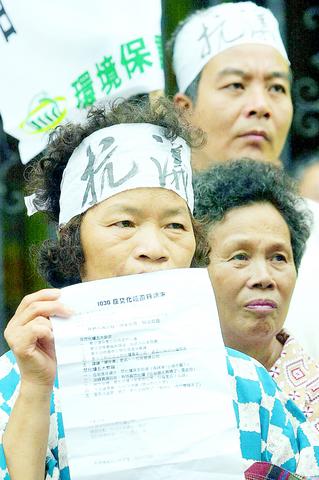
PHOTO: CHIANG YING-YING, TAIPEI TIMES
At a budget review meeting at the Legislative Yuan yesterday, EPA Administrator Hau Lung-bin (郝龍斌) expressed those fears when lawmakers raised questions pertaining to his agency's burn-oriented waste management policy.
Some legislators said that the EPA is inappropriately spending NT$3.7 billion of its budget -- which accounts for 40.5 percent of its total budget for the 2003 fiscal year -- because its burn-oriented waste management policy is a mistake.
Su Chih-fen (蘇治芬), a DPP legislator from Yunlin County, showed slides at the meeting to back his accusation that the EPA failed to operate incinerators appropriately. He also accused the EPA of mishandling the fly ash and bottom ash collected from such plants.
Environmental officials said, however, that the budget for building incinerators is necessary. According to Hau, about 10 counties and cities currently rely on landfills due to the lack of large waste incinerators. If the planned incinerators cannot be built, garbage crises in those counties would be unavoidable, he said.
On Tuesday, one day after environmentalists urged lawmakers to turn down the EPA budget proposal, several local authorities stressed their firm stance on the need to build new incinerators. These included authorities from Taipei, Hualien, Nantou and Penghu counties.
"Many local governments want to build their own incinerators because local councils always oppose collaborative cross-border transfer of waste," Hau said.
Hau said that the Hsinchu City Government would like to burn waste from its neighbor, Hsinchu Count,; but the plan to do so was turned down by the city council. Similar situations exists in other places, Hau said.
Outside the Legislative Yuan hundreds of residents from Hsinchu County expressed their anger over a proposal to build a new incinerator in Chupei (竹北). Protesters said that a planned incinerator there would be a waste because there was already an incinerator nearby.
Participants in the "1030 Anti-incinerator Demonstration," which was carried out by 102 environmental groups from across the nation, has several demands. These included an immediate halt to incinerator projects already under construction, that Hau be fired and replaced, that a national environmental conference be convened, and that there be a comprehensive investigation into the scandals pertaining to incinerators.
"If the ironic policy is left over from the former KMT-led government, EPA head Hau should reverse it with courage," said Lin Wei-chou (林為洲), a Hsinchu County councilor and leader the demonstration.
On the basis of the EPA's original estimates in the 1990s, Taiwan's 36 incinerators would have been capable of burning 30,400 tonnes of municipal solid waste per day by the end of next year. In March, the EPA canceled four incinerator projects, reducing the total capacity for treating waste by 3,250 tonnes per day.
Last year, residents generated 19,886 tonnes of household waste per day, which was less than the capacity -- 21,000 tonnes -- of 19 operational waste incinerators.

A group of Taiwanese-American and Tibetan-American students at Harvard University on Saturday disrupted Chinese Ambassador to the US Xie Feng’s (謝鋒) speech at the school, accusing him of being responsible for numerous human rights violations. Four students — two Taiwanese Americans and two from Tibet — held up banners inside a conference hall where Xie was delivering a speech at the opening ceremony of the Harvard Kennedy School China Conference 2024. In a video clip provided by the Coalition of Students Resisting the CCP (Chinese Communist Party), Taiwanese-American Cosette Wu (吳亭樺) and Tibetan-American Tsering Yangchen are seen holding banners that together read:

UNAWARE: Many people sit for long hours every day and eat unhealthy foods, putting them at greater risk of developing one of the ‘three highs,’ an expert said More than 30 percent of adults aged 40 or older who underwent a government-funded health exam were unaware they had at least one of the “three highs” — high blood pressure, high blood lipids or high blood sugar, the Health Promotion Administration (HPA) said yesterday. Among adults aged 40 or older who said they did not have any of the “three highs” before taking the health exam, more than 30 percent were found to have at least one of them, Adult Preventive Health Examination Service data from 2022 showed. People with long-term medical conditions such as hypertension or diabetes usually do not
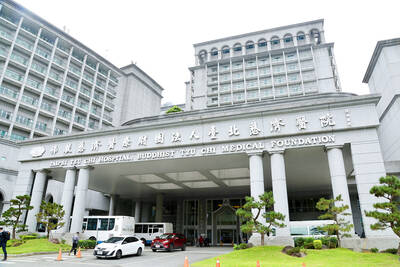
POLICE INVESTIGATING: A man said he quit his job as a nurse at Taipei Tzu Chi Hospital as he had been ‘disgusted’ by the behavior of his colleagues A man yesterday morning wrote online that he had witnessed nurses taking photographs and touching anesthetized patients inappropriately in Taipei Tzu Chi Hospital’s operating theaters. The man surnamed Huang (黃) wrote on the Professional Technology Temple bulletin board that during his six-month stint as a nurse at the hospital, he had seen nurses taking pictures of patients, including of their private parts, after they were anesthetized. Some nurses had also touched patients inappropriately and children were among those photographed, he said. Huang said this “disgusted” him “so much” that “he felt the need to reveal these unethical acts in the operating theater
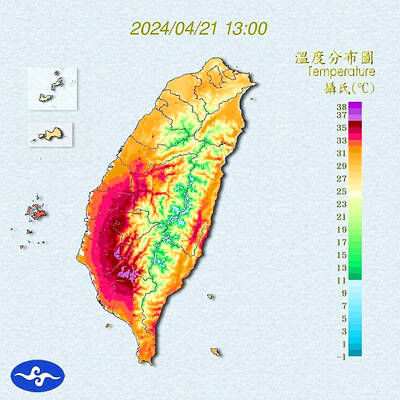
Heat advisories were in effect for nine administrative regions yesterday afternoon as warm southwesterly winds pushed temperatures above 38°C in parts of southern Taiwan, the Central Weather Administration (CWA) said. As of 3:30pm yesterday, Tainan’s Yujing District (玉井) had recorded the day’s highest temperature of 39.7°C, though the measurement will not be included in Taiwan’s official heat records since Yujing is an automatic rather than manually operated weather station, the CWA said. Highs recorded in other areas were 38.7°C in Kaohsiung’s Neimen District (內門), 38.2°C in Chiayi City and 38.1°C in Pingtung’s Sandimen Township (三地門), CWA data showed. The spell of scorching


 RSS
RSS