


Transfers of nuclear technologies from advanced countries to Asian countries should be terminated in order to promote world peace, former DPP chairman Lin I-hsiung (林義雄) said yesterday as the 10th No Nuke Asia Forum opened in Taipei.
When making his opening remarks at the forum, Lin said that governments in favor of nuclear power together with the nuclear industry are pursuing great profits by risking people's lives. In doing so, they were taking advantage of Asian people's ignorance about the dangers of running nuclear power plants, Lin said.
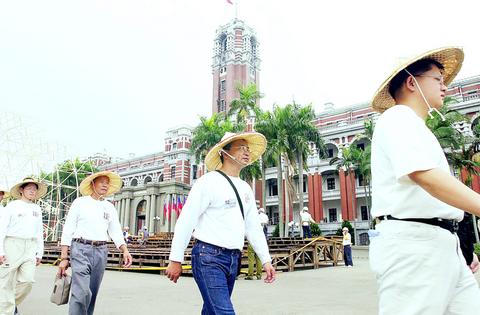
PHOTO: LIAO RAY-SHANG, TAIPEI TIMESN
After the1986 Chernobyl nuclear disaster, developed countries froze new projects for building nuclear power plants. The nuclear industry, facing financial difficulties, thus turned to Asia to look for new markets, Lin said.
But building a nuclear power plant in one's own country was actually like building an unexploded nuclear bomb, Lin charged.
"If the US keeps exporting its nuclear technologies without concern for local peoples' lives, it has no right to condemn those terrorist attacks against it," Lin said.
Similarly, Japan's memorials to the atomic bomb victims of Hiroshima and Nagasaki look ironic as it continues exporting its nuclear technologies, Lin said.
Since Sept. 21, Lin and local anti-nuclear activists have been carrying out a planned year-long protest to call for a referendum on nuclear power. By the year 2004, they want a plebiscite in which the people of Taiwan can decide the future of the Fourth Nuclear Power Plant.
Local anti-nuclear activists, who persistently resist the establishment of the plant, have argued for years that Taiwan, like many other countries, is the victim of the multinational corporations' search for new markets.
The nuclear reactors and power generators of the controversial plant are designed by the US-based General Electric, but are actually built by Japanese firms Hitachi and Toshiba.
According to Japanese activists attending the forum, the two Japanese companies have been implicated in a recent scandal pertaining to coverups carried out by various power utilities, including the Tokyo Electric Power Company (TEPCO).
"We do hope that Taiwanese people can also learn lessons from the scandal," Hideyuki Ban (伴英幸), secretary-general of the Japan-based Citizens' Nuclear Information Center, told the Taipei Times.
Since the Japanese scandal was exposed late last months, the close links between state-run Taiwan Power Company (Taipower) and TEPCO has worried Taiwanese anti-nuclear activists.
"The excuse pertaining to Japan's excellence at operating nuclear power plants, which was used by Taipower to persuade the public into accepting nuclear power, does not exist," said Lai Wei-chieh (
DPP Legislator Lai Chin-lin (賴勁麟) told the Taipei Times that he would soon be working with other lawmakers to demand a full explanation from Taipower.
He wants to know not only about Taipower's relationship with TEPCO, but also what impact the scandal has made on the quality of the new nuclear reactors which are now being installed in Taiwan.
If necessary, Lai said, lawmakers would try to discuss with the Cabinet the possibility of halting construction of the plan until it gets full answers from Taipower.
"Ensuring nuclear safety is more important than meeting the deadline," Lai said.
The controversial nuclear plant, located in Kungliao township (貢寮) of Taipei County, is scheduled to open on July 1, 2006.
Minister Without Portfolio Yeh Jiunn-rong (葉俊榮) told the Taipei Times that the impact being made on Taiwan by the Japanese scandal deserved further investigation.
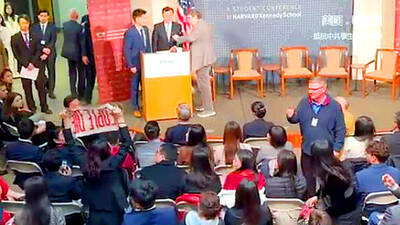
A group of Taiwanese-American and Tibetan-American students at Harvard University on Saturday disrupted Chinese Ambassador to the US Xie Feng’s (謝鋒) speech at the school, accusing him of being responsible for numerous human rights violations. Four students — two Taiwanese Americans and two from Tibet — held up banners inside a conference hall where Xie was delivering a speech at the opening ceremony of the Harvard Kennedy School China Conference 2024. In a video clip provided by the Coalition of Students Resisting the CCP (Chinese Communist Party), Taiwanese-American Cosette Wu (吳亭樺) and Tibetan-American Tsering Yangchen are seen holding banners that together read:

UNAWARE: Many people sit for long hours every day and eat unhealthy foods, putting them at greater risk of developing one of the ‘three highs,’ an expert said More than 30 percent of adults aged 40 or older who underwent a government-funded health exam were unaware they had at least one of the “three highs” — high blood pressure, high blood lipids or high blood sugar, the Health Promotion Administration (HPA) said yesterday. Among adults aged 40 or older who said they did not have any of the “three highs” before taking the health exam, more than 30 percent were found to have at least one of them, Adult Preventive Health Examination Service data from 2022 showed. People with long-term medical conditions such as hypertension or diabetes usually do not
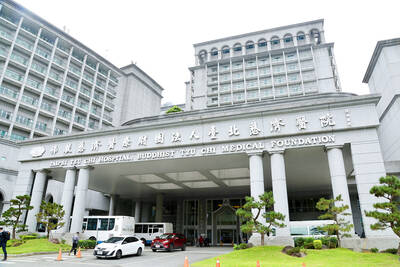
POLICE INVESTIGATING: A man said he quit his job as a nurse at Taipei Tzu Chi Hospital as he had been ‘disgusted’ by the behavior of his colleagues A man yesterday morning wrote online that he had witnessed nurses taking photographs and touching anesthetized patients inappropriately in Taipei Tzu Chi Hospital’s operating theaters. The man surnamed Huang (黃) wrote on the Professional Technology Temple bulletin board that during his six-month stint as a nurse at the hospital, he had seen nurses taking pictures of patients, including of their private parts, after they were anesthetized. Some nurses had also touched patients inappropriately and children were among those photographed, he said. Huang said this “disgusted” him “so much” that “he felt the need to reveal these unethical acts in the operating theater
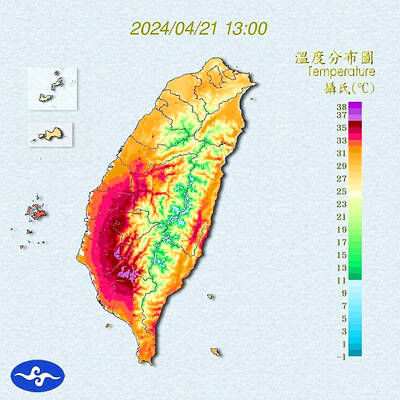
Heat advisories were in effect for nine administrative regions yesterday afternoon as warm southwesterly winds pushed temperatures above 38°C in parts of southern Taiwan, the Central Weather Administration (CWA) said. As of 3:30pm yesterday, Tainan’s Yujing District (玉井) had recorded the day’s highest temperature of 39.7°C, though the measurement will not be included in Taiwan’s official heat records since Yujing is an automatic rather than manually operated weather station, the CWA said. Highs recorded in other areas were 38.7°C in Kaohsiung’s Neimen District (內門), 38.2°C in Chiayi City and 38.1°C in Pingtung’s Sandimen Township (三地門), CWA data showed. The spell of scorching


 RSS
RSS