


Two DPP lawmakers yesterday urged the government to investigate a fee arrangement for a Taipei City recreation center between the Cabinet-level Overseas Chinese Affairs Commission and the KMT- affiliated China Youth Corps (CYC).
DPP lawmakers Lee Chen-nan (
Lee said that over the years the Cabinet-level Overseas Chinese Affairs Commission has undercharged the China Youth Corps while allowing the group to use the Youth Recreation Center in Shihlin.
He accused the commission of playing a prodigal son at the expense of state coffers and prodded the government to terminate the arrangement as part of the effort to probe the legality of KMT assets.
Lee said the commission should have determined its rate by referring to the current land values and the buildings on the site as required by a 1995 land rule.
"But the commission has ignored the regulation and collected its fees based on the worth of the buildings alone," he said. "The commission should take a tougher stand on the matter now that the KMT is no longer in power."
The Cabinet approved the construction of the center in 1978 after then-commission officials complained about a lack of facilities to entertain overseas youth.
The Taipei City Government, the National Property Bureau and the railway bureau own different parts of the land, according to commission official Wang Chen-tai (
"The figure is always calculated according to a set formula," Wang said, adding that the commission owns only two-thirds of the center's new buildings.
The China Youth Corps, formerly a KMT propaganda arm, has added three new buildings to the original establishment. Currently, the youth group has to pay the commission NT$7.8 million a year, a sum CYC official Chen Kuo-yi (陳國義) said is not extraordinarily low.
In recent years, the group has become increasingly independent. Its board members have rejected candidates favored by the KMT headquarters for their leadership positions. Jeanne Tchong-koei Li (
But DPP lawmaker Tsai Chi-fang insisted that the money paid to the Cabinet commission is unduly modest, noting that its Peitou club earns the agency an annual income of NT$40 million. A 1999 pact stipulates that the sum the CYC pays the commission must not be less than N$7.7 million a year.
"I find it more advisable for the private sector to manage the youth recreation center," Tsai told reporters. "I don't see what is keeping the commission from doing that." The lawmaker called on the government to take his advice into consideration when proposing legislation.
Earlier, the Cabinet introduced two bills aimed at regulating political parties and allowing authorities to take action against properties illegally acquired by any party.

FUKUOKA SITUATION: Japanese media reported that the pathogen is expected to be identified by the summer, while the CDC downplayed the idea that it was hMPV A “mysterious cold-like illness” reported in Japan’s Fukuoka Prefecture does not seem to be a new disease, but Japanese authorities have been asked about the situation, the Centers for Disease Control (CDC) said yesterday. The Fukuoka Prefectural Medical Association on Wednesday told a news conference that a “mystery cold” that has become a hot topic on social media is “highly likely to be caused by some kind of viral infection,” Japan’s KBC News reported. “Many people are experiencing symptoms starting with a sore throat, followed by a runny nose, phlegm and a severe cough,” KBC News reported, citing association officials. Health authorities are

Nvidia Corp CEO Jensen Huang (黃仁勳) arrived in Taiwan yesterday ahead of upcoming AI and technology events, saying he plans to meet with clients and Taiwan Semiconductor Manufacturing Co Chairman C.C. Wei (魏哲家) during his visit. After landing at Taipei Songshan Airport, Huang posed for photos with fans and handed out Yakult drinks to reporters and supporters waiting at the scene, saying he has “a lot to do” during the trip. Asked about reports that Nvidia’s planned headquarters site in Taipei’s Beitou Shilin Technology Park could break ground on May 27, Huang said that if the company holds an event, he would

The Ministry of Finance this afternoon announced the winning numbers for the March-April uniform invoice lottery. The winning number for the NT$10 million (US$318,060) special prize is 19531471, and the winning number for the NT$2 million grand prize is 85941329. Three numbers were drawn for the NT$200,000 first prize: 07225810, 20231230 and 83518781. Those with receipts matching the last seven digits of any of the first-prize numbers will win the NT$40,000 second prize, while those matching the last six digits will win the NT$10,000 third prize. Those whose receipts match the last five digits of the first-prize numbers can claim the NT$4,000 fourth prize,
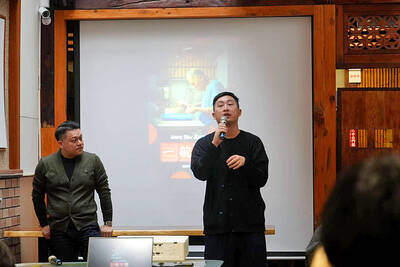
Taiwan Travelogue (臺灣漫遊錄), which earlier this week became the first Taiwanese novel to win the International Booker Prize, is to be adapted into a television series through a Taiwan-Japan coproduction, producer Chang Chen-yu (張辰漁) said yesterday. Chang, a producer at World Softest Production Film Co, wrote on Facebook that the company had been searching for projects with international appeal that retain a strong Taiwanese identity after colleagues and Japanese partners strongly recommended the novel. After reading the book, Chang said he immediately decided to pursue the screen rights. “A great story has the power to transcend time and borders, and connect countless people,”


 RSS
RSS