


Once famous for his exploits on the basketball court, PFP Legislator Cheng Chih-lung (鄭志龍) is now making headlines for his increasingly public love life.
On July 24, his wife, Lu Tsu-ying (
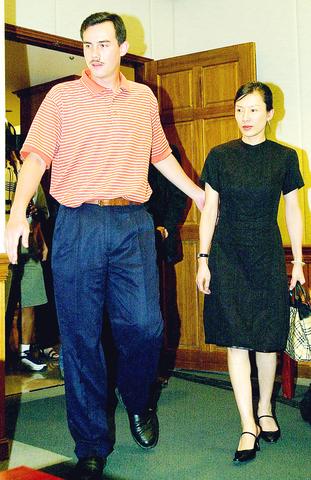
TAIPEI TIMES FILE PHOTO
"Ah-lung and I worked very hard to manage our marriage and family, because we didn't want our children to walk down the same road that we've been through before. I feel very sad and helpless now that things are going against our wishes," Lu said in the letter.
Lu later relented, after Cheng begged for her forgiveness, and decided to give her husband another chance for the sake of their children.
Previous infidelity
Cheng is reported to have had four previous affairs, and a family friend said the onus is on the former basketball star to hold his 12-year-old marriage together.
"It is now up to Cheng to decide whether the acrimony in his marriage will end," said PFP Legislator Liu Wen-hsiung (
Cheng, 33, was already a popular idol for many Taiwanese teenagers, especially his female fans, when he joined the national basketball team at the age of 17.
But despite the attention, Cheng said he fell in love with Lu the first time he met her at a pub 12 years ago.
Lu was initially cautious about getting involved with Cheng because of his flamboyant love life, but changed her mind when she got to know his family background.
Broken families
"Just like Ah-lung, I've never met my father and know nothing about him. The feeling of [growing up] without a father narrowed the distance between myself and Ah-lung," Lu said in the preface of Cheng's biography published in 1996.
Cheng's father is from the US, while his mother is an aborigine from the Ami tribe. The two met in Taiwan but never married, and his father returned to the US before Cheng was born.
In the biography, Cheng vowed to put his past behind him to give his own children a traditional family upbringing.
"The past is not important to me any more now that I have my own family. The most important thing is to take good care of my family and give my two sons complete love," Cheng says.
But temptation has continued to hound Cheng, even after his marriage.
Lu recalls in his biography's preface an occasion when she went to watch her husband play basketball in Panchiao, Taipei County.
"When we were walking hand in hand out of the stadium after the game, a beautiful, long-haired girl blocked our way and said: `Come, Ah-lung, let's go have afternoon tea together,'" Lu said.
Temptation
Before the alleged affair with May Chin, Cheng is reported to have succumbed to temptation several times.
The last time was four years ago, when Cheng reportedly lived with a female fan in Tamshui, Taipei County, prompting Lu to threaten Cheng with separation.
She later forgave Cheng, following mediation by their friends, and did not use the media to make her dissatisfaction known.
But her recent attempt to bring her husband's indiscretions into the open suggests Cheng has few chances left to save his marriage.
Over the past two weeks, Cheng has tried to mend the relationship with his wife and has gone on an overseas trip with his family.
"What the couple needs the most is the support of the public," Liu said.
"We should give a man who is able to correct his mistakes and a brave woman a chance to regain peace and happiness in their family."

The Ministry of Finance this afternoon announced the winning numbers for the March-April uniform invoice lottery. The winning number for the NT$10 million (US$318,060) special prize is 19531471, and the winning number for the NT$2 million grand prize is 85941329. Three numbers were drawn for the NT$200,000 first prize: 07225810, 20231230 and 83518781. Those with receipts matching the last seven digits of any of the first-prize numbers will win the NT$40,000 second prize, while those matching the last six digits will win the NT$10,000 third prize. Those whose receipts match the last five digits of the first-prize numbers can claim the NT$4,000 fourth prize,

SIX SUBSIDIES: The monthly allowance for older farmers is to increase to NT$10,000, and NT$5,000 is to be given to homemakers under the national pension system, Lai said The government is to implement major welfare policies for disadvantaged groups, including raising the monthly allowance for older farmers to NT$10,000 and providing homemakers with NT$5,000 per month, President William Lai (賴清德) said yesterday. Lai made the remarks during a visit to Wangling Temple in Chiayi County, saying that the planned increases were being introduced amid economic growth and an increase in tax revenue. Touting a policy, in which the government plans to provide a monthly allowance of NT$5,000 for every child under the age of 18 in a bid to address Taiwan’s low birthrate, Lai said that if received for the
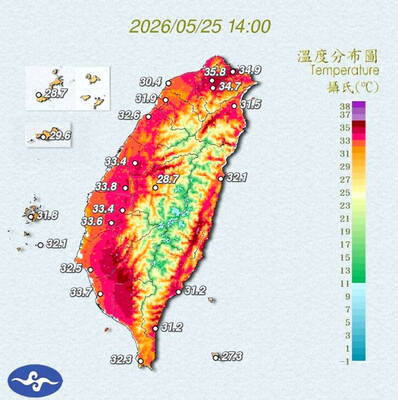
STAY COOL: The HPA recommended that people stay hydrated, use air-conditioning or fans while indoors, wear loose-fitting clothes and walk in the shade while outdoors Employers must implement measures such as installing cooling equipment, and providing drinking water and rest breaks for outdoor workers starting from Monday next week, the Taipei Department of Labor said on Sunday. Employers who fail to comply could face fines of NT$30,000 to NT$300,000 under the Occupational Safety and Health Act (職業安全衛生法), the department said. Businesses in Taipei employing fewer than 100 workers, as well as registered self-employed workers with labor insurance coverage, could receive on-site assessments and guidance from occupational safety consultants to help them apply for central government subsidies to implement or improve heat-protection measures, it said. Under the Ministry of

NATIONAL SECURITY: Authorities are working to confirm the identities of the military personnel involved and investigating possible illegal conduct and regulatory violations Authorities are probing possible national security implications after Kinmen police and immigration officers on Sunday found a Chinese woman allegedly posing as a tourist while engaging in prostitution involving more than 10 military personnel. The woman, surnamed Chen (陳), has since been deported, authorities said, adding that investigators are still working to confirm the identities of those implicated, as the records only listed code names and aliases. The case stemmed from a report received by the Kinmen District Prosecutors’ Office on Friday last week from the Jinhu Precinct of the Kinmen County Police Bureau. On Sunday, police, along with the National Immigration


 RSS
RSS