


President Chen Shui-bian (陳水扁) started acting as the DPP's new chairman yesterday by meeting with the party's staff and putting his signature to new appointments.
Senior Presidential Advisor Chang Chun-hsiung (
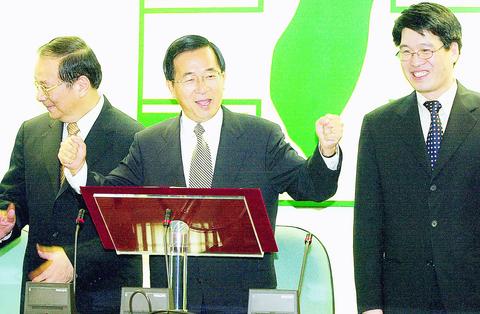
PHOTO: CHEN CHENG-CHANG, TAIPEI TIMES
The committee is comprised of 15 members. Ten are elected and five are reserved seats. The other two members who were given reserved seats are President Chen himself, and lawmaker Ker Chien-ming (柯建銘).
Calling the visit to the party's headquarters "an orientation tour," the new chairman said the party is like a big family full of energy and vitality, where every staff member is regarded as part of the same family.
"As a party chairman, I am not here to lead the people, but to follow the people.? I hope every member of the family will bring passion and creativity to their work in this free and open environment -- and work together so that we can reach our goals," Chen said.
"After I have settled into the position [of party chairman] I will be sure to continue the tradition of open-ness and liberal thinking."
The president said he knows most of the staff members chose to work for the DPP because they have great expectations for the party and hope to learn and grow by contributing to society.
Chen said he considers a well-designed training program to be the best thing for employees' morale, and he will ask the party's secretary-general to outline plans for professional training programs.
In addition to the party's staff members, most of its high-ranking officials also appeared at their headquarters to give Chen a warm welcome.
Also yesterday, Chang Chun-hsiung appointed DPP lawmaker Chen Chong-yi (陳宗義) as the director of the party's youth development department while Juan Chao-hsiung (阮昭雄), a close aide of former chairman Frank Hsieh (謝長廷), was appointed as his deputy.
Chen Chong-yi filled the vacancy that was originally earmarked for lawmaker Duan Yi-kang (段宜康), who declined from taking the post Thursday because he was reportedly upset about the fact that the party chose the deputy without consulting him.
The only DPP post that is still vacant is for the director of the party's survey center.
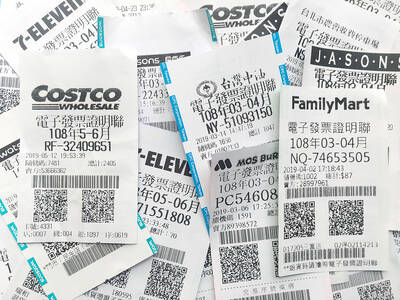
A NT$39 receipt for two bottles of tea at a FamilyMart was among the NT$10 million (US $312,969) special prize winners in the January-February uniform invoice lottery. FamilyMart said that two NT$10 million-winning receipts were issued at its stores, as well as two NT$2 million grand prizes and three NT$200,000 first prizes. The two NT$10 million receipts were issued at stores in Pingtung County and Yilan County’s Dongshan Township (冬山). One winner spent just NT$39 on two bottles of tea, while another spent NT$80 on water, tea and coffee, the company said. Meanwhile, 7-Eleven reported three NT$10 million winners — in New Taipei

Considering that most countries issue more than five denominations of banknotes, the central bank has decided to redesign all five denominations, the bank said as it prepares for the first major overhaul of the banknotes in more than 24 years. Central bank Governor Yang Chin-lung (楊金龍) is expected to report to the Legislative Yuan today on the bank’s operations and the redesign’s progress. The bank in a report sent to the legislature ahead of today’s meeting said it had commissioned a survey on the public’s preferences. Survey results showed that NT$100 and NT$1,000 banknotes are the most commonly used, while NT$200 and NT$2,000

ANNUAL EVENT: Two massive Pokemon balloons are to be set up in Daan Park, with an event zone operating from 10am to 6pm This year’s Taipei Floral Picnic is to be held at Daan Park today and tomorrow, featuring an exclusive Pokemon Go event, a themed food market, a coffee rave picnic area and stage performances, the Taipei Department of Information and Tourism said yesterday. Two massive Pokemon balloons are to be set up in the park as attractions, with an exclusive event zone operating from 10am to 6pm, it said. Participants who complete designated tasks on-site would have a chance to receive limited-edition souvenirs, it added. People could also try the newly launched game Pokemon Pokopia in the trial area, the department said. Three PokeStops are
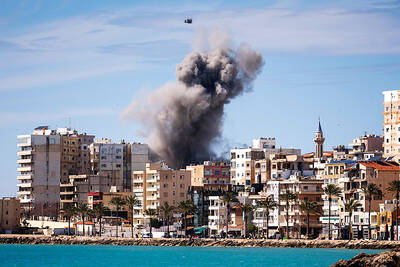
Taiwan is concerned that China could exploit the US’ war in the Middle East, with state media citing examples from the conflict to cast doubt on the efficiency of US weapons Taiwan would use to repel an invasion. Taiwanese officials said the resumption of Beijing’s large-scale air force incursions near Taiwan after an unusual decline show that China wants to take advantage of the redeployment of US forces from East Asia to the Middle East. “This is a moment for China to exercise influence,” a senior Taiwanese security official said, speaking on condition of anonymity. “What China is trying to create is a


 RSS
RSS