


A blue-ribbon panel appointed by Congress has urged the George W. Bush administration to maintain a policy of "substantive military dialogue" with Taiwan to counter China's continued military buildup across the Strait.
The report warns about the possibility of a major crisis in the Taiwan Strait in the coming years and says that the US "cannot stand aside" if the situation worsens.
The 200-page report by the US-China Security Review Commission is scheduled to be released Monday. The commission was established by Congress in October 2000 to study China's military and economic policies and their implications for US policy.
"While cross-strait economic interactions have flourished since the 1990s, the two sides are locked in an uneasy standoff," the report says.
"China's political and military strategy is designed to remind US leaders of the significantly increased direct costs to America and its regional relationships should our military forces intervene to challenge Chinese interests."
Noting that the situation in the Strait will remain "volatile" in coming years, the report notes that "the real possibility that tensions could erupt into a major crisis must be factored into US policy and planning."
Key findings of the 12-member commission include: "China is enhancing its capability to carry out attacks across the Taiwan Strait with its special operations forces, air forces and navy and missile forces with little notice. It appears the Chinese buildup is designed to forestall pro-independence political movements in Taiwan and help bring about an eventual end to the island's continued separate status."
The US should "continue its current policy of substantive military dialogue with Taiwan and conduct exchanges covering issues ranging from threat analysis to doctrine, to force planning," the report says. It also calls for a greater congressional role in Taiwan policy planning and implementation.
China's military buildup across the Strait is "seriously affecting the region's balance of power," the commissioners concluded. While it would take 10 to15 years for China to successfully dominate the region, "even now at considerable cost and with substantial losses, the PLA Air Force could establish the air and sea superiority needed for a successful invasion," they say.
Other scenarios include a broad missile attack which "will have to be prosecuted until Taiwan surrenders," and a blockade to cripple Taiwan economically and isolate it internationally.
While Beijing is currently pursuing a policy of economic integration with China, this "could be supplanted by more troublesome strategies and actions in the next three to five years.
"After that time, the PLA will have sufficient military capability to pursue forceful reunification," it says.
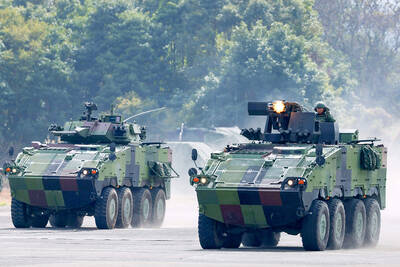
Taiwan must first strengthen its own national defense to deter a potential invasion by China as cross-strait tensions continue to rise, multiple European lawmakers said on Friday. In a media interview in Taipei marking the conclusion of an eight-member European parliamentary delegation’s six-day visit to Taiwan, the lawmakers urged Taipei to remain vigilant and increase defense spending. “All those who claim they want to protect you actually want to conquer you,” Ukrainian lawmaker Serhii Soboliev said when asked what lessons Taiwan could draw from Russia’s invasion of Ukraine. Soboliev described the Kremlin as a “new fascist Nazi regime” that justified
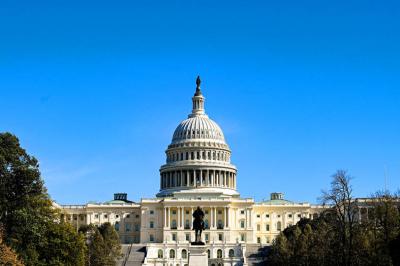
The US House of Representatives yesterday passed the PROTECT Taiwan Act, which stipulates that Washington would exclude China from participating in major global financial organizations if its actions directly threaten Taiwan’s security. The bill, proposed by Republican US Representative Frank Lucas, passed with 395 votes in favor and two against. It stipulates that if China’s actions pose any threat to Taiwan’s security, economic or social systems, the US would, “to the maximum extent practicable,” exclude China from international financial institutions, including the G20, the Bank for International Settlements and the Financial Stability Board. The bill makes it clear that China
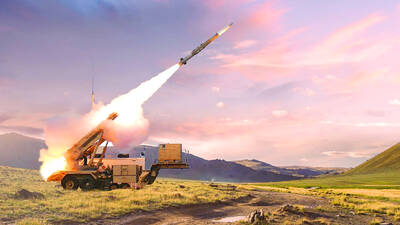
‘T-DOME’: IBCS would increase Taiwan’s defense capabilities, enabling air defense units to use data from any sensor system and cut reaction time, a defense official said A defense official yesterday said that a purported new arms sale the US is assembling for Taiwan likely includes Integrated Battle Command Systems (IBCS). The anonymous official’s comments came hours after the Financial Times (FT) reported that Washington is preparing a US$20 billion arms sale encompassing “Patriot missiles and other weapons,” citing eight sources. The Taiwanese official said the IBCS is an advanced command and control system that would play a key role in President William Lai’s (賴清德) flagship defense program, the “T-Dome,” an integrated air defense network to counter ballistic missiles and other threats. The IBCS would increase Taiwan’s

NOMINAL NEWLYWEDS: A man’s family and his wife — his long-term caregiver — are engaged in a legal dogfight over the propriety and validity of the recent union A centenarian’s marriage to his caregiver unbeknownst to his children has prompted legal action, as the caregiver accuses the man’s children of violating her personal liberty and damaging her reputation, while the children have sought a legal option to have the marriage annulled. According to sources, the 102-year-old man surnamed Wang (王) lives in Taipei’s Zhongshan District (中山) and previously worked as a land registration agent. Wang reportedly owns multiple properties and parcels of land worth several hundred million New Taiwan dollars and has ten children. His caregiver, a 69-year-old surnamed Lai (賴), has been caring for him since about 1999,


 RSS
RSS