


In 1951, at age 25, she came alone to help improve the lives of the people of Taiwan.
In 1971, when Taiwan was forced out of the UN and some people were scrambling to emigrate, she didn't think about packing up and leaving. Nor did the disastrous 921 earthquake shake her desire to help the people of Taiwan.

PHOTO COURTESY OF DORIS BROUGHAM
Now, more than 50 years after she first set foot in Taiwan, Doris Brougham is still ceaselessly pouring her time and energy into enhancing the English-language skills of the nation's populace.

PHOTO COURTESTY OF DORIS BROUGHAM
Known to her students as teacher Peng Meng-hui (彭蒙惠老師), Brougham is the founder of the nation's most popular English radio program, Studio Classroom (空中英語教室), and magazine -- Let's Talk in English (大家說英語).
Brougham's lifelong dedication to Taiwan and its people has not gone unnoticed. Earlier this month President Chen Shui-bian (
"[Studio Classroom] is an essential classic that young Tai-wanese students cannot do without when studying English," Chen said.
"For 40 years, [Studio Classroom] without doubt, has contributed a lot to advancing Taiwanese youth's global vision, as well as enhancing their English language skills."
Brougham, who was born in Seattle, originally came to Taiwan as a missionary. She said she never intended to work in media and that the success of the Studio Classroom since its establishment in 1962 was a great surprise to her.
"It all started when I thought broadcasting would be a great evangelical way to reach people," Brougham said in fluent Mandarin, recalling her time with the Aborigines in Hualien, a mountainous region in eastern Taiwan where she spent her first three years in Taiwan.
During this time, Brougham also learned to speak the Ami language spoken by the Aboriginal tribe of the same name.
"With permission from Tong Chien-kuan (
"I set up a simple studio in my place and started producing a program that consisted of music, skits and evangelical messages.
"Coincidentally," Brougham said, "shortly afterward, the Ministry of Education wanted broadcasting stations to produce educational programs. It was then that I got an invitation from Fu Hsing Broadcasting Station (
"Having witnessed several times Taiwanese youths having a hard time communicating -- and thus losing the opportunity to integrate internationally because of their inadequate English -- I realized there was a strong need to teach them English."
Since Studio Classroom's debut 40 years ago, it has become one of the main supplements to many of Taiwan's English speakers in their English studies.
In 1994, Brougham set up the Doris Brougham Scholarship to award academic excellency.
However, because of the nation's rigid Immigration Law (入出國及移民法), Brougham, like Bjarne Gislefoss (徐賓諾), former superintendent of the Puli Christian Hospital, still can't obtain permanent residency despite dedicating herself to Taiwan for more than 50 years.
"I understand the government has its concerns and reasons to make the law the way it is," Brougham said.
"But it is true that it would have been much more convenient [to have permanent residency] without having to keep an eye on the calendar and keep track of the time until I have to renew my visa."
Brougham added that the visa issue did not bother her much and she wished to go on contributing what she could to English-language education in Taiwan.
She said Taiwan was an extremely adorable place and that she was happy to be able to give something back to Taiwan.
"I want to do what I can to help out more needy people and make people happy."
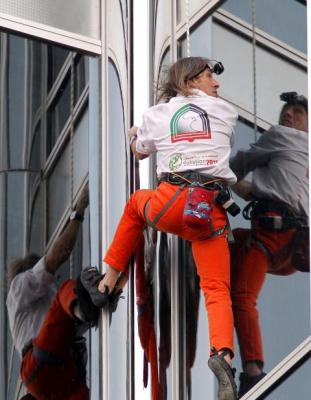
Alain Robert, known as the "French Spider-Man," praised Alex Honnold as exceptionally well-prepared after the US climber completed a free solo ascent of Taipei 101 yesterday. Robert said Honnold's ascent of the 508m-tall skyscraper in just more than one-and-a-half hours without using safety ropes or equipment was a remarkable achievement. "This is my life," he said in an interview conducted in French, adding that he liked the feeling of being "on the edge of danger." The 63-year-old Frenchman climbed Taipei 101 using ropes in December 2004, taking about four hours to reach the top. On a one-to-10 scale of difficulty, Robert said Taipei 101

Taiwanese and US defense groups are collaborating to introduce deployable, semi-autonomous manufacturing systems for drones and components in a boost to the nation’s supply chain resilience. Taiwan’s G-Tech Optroelectronics Corp subsidiary GTOC and the US’ Aerkomm Inc on Friday announced an agreement with fellow US-based Firestorm Lab to adopt the latter’s xCell, a technology featuring 3D printers fitted in 6.1m container units. The systems enable aerial platforms and parts to be produced in high volumes from dispersed nodes capable of rapid redeployment, to minimize the risk of enemy strikes and to meet field requirements, they said. Firestorm chief technology officer Ian Muceus said

MORE FALL: An investigation into one of Xi’s key cronies, part of a broader ‘anti-corruption’ drive, indicates that he might have a deep distrust in the military, an expert said China’s latest military purge underscores systemic risks in its shift from collective leadership to sole rule under Chinese President Xi Jinping (習近平), and could disrupt its chain of command and military capabilities, a national security official said yesterday. If decisionmaking within the Chinese Communist Party has become “irrational” under one-man rule, the Taiwan Strait and the regional situation must be approached with extreme caution, given unforeseen risks, they added. The anonymous official made the remarks as China’s Central Military Commission Vice Chairman Zhang Youxia (張又俠) and Joint Staff Department Chief of Staff Liu Zhenli (劉振立) were reportedly being investigated for suspected “serious

American climber Alex Honnold is to attempt a free climb of Taipei 101 today at 9am, with traffic closures around the skyscraper. To accommodate the climb attempt and filming, the Taipei Department of Transportation said traffic controls would be enforced around the Taipei 101 area. If weather conditions delay the climb, the restrictions would be pushed back to tomorrow. Traffic controls would be in place today from 7am to 11am around the Taipei 101 area, the department said. Songzhi Road would be fully closed in both directions between Songlian Road and Xinyi Road Sec 5, it said, adding that bidirectional traffic controls would


 RSS
RSS