


Five years ago, Koo Yen-hon (辜晏宏) left China Synthetic Rubber Corp, an affiliate of the Koo's group, and moved to Lukang with his wife to take charge of the Lukang Folk Arts Museum.
Knowing nothing about museum management, it was a challenging but honorable mission for Koo, because he was chosen by his family to take care of the house built by his grandfather, Koo Hsien-jung (辜顯榮).
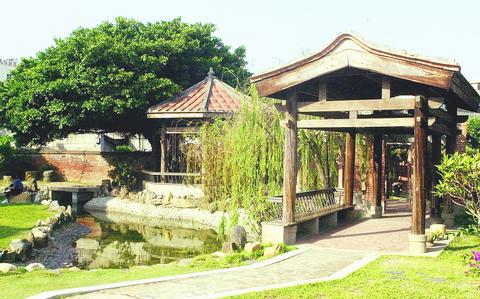
PHOTO: HU WEI-MING, TAIPEI TIMES
The Baroque-style building, which took seven years to construct and was completed in 1919, symbolizes the glory of the Koo business empire over the past century.
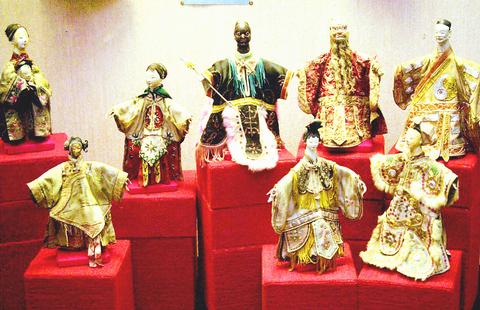
PHOTO: HU WEI-MING, TAIPEI TIMES
Before 1895, Koo Hsien-jung was already a successful businessman in Lukang. Being a far-sighted and an ambitious man, the elder Koo had foreseen the declining position of his home town and the emergence of Taipei in terms of its trade and political importance.
With this in mind he moved to Taipei to develop his business and established a foothold in Tataocheng, now the Tatung district, then the business center of the Taipei area.
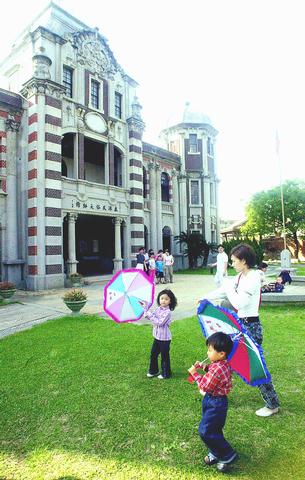
PHOTO: HU WEI-MING, TAIPEI TIMES
The concession of Taiwan
After China signed the Shimonoseki Treaty conceding Taiwan to Japan in April 1895, the Japanese, in May, immediately sent troops to take over the island.
In an effort to prevent Taiwan from being occupied by Japan, an independent republic called Democratic Taiwan (台灣民主國) was created in Taipei under the leadership of Tang Ching-sung (唐景崧).
After the Japanese army conquered Keelung in June, the short-lived republic eventually collapsed, and Tang, together with some key officials, fled to China.
Without a government to maintain law and order, Taipei City fell into chaos. Soldiers and gangsters became bandits. Business circles, in particular, were longing for an authority to enforce security and order.
Though the Japanese army had superiority over their Chinese counterparts and the Taiwanese militia in terms of training and weaponry, they had still failed to conquer Taipei City due to the solid construction of the Taipei Gate.
In an attempt to restore security, Tataocheng businessmen moved to open the Taipei Gate and welcome the arrival of Japanese troops.
On June 6, 1895, Koo Hsien-jung opened the gate and guided the Japanese into the city. Koo's move became the turning point of his business and political career.
From then on, he won the confidence of the Japanese by demonstrating his allegiance to the colonial rulers.
In 1896, he was nominated as head of the Taipei Security Bureau. In 1921, he was selected as a council member of the Taiwan Governor's Office. In 1934, he was chosen as the first Taiwanese to be a congressman of the upper house of the Diet.
Apart from his political career, he had also dealt with monopoly businesses, such as salt, sugar and opium. In addition, he had participated in the establishment of the Changhwa Commercial Bank and ran the pro-Japan Taiwan Jih-jih Hsin Pao.
But the family's eminence did not perish with the withdrawal of the Japanese in 1945. The family's present economic and political influence is no less than the elder Koo enjoyed.
Koo Chen-fu (辜振甫), the chairman of the Koo's group and Taiwan's chief negotiator for cross-strait affairs, was Koo Hsien-jung's fifth son.
Jeffrey Koo (辜濂松), president of Chinatrust Commercial Bank and a national policy adviser, is a third-generation heir from Koo Hsien-jung's fourth son, Koo Yueh-fu (辜岳甫).
But the Koo family did not always sail with the wind, because of changes in the government and the ironic way history has of repeating itself.
In 1895, the Chinese nationalists plotted an aborted independence movement to prevent Taiwan from being handed over to Japan. In 1945, right after Japan surrendered to the Chinese, a few Japanese military men, allegedly with Koo Chan-fu's help, hatched their own plan, to keep the island from Chinese rule.
In 1946, Koo Chen-fu was put in jail by the KMT government for 19 months, having been accused of being a "traitor" for his involvement in the plan.
It was not the only nightmare for the Koo family during the painful switch of government. In a TV program special on celebrities that aired in June last year, Jeffrey Koo recalled how his mother, Koo Yen Pi-hsia (辜顏碧霞), was taken away from her home by KMT secret police.
Koo Yen Pi-hsia was once arrested under the accusation of "sponsoring a bandit," for sponsoring Taiwanese dissident writer Lu Ho-jo's (呂赫若) trip to Japan.
Gaining trust
But thanks to Koo Chen-fu's interpersonal skills, after Chiang Kai-shek (蔣介石) and his army fled to Taiwan in 1949, he soon gained Chiang's trust, despite the Koo family's close links to Japan.
Koo's wife, Cecilia Y. Koo (辜嚴倬雲) then became Madame Chiang Kai-shek's (蔣宋美齡) closest aide.
Among Koo Hsien-jung's six wives, one was Japanese, and two of Koo Hsien-jung's 12 sons married Japanese women. Some members of the Koo family are living in Japan.
Koo Chen-fu, for example, is well known for his personal links to Japanese politicians, including former Japanese prime minister Yoshiro Mori.
A source in the Ministry of Foreign Affairs told the Taipei Times that each time Mori visited Taiwan as a member of the lower house, before becoming the prime minister, Koo Chen-fu had always hosted a banquet to receive him.
Koo Chen-fu's youngest brother, Koo Kuan-min (辜寬敏), has won respect within the DPP for his long devotion to Taiwan's independence while living in Japan in the 1950s and 1960s.
However, the Koo family's Japanese connections did not trigger the KMT government's suspicion over the family's loyalty. To the contrary, members of the Koo family, like Koo Chen-fu, Koo Kuan-min and Jeffrey Koo, frequently played the role of the KMT government's special envoys on Taiwan-Japan affairs.
Even after the DPP took control of the government, the Koo family seems willing to serve the nation's interests regardless of who is in power.
Sources in the government said Jeffrey Koo is still active in bridging President Chen Shui-bian's (陳水扁) participation in APEC. His uncle, Koo Chen-fu, is serving the DPP government and trying to resume dialogue with China.
Compared with the hasty approach other business groups have taken to investing in China, such as the Formosa Plastics and the Evergreen Group, the Koo group seems relatively patient.
The Koo's low profile on the issue of "marching toward China" is seen as a political gesture to solidify its support for the government's policy.
In the light of Taiwan's complicated history in the past century, the Koo family's relations with the authorities in different times may well explain Koo Hsien-jung's controversial role and how Taiwan's national identity has evolved.
Whether Koo Hsien-jung was a traitor of Taiwan may be irrelevant at a time when Taiwan's national identity did not exist. It is a widely shared opinion that Tai-wan's national identity began to take shape under Lee Teng-hui's (李登輝) presidency.
"History just happened like that. My grandfather turned the page for my family. You can not imagine how small my great grandfather's tomb was," Koo Yen-hon told the Taipei Times.
According to Chinese tradition, the bigger the tomb, the more eminent the family was.
"Nobody, even us [the offspring of Koo Hsien-jung], knows why finally my grandfather went alone to welcome the Japanese, as the plan was proposed by several influential Taiwanese businessmen in Tataocheng," Koo Yen-hon added.
Knowing that union is power, the Koo family is one of tradition and discipline, under the leadership of Koo Chen-fu. According to Koo Yen-hon, family members aren't troubled by the fact that they don't always share the same political and religious beliefs.
Koo Kuan-min, for example, had long been a political dissident before the DPP took power, while Koo Chen-fu used to be a member of KMT's most powerful decision-making body, the Central Standing Committee.
"My aunt [Cecilia Y. Koo], being a Christian, also holds incense sticks to worship my grandfather on the anniversaries of his death," said Koo Yen-hon.
Koo's family members never call their relatives by name, but always by the title of family hierarchy.
Koo Yen-hon, for instance, calls his cousin Jeffrey Koo, who is seven years older than him, "third elder brother" (三兄).
To take charge of a museum, specializing in collections of relics of Taiwanese civil life and folk arts, Koo Yen-hon has been engaged in bridging Taiwan's recent history with the museum's collections.
Creation of the museum
In 1973, Koo Chen-fu and his younger brother Koo Wei-fu (辜偉甫) donated their family house and established the Lukang Folk Arts Museum Foundation.
Koo Wei-fu, Koo Yen-hon's father, had been known as an intellectual rather than business-minded entrepreneur. He was the founder of the Jung-hsing Garden, Jung-hsing Kindergarten and the Jung-hsing Children's Chorus.
As a layman of museum management five years ago, and frustrated with that fact that Taiwan was still a desert in this field, Koo Yen-hon had to seek professional assistance from the Japanese Museum Management Association.
Knowing Japan very well thr-ough the fact that he was mothered by a Japanese lady and was educated in Japan in his youth, Koo Yen-hon found a short cut to the profession fast.
After two years of learning the Japanese experience, he began to put his professional knowledge into practice three years ago.
He began to enrich the museum's collection by purchasing and collecting donations from Koo family members.
In addition, he made the museum come to life by having museum employees serve as guides to explain the social functions of every individual piece of the collection.
At the beginning, the employees didn't seem to understand why they had to do an oral guide for the visitors. It was hard for Koo Yen-hon to convince them of the necessity.
Museum guide
With Japanese as a mother tongue and fluent in English, Koo Yen-hon often serves as a museum guide when there are foreign visitors, because the museum lacks staff fluent in foreign languages.
Visitors' discipline is also a problem for museum managers. The most irritating behavior of visitors are shouting and running around. Very often, parents and teachers just tolerate and ignore children's bad behavior.
So, Koo Yen-hon had to set up rules for visitors. As a museum tour is a journey of knowledge, decent behavior is a must if one is to show respect and appreciation for knowledge.
Managing a museum requires a lot of energy. Fortunately, Koo Yen-hon's wife, Hsiao Wei-cheng (蕭慰真), is very helpful.
She is a patient teacher of badly behaved children. Looking mother-like and always smiling, her job is to give advice about disciplining children in a kind way.
Since the visitors' applause is the best award for the job of guide, Koo Yen-hon has finally been proved right. For him, without giving knowledge to the visitors, the museum is dead.
Now, Huang Ching-yi, a senior museum guide who has been working for the museum from the very beginning, can easily impress visitors with her abundant knowledge of old Taiwanese civil life.
Collection pieces are increasing and have exceeded 6,000 articles. According to Hsiao Wei-cheng, the museum hopes to renew pieces of the exhibition every season, so that visitors can view different objects in the museum's collection.
It'll be the 30th anniversary of the creation of the museum, the first private museum in Taiwan, on Nov. 10 next year.
It has been a hard and difficult ride, due to the fact that funds from both the Koo family and government are limited. But Koo Yen-hon has so much work to accomplish.
One major frustration for Koo Yen-hon is the regulations and conditions of the government's funding, and the owner has no say in it.
Ku Feng Lo (古風樓), for instance, an example of southern-Hokkien architecture, located by the main building and also part of the museum, has been renovated through government subsidies.
But the result is not totally satisfactory, with some original elements of the building having been replaced with new materials.
"Don't you find it strange to see a house aging over one century but looks brand new?" asked Koo Yen-hon.
However, imperfection means a lot can be improved, otherwise Koo Yen-hon's passion and efforts wouldn't be needed.
"We enjoy our work, otherwise, it would be difficult to appreciate life in this remote township [Lukang]. This is a mission that we [the Koo family] will pass on, regarding the family's history and tradition," Hsiao Wei-cheng said."

The military has spotted two Chinese warships operating in waters near Penghu County in the Taiwan Strait and sent its own naval and air forces to monitor the vessels, the Ministry of National Defense (MND) said. Beijing sends warships and warplanes into the waters and skies around Taiwan on an almost daily basis, drawing condemnation from Taipei. While the ministry offers daily updates on the locations of Chinese military aircraft, it only rarely gives details of where Chinese warships are operating, generally only when it detects aircraft carriers, as happened last week. A Chinese destroyer and a frigate entered waters to the southwest

A magnitude 6.1 earthquake struck off the coast of Yilan County at 8:39pm tonight, the Central Weather Administration (CWA) said, with no immediate reports of damage or injuries. The epicenter was 38.7km east-northeast of Yilan County Hall at a focal depth of 98.3km, the CWA’s Seismological Center said. The quake’s maximum intensity, which gauges the actual physical effect of a seismic event, was a level 4 on Taiwan’s 7-tier intensity scale, the center said. That intensity level was recorded in Yilan County’s Nanao Township (南澳), Hsinchu County’s Guansi Township (關西), Nantou County’s Hehuanshan (合歡山) and Hualien County’s Yanliao (鹽寮). An intensity of 3 was

Instead of focusing solely on the threat of a full-scale military invasion, the US and its allies must prepare for a potential Chinese “quarantine” of Taiwan enforced through customs inspections, Stanford University Hoover fellow Eyck Freymann said in a Foreign Affairs article published on Wednesday. China could use various “gray zone” tactics in “reconfiguring the regional and ultimately the global economic order without a war,” said Freymann, who is also a nonresident research fellow at the US Naval War College. China might seize control of Taiwan’s links to the outside world by requiring all flights and ships entering or leaving Taiwan
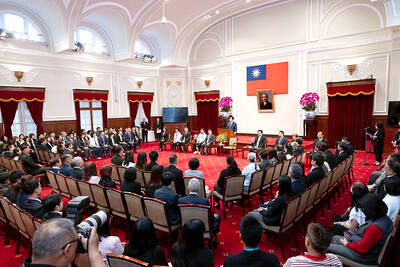
The next minimum wage hike is expected to exceed NT$30,000, President William Lai (賴清德) said yesterday during an award ceremony honoring “model workers,” including migrant workers, at the Presidential Office ahead of Workers’ Day today. Lai said he wished to thank the awardees on behalf of the nation and extend his most sincere respect for their hard work, on which Taiwan’s prosperity has been built. Lai specifically thanked 10 migrant workers selected for the award, saying that although they left their home countries to further their own goals, their efforts have benefited Taiwan as well. The nation’s industrial sector and small businesses lay


 RSS
RSS