


While government officials said that national interests should outweigh press freedom, media workers and scholars believe that press freedom must be protected and that the public has a right to know the truth.
Lawmakers, however, said that there should be a law or independent office to protect both press freedom and national security.
The raid by the Taiwan High Court Prosecutors' Office on Next magazine last Wednesday sparked a discussion on the importance of national security and press freedom.
Last Wednesday, the Chinese-language newspaper China Times printed stories about two secret funds worth more than NT$3.5 billion belonging to the National Security Bureau (NSB). The articles appeared on the newspaper's front page as well as on its second and third pages.
The stories prompted the Taiwan High Court Prosecutors' Office last Friday to charge Huang Ching-lung (黃清龍), the editor in chief of the newspaper, with breaching national security.
Paparazzi style
Next magazine, a tabloid publication known for its paparazzi style reporting, also carried a story about the two secret funds in last Thursday's edition. The story also mentioned the alleged embezzlement of more than NT$192 million by former NSB chief cashier Colonel Liu Kuan-chun (
Prosecutors then raided the magazine's Hsintien office, its printing plant in Taoyuan and the apartment of Hsieh Zhong-liang (
Hsieh was charged with the same violation as Huang last Thursday. The prosecutors' office has ordered Hsieh to answer questions next Thursday about who tipped him off about the two secret NSB accounts.
Local media immediately protested the charges citing press freedom and said that the public has the right to know the truth, especially as it pertains to scandals and corruption.
Ku Ling-ling (
The right to know
"I'm sorry for this," she said. "People have the right to know the truth. Honestly, I can't believe that a thing like this could happen today in Taiwan.
"I think it goes without saying that media workers should protest against this because it was against democracy."
Yu Chia-chang (
"Press freedom is actually an important index for democracy," Yu said. "An Austrian senior reporter talked to me few days ago. He was quite surprised that Taiwan's government would do something like this to violate press freedom because Taiwan has been a democratic country in his mind for years.
"Now what would he think of us?" he added.
The Ministry of Justice, however, said that the magazine and the newspaper stories might have damaged Taiwan's intelligence system, which is supposed to remain secret.
National interests
In response to the media workers' argument, Minister of Justice Chen Ding-nan (陳定南) said that press freedom should not be unlimited, adding that prosecutors will charge anybody who endangers national security because the nation's interests should be put first.
"Press freedom is important, but I think national security weighs more," he said. "National interests should be the first priority for everybody. Nothing is more important than this."
Lawmakers said that national interests are also their main concern. However, both press freedom and national security should be protected by laws or some other mechanism when the two come in conflict.
Constitutional rights
"Our constitution clearly states that people's freedom of speech is protected," KMT lawmaker John Chang (章孝嚴) said.
He said that the legislature should pass bills on state secrets, government information disclosure, national-intelligence supervision and intelligence archives as soon as possible so that both the government and the media have regulations to follow when arguments over national security and press freedom crop up.
The four bills are on hold, awaiting approval by the legislature.
"People have different definitions of `secrets,'" he said. "It will make things easier if there is a manual to follow."
Aside from making new laws, DPP lawmaker Lee Wen-chung (李文忠) suggested the creation of a new group called the National Intelligence Supervisory Committee (國家情報監督委員會). Lee said that any future committee members who leak classified information could be expelled from the body and referred to the legislature's Discipline Committee for punishment.
"In the future, we can even deprive committee members' immunity if they leak classified information and charge them under the Criminal Code," Lee said.
"In fact, a person who leaks classified information about national security can be regarded as a traitor."
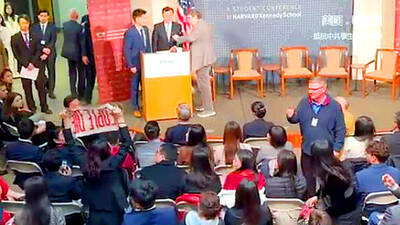
A group of Taiwanese-American and Tibetan-American students at Harvard University on Saturday disrupted Chinese Ambassador to the US Xie Feng’s (謝鋒) speech at the school, accusing him of being responsible for numerous human rights violations. Four students — two Taiwanese Americans and two from Tibet — held up banners inside a conference hall where Xie was delivering a speech at the opening ceremony of the Harvard Kennedy School China Conference 2024. In a video clip provided by the Coalition of Students Resisting the CCP (Chinese Communist Party), Taiwanese-American Cosette Wu (吳亭樺) and Tibetan-American Tsering Yangchen are seen holding banners that together read:

UNAWARE: Many people sit for long hours every day and eat unhealthy foods, putting them at greater risk of developing one of the ‘three highs,’ an expert said More than 30 percent of adults aged 40 or older who underwent a government-funded health exam were unaware they had at least one of the “three highs” — high blood pressure, high blood lipids or high blood sugar, the Health Promotion Administration (HPA) said yesterday. Among adults aged 40 or older who said they did not have any of the “three highs” before taking the health exam, more than 30 percent were found to have at least one of them, Adult Preventive Health Examination Service data from 2022 showed. People with long-term medical conditions such as hypertension or diabetes usually do not
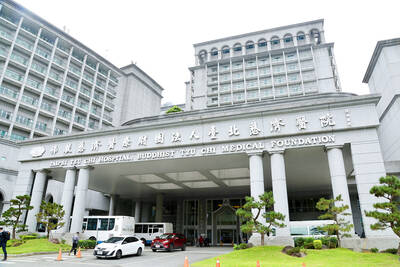
POLICE INVESTIGATING: A man said he quit his job as a nurse at Taipei Tzu Chi Hospital as he had been ‘disgusted’ by the behavior of his colleagues A man yesterday morning wrote online that he had witnessed nurses taking photographs and touching anesthetized patients inappropriately in Taipei Tzu Chi Hospital’s operating theaters. The man surnamed Huang (黃) wrote on the Professional Technology Temple bulletin board that during his six-month stint as a nurse at the hospital, he had seen nurses taking pictures of patients, including of their private parts, after they were anesthetized. Some nurses had also touched patients inappropriately and children were among those photographed, he said. Huang said this “disgusted” him “so much” that “he felt the need to reveal these unethical acts in the operating theater
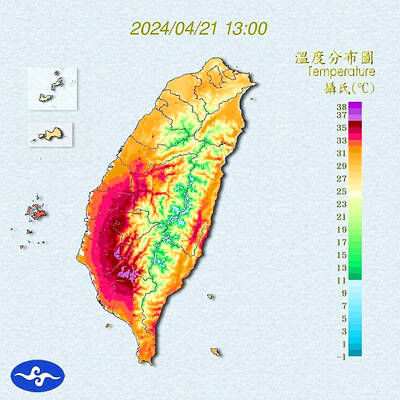
Heat advisories were in effect for nine administrative regions yesterday afternoon as warm southwesterly winds pushed temperatures above 38°C in parts of southern Taiwan, the Central Weather Administration (CWA) said. As of 3:30pm yesterday, Tainan’s Yujing District (玉井) had recorded the day’s highest temperature of 39.7°C, though the measurement will not be included in Taiwan’s official heat records since Yujing is an automatic rather than manually operated weather station, the CWA said. Highs recorded in other areas were 38.7°C in Kaohsiung’s Neimen District (內門), 38.2°C in Chiayi City and 38.1°C in Pingtung’s Sandimen Township (三地門), CWA data showed. The spell of scorching


 RSS
RSS