


The Mainland Affairs Council (MAC) promised yesterday to restrict the types of work that former Taiwan government officials who have been out of office for three years or more may accept in China.
The MAC also vowed to impose stricter penalties on incumbent government officials who visit China and former officials who cross the Strait within the three-year period.
But a MAC official told the Taipei Times that whether to put the issue under the realm of criminal law is still under discussion.
"We are looking at all kinds of occupations in China and are going to establish a measure which will list each type of post," said Tsai Ing-wen (蔡英文), chairperson of the MAC. Tsai was responding to a question from PFP lawmaker Chin Huei-chu (秦慧珠) about how the government intended to address the issue raised by a TSU lawmaker Tuesday of former government officials working in China illegally.
Tsai was attending a session of the Legislative Yuan's Home and Nations' Committee for the second consecutive day after the committee decided to ask her to return for legislators' questions following her routine outline of MAC policy to the committee on Wednesday.
Yesterday's session was dominated by the question of former government officials' ties to China, in the light of TSU legislator Liao Pen-yen's (
An official at the MAC who wished to remain anonymous told the Taipei Times yesterday that the MAC is still discussing the precise form that the new penalties will take, but said that they will be "more sophisticated" and "heavier."
The official added, "We are still discussing whether to make the offences criminal."
The existing regulations are a matter of administrative law, which means that transgressors, who can be fined between NT$100,000 and NT$500,000, do not get a criminal record.
Article 33 of the Statute Gov-erning the Relations between the People of the Taiwan Area and the Mainland Area (
DPP legislator Chen Chi-mai (
Tsai said: "Soliciting business may amount to a violation of Article 33, but the MAC must investigate further and obtain evidence."
Ho His-Chun, a former director of the science park, is now an adviser to China's Changzhou and Haimen science parks.
Tung Hu, also a former director of the park, is currently an adviser to Shanghai's Zhangjiang Industrial Complex.
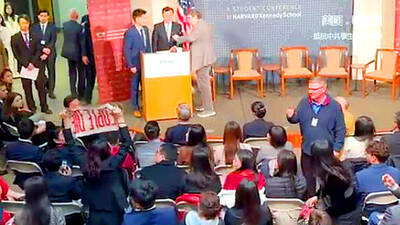
A group of Taiwanese-American and Tibetan-American students at Harvard University on Saturday disrupted Chinese Ambassador to the US Xie Feng’s (謝鋒) speech at the school, accusing him of being responsible for numerous human rights violations. Four students — two Taiwanese Americans and two from Tibet — held up banners inside a conference hall where Xie was delivering a speech at the opening ceremony of the Harvard Kennedy School China Conference 2024. In a video clip provided by the Coalition of Students Resisting the CCP (Chinese Communist Party), Taiwanese-American Cosette Wu (吳亭樺) and Tibetan-American Tsering Yangchen are seen holding banners that together read:

UNAWARE: Many people sit for long hours every day and eat unhealthy foods, putting them at greater risk of developing one of the ‘three highs,’ an expert said More than 30 percent of adults aged 40 or older who underwent a government-funded health exam were unaware they had at least one of the “three highs” — high blood pressure, high blood lipids or high blood sugar, the Health Promotion Administration (HPA) said yesterday. Among adults aged 40 or older who said they did not have any of the “three highs” before taking the health exam, more than 30 percent were found to have at least one of them, Adult Preventive Health Examination Service data from 2022 showed. People with long-term medical conditions such as hypertension or diabetes usually do not
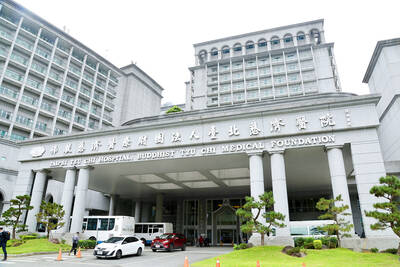
POLICE INVESTIGATING: A man said he quit his job as a nurse at Taipei Tzu Chi Hospital as he had been ‘disgusted’ by the behavior of his colleagues A man yesterday morning wrote online that he had witnessed nurses taking photographs and touching anesthetized patients inappropriately in Taipei Tzu Chi Hospital’s operating theaters. The man surnamed Huang (黃) wrote on the Professional Technology Temple bulletin board that during his six-month stint as a nurse at the hospital, he had seen nurses taking pictures of patients, including of their private parts, after they were anesthetized. Some nurses had also touched patients inappropriately and children were among those photographed, he said. Huang said this “disgusted” him “so much” that “he felt the need to reveal these unethical acts in the operating theater
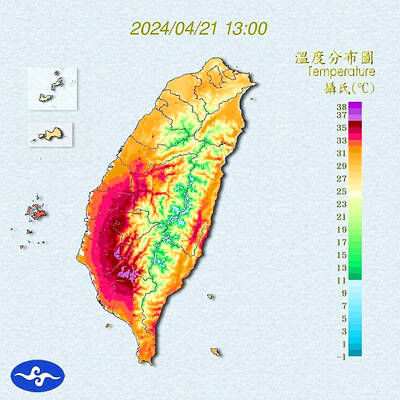
Heat advisories were in effect for nine administrative regions yesterday afternoon as warm southwesterly winds pushed temperatures above 38°C in parts of southern Taiwan, the Central Weather Administration (CWA) said. As of 3:30pm yesterday, Tainan’s Yujing District (玉井) had recorded the day’s highest temperature of 39.7°C, though the measurement will not be included in Taiwan’s official heat records since Yujing is an automatic rather than manually operated weather station, the CWA said. Highs recorded in other areas were 38.7°C in Kaohsiung’s Neimen District (內門), 38.2°C in Chiayi City and 38.1°C in Pingtung’s Sandimen Township (三地門), CWA data showed. The spell of scorching


 RSS
RSS