


In recent years, the National Health Insurance program (NHI) has faced mounting financial woes, leading to talk of increasing premiums and plans by the Bureau of National Health Insurance to exclude certain non-essential medication from NHI coverage.
In an exclusive interview with the Taipei Times, Fritz Britt, head of the Novartis Policy Office, Novartis AG, and Stefan Ziegler, Novartis Asia-Pacific regional head, talked about their thoughts on Taiwan's NHI system and how it compares with European health care systems.
Analyzing the cost distribution of the NHI, Britt said that he felt Taiwan was very "hospital heavy," meaning that the system favors the hospitals.
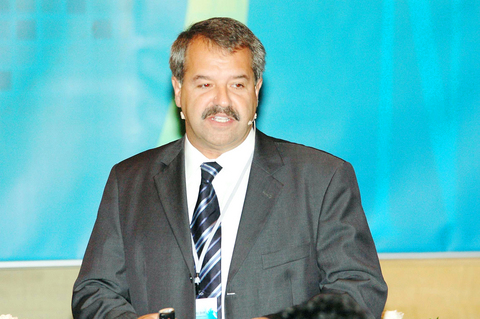
PHOTO COURTESY OF NOVARTIS
"Hospitals tend to be pretty expensive. In all the health systems I have seen, if you have [a scenario in which] you shift power to one of the players, then it's going to be more of a power game than a real balanced system. My experience of European systems is that you would rather have a balanced hospital and [clinic] system," Britt said.
According to Britt, 20 years ago in France the trend was the same, with hospitals tending to grow ever bigger. As a result, regulations were brought in to restrict hospitals to a certain growth rate. Britt said in comparison, hospitals in European countries such as France, Italy, Spain and Germany are far more closely controlled by the state, and subject to far more regulation.
"We don't want to jeopardize [clinics] because it's the [combination of hospitals and clinics] that makes treatment cost-efficient, and not [a health care system] in which the hospitals have a monopoly," Britt said.
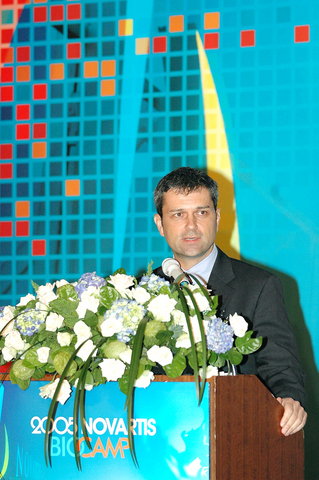
PHOTO COURTESY OF NOVARTIS
Pointing to another "bucket" of costs, Britt talked about how Taiwan's NHI covers a broader range of services than other, more established systems in which services are more narrowly defined.
"Even in France or Italy -- the traditional total coverage systems -- they are now saying that [certain] treatments are privately paid for, that they are not covered by the reimbursement system. In the drug field, these are the over-the-counter drugs, the drugs for coughs colds, headaches -- the day-to-day types of drugs," Britt said. He went on to suggest that a good move for Taiwan would be to have some non-essential drugs being paid for "out of pocket."
"[Taking] these treatments out of the system means you free up money for the really costly interventions. This way you can really get rid of the financial pressure," Britt said.
Aside from regulatory changes, Britt and Zeigler emphasized the role which investment plays in cost containment.
"If you look around, the companies which survive are not only cutting costs, they are also investing in opportunities," Britt said.
By way of example, Britt pointed out that although advances in medical treatment and new types of drugs are expensive, they help to offset costs in other areas by reducing the length of hospital visits and keeping NHI members in the workforce.
"Innovation is probably the key to overall cost containment," he explained.
In Europe, where cost-cutting has been taken about as far as possible, efforts are being made to improve working methods and to use treatments and drugs that lead to shorter treatment loops.
Britt and Ziegler stressed that cost containment rather than cost-cutting was the goal, since with the increase in the number of diseases and the ageing population it was natural that the health system should grow -- preferably at a proportionate rate to the GDP.
According to Britt, in 2002 the percentage of health care expenditure as a percentage of GDP in Taiwan was 6 percent, which compares favourably to European countries where the figure is typically between 8-10 percent.
"The question is: 'What is the right proportion?' Most countries try to be between 8-10 percent of GDP," Britt said, explaining that where the proportion of health expenditure to GDP was higher than 10 percent, the health outcome wasn't necessarily visibly better.
However, in those countries where the figure is below 8 percent -- such as certain countries in Africa, Poland, or Hungary -- problems with the quality of health care result.
Ziegler explained that health expenditure as a percentage of GDP reflected things such as doctors per capita, hospital beds per capita and the time it takes to see a doctor.
"When you go below 8-10 percent of GDP it means you start to take infrastructure out of the system; you take a hospital out of the system, you take a [clinic] out of the system. When you decide [to do] this, you take that money and you put it somewhere else." Ziegler said, adding that such choices were conscious political decisions that affected the quality of health care.
Speaking about general recommendations for Taiwan's system, Britt said: "Taiwan needs a Taiwanese system. You can't copy another system -- there is no economically correct system."
Britt went on to explain that a system that worked in one country couldn't be guaranteed to work in another, since each has different starting points.
Britt referred to the Swiss health care system -- the only such system in Europe that is not bankrupt, according to Britt -- as an example. He said that a similar system couldn't be implemented elsewhere due to cultural differences and the fact that people would fight the changes.
Ziegler concluded by saying that what was important for Taiwan was that there should be a "vision" going forward.
"Say the vision 5-10 years down the road is a natural mix between private payments, private insurance systems, government insurance ? then you can work towards that."

‘NO SECURITY RISK’: The Railway Bureau reassured the public that the technicians’ activities were limited to technical guidance and did not involve sensitive systems The Railway Bureau yesterday said it had invited eight Chinese technicians to assist with an airport MRT construction project. The bureau issued the confirmation after an Internet user said Chinese nationals had entered the construction zone of Taiwan Taoyuan International Airport’s Terminal 3 project. They asked why “individuals from an enemy state” were allowed access to such a major national infrastructure project, which raised serious concerns over Taiwan’s industrial safety, sensitive systems and information security. The bureau’s Northern Region Engineering Branch Office said subcontractor Taiwan Handle Industrial Co (台灣手把工業) of the Taoyuan airport MRT’s “Contract No. CU05 Project A14 Station Civil, MEP &

A US uncrewed surface vessel (USV) encountered multiple Chinese warships during an autonomous transit of the Taiwan Strait, US defense company Seasats said in a statement on Wednesday. Seasats announced that a Lightfish USV had completed the first autonomous transit of the Taiwan Strait. Over five days, the USV traversed the entire length of the Strait while constantly monitoring surface vessel traffic, the company said. The Lightfish encountered multiple Chinese warships, one of which was a Chinese People’s Liberation Army Navy (PLAN) Type 056 corvette, it said. The Chinese vessels were operating “well within Taiwan’s exclusive economic zone without transmitting their identity via the
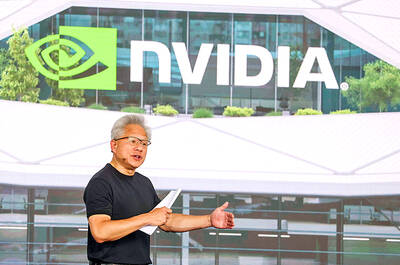
‘BOOMING’: ’ The number of partners we have here is incredible. You can see from their stock prices. They’re doing so well, they’re so happy,’ Jensen Huang said Nvidia Corp’s spending in Taiwan has ballooned to about US$150 billion a year, 10 times the US$10 billion to US$15 billion the company spent five years ago, Nvidia chief executive officer Jensen Huang (黃仁勳) said yesterday, suggesting Taiwan’s strategic importance in the global artificial intelligence (AI) supply chain. “Taiwan is the epicenter of the AI revolution. This is where the chips come, packaging comes. This is where the systems are made. This is where AI supercomputers were created,” Huang said at a meeting for the company’s employees in Beitou-Shilin Technology Park (北投士林科技園區) in Taipei, the planned site of Nvidia’s Taipei headquarters. “Taiwan
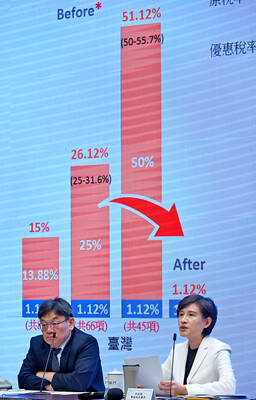
GREATER REACH? Auto parts and wood products would face tariffs of up to 15%, matching those targeting the EU, Japan and South Korea, Vice Premier said The US has announced that preferential tariff treatment for Taiwan’s non-semiconductor Section 232 goods would take effect retroactively from May 1, the Executive Yuan said yesterday. The US government yesterday posted a notice on the Federal Register’s public inspection Web site previewing tariff concessions for Taiwan under a memorandum of understanding (MOU) on Taiwan-US investment after two months of negotiations. The MOU signed on Jan. 15 stipulated three major preferential tariff arrangements: a 15 percent “reciprocal” tariff rate for Taiwan without stacking most-favored nation (MFN) rates; preferential Section 232 treatment for semiconductors and related products; and preferential Section 232 treatment for non-semiconductor


 RSS
RSS