

The Chan sisters on Sunday set up a quarter-final showdown in the women’s doubles at the US Open, while fellow Taiwanese Hsieh Su-wei also kept her campaign alive at the final Grand Slam of the year in New York.
Second seeds Chan Yung-jan and Martina Hingis edged 13th seeds Kristina Mladenovic of France and Anastasia Pavlyuchenkova of Russia 6-4, 7-5 in 1 hour, 26 minutes on Court 5, their longest match so far at Flushing Meadows.
The Taiwanese-Swiss duo hit 34 winners while saving two of four break points and converting four of six to advance to a quarter-final against Chan Hao-ching and Zhang Shuai, who took 1 hour, 54 minutes to see off Daria Gavrilova of Australia and Daria Kasatkina of Russia 6-3, 1-6, 6-2 on Court 7.
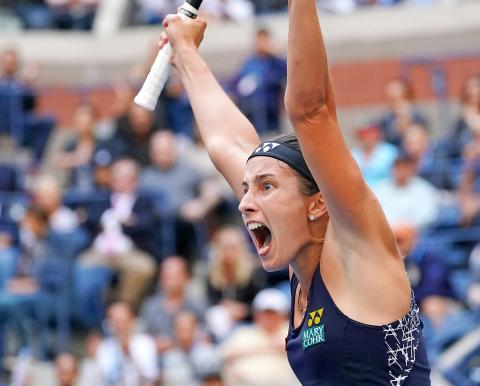
Photo: Robert Deutsch-USA Today
The Taiwanese-Chinese pairing saved seven of 11 break points and won five of 21 as their opponents fired down six double faults to set up a showdown of the Taiwanese siblings at the Billie Jean King National Tennis Center.
Earlier on Court 7 in the second round, 12th seeds Hsieh and Monica Niculescu took 1 hour, 15 minutes to see off the challenge of Japanese duo Eri Hozumi and Miyu Kato 6-4, 6-2 and set up a third-round clash with fifth seeds Timea Babos of Hungary and Andrea Hlavackova of the Czech Republic.
In the second round of the mixed doubles, third seeds Chan Hao-ching and Michael Venus of New Zealand edged Alicja Rosolska of Poland and Santiago Gonzalez of Mexico 6-3, 6-7 (8/10), 10-6 to set up a quarter-final against seventh seeds Gabriela Dabrowski of Canada and Rohan Bopanna of India, while elder sister Chan Yung-jan and Nenad Zimonjic of Serbia fell to a 6-4, 6-3 defeat to Coco Vandeweghe of the US and Horia Tecau of Romania in exactly an hour.
In the singles, Maria Sharapova described her return to center stage after a 15-month doping ban as “a great ride,” despite her campaign ending in the fourth round.
The former world No. 1 and five-time Grand Slam winner fell 5-7, 6-4, 6-2 to Latvian 16th seed Anastasija Sevastova.
It was her first appearance at a Slam since last year’s Australian Open, where she failed a drugs test and was kicked out of the sport until April this year.
“It’s been a really great ride in the last week,” the 30-year-old Russian said. “Ultimately, I can take a lot from this week. It’s great to get that major out of the way. It was an incredible opportunity. I’m very thankful for it. I did my best. I can be proud of that.”
Sharapova, the world No. 146, had needed a wild card into the final Grand Slam of the year, where she was champion in 2006.
The US Tennis Association’s decision was not met with universal approval.
Former world No. 1 Caroline Wozniacki claimed it was “unacceptable” for a player with a doping suspension to be given prime-time spots on the prestigious Arthur Ashe Stadium.
Sharapova played all of her four matches in the 24,000-capacity arena.
The Russian insisted that she had nothing to prove to her critics.
“I feel like I’m really beyond that,” she said. “I think there’s only a way to show it on the court, because that’s what really matters to me. I have so many things in my life, but there’s a desire to keep going for more and to keep living through these moments out on these courts.”
Sevastova, who was also a quarter-finalist in New York last year, said she was happy to see Sharapova playing again and that she felt no desire to prove a point on behalf of her peers.
“I think some players have that. I don’t have that. I have great respect for her,” the 26-year-old said.

The Football Association of Ireland (FAI) has found itself divided ahead of their two Nations League clashes with Israel, with the players disagreeing over whether to boycott the first game today and goalkeeper Gavin Bazunu withdrawing from the squad. After hours of fraught meetings among the players and occasionally involving coaches and officials, FAI chief executive officer David Courell said at a news conference that had been delayed by several hours that a “significant majority” of the squad had agreed to play the game in Hungary, but it was far from a unanimous decision. The handful of Irish journalists present questioned Courell

MORE MEDALS: Taiwan’s men’s table tennis team added a bronze to the nation’s medal haul, while the women’s basketball team advanced to the semi-finals Taiwan yesterday secured their first e-sports medal at the Aichi-Nagoya Asian Games, claiming bronze in the Naraka: Bladepoint tournament after falling 0-3 to China in the semi-finals. The Taiwanese squad, comprising Liu Tang-shiun, Chen Shang-yi, Cheng Hsu-yu, Yen Kai-en and Yeh Chih-yu, had already secured a place on the podium when they advanced to the final four as the runners-up in their preliminary group. The bronze is first e-sports medal Taiwan has won at this year’s Asian Games. Naraka: Bladepoint is a game in which the players fight each other to be the last one standing. The game incorporates martial arts-inspired melee combat. TABLE
CONFUSION, DISORDER: Late-coming entrants and insufficient logistics have given this year’s Games a shoddy execution, the organizing committee’s head said The chief organizer of the Asian Games apologized yesterday for the logistical headaches plaguing the event, saying a late influx of athletes and officials had made it difficult to run smoothly. The number of participants at the continental showpiece ballooned to 17,000 following a flurry of late entries — about 2,000 more than the organizing committee had initially projected. The unexpected surge strained accommodation and transport networks, prompting complaints from athletes and team officials over cramped rooms, small beds and travel delays. “There have been mistakes in accommodation and transport, for various reasons,” AINAGOC secretary-general Satoshi Murate told a press conference. “Whatever the
The Asian Games has crowned teenage champions before, but this edition has witnessed stunning successes by child prodigies, including Yuki Kurihara standing atop the podium aged just 11. The Japanese primary school student beat opponents three times his age on the way to a historic gold in e-sports in Nagoya. He is Japan’s youngest Asian Games winner in history and almost certainly the youngest the Games have ever seen. Kurihara did not even react after taking home the gold in Saturday’s final in Puyo Puyo Champions, a puzzle game where players try to clear their screen of colored blobs by lining them up


 RSS
RSS