


Images of a beaming FIFA president Sepp Blatter and a small blue certificate in the Chinese city of Zibo proclaim it as the birthplace of soccer, to the fury of English experts.
A map in Zibo’s Qi State History Museum shows a thin line stretching from China to Egypt, then to Greece, Rome and France, before finishing in England, commonly known as the home of soccer after the rules were codified there in the 19th century.
The track represents the path of soccer’s development, according to the museum, with the certificate — signed by Blatter — honoring China as “the cradle of the earliest forms of football,” but international experts are skeptical of such claims, pointing to a “tenuous” link between the ancient Chinese game of cuju and the modern sport, and questioning FIFA’s motives.
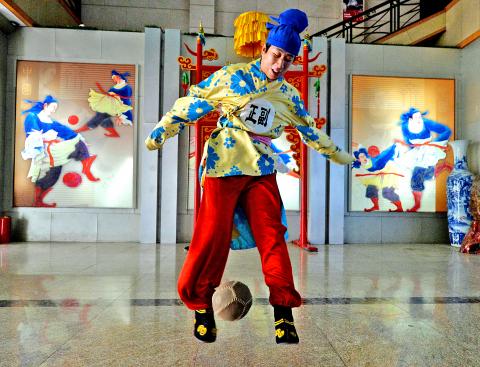
Photo: AFP
Despite its long supposed soccer history, China’s national team failed to qualify for the FIFA World Cup finals in Brazil next week.
China has only appeared at one finals, in 2002, when they lost all three of their group matches and went out without even scoring a goal, but millions of fans will be watching the tournament and in Zibo — the modern city on the site of the ancient Qi state’s capital Linzi — soccer is booming.
Statues of cuju players stand on street corners and posters on bus shelters depict the supposed forebear of the modern game.
“I really like Sepp Blatter,” beams Zhu Shuju, vice director at the separate Zibo Football Museum, which pays homage to the sport’s history, and gives huge prominence to Blatter and other FIFA officials.
“He is very popular here,” she added, surrounded by images of Blatter and with a video of his speech confirming Zibo’s status continuously looping in the background.
Zibo has invited Brazilian superstar Pele to open a new multimillion-dollar museum later this year.
Different types of cuju existed in ancient China, but the competitive game still played today involves keeping a leather ball stuffed with feathers off the ground without using arms or hands, before heading or kicking it though a hole above head height.
A gladiatorial version with much physical contact emerged in the Warring States period which unified China almost 2,500 years ago and was popular with soldiers exercising their legs after days on horseback, but experts outside China believe there are huge differences between cuju and modern soccer.
“I find it absurd to suggest ancient Chinese had comparable mentalities as football enthusiasts today,” Ellis Cashmore, professor of culture, media and sport at Britain’s Staffordshire University, said via e-mail. “So the link is tenuous.”
Historians say other ball sports existed at about the same time as cuju emerged, including a Greek game known as episkyros.
An ancient stone carving at the Acropolis Museum in Athens shows a naked Greek athlete balancing a ball on his thigh and some say episkyros evolved into a game played by the Romans, called harpastum, which was then transported to Britain.
There the modern game was born when the Football Association rules, drawing on a public school mob game, were written by Ebenezer Cobb Morley in 1863 and they have since changed very little.
For British historian Tom Holland, soccer began in the 19th century.
“I’m afraid I don’t know anything about the classical origins of football, for the simple reason they don’t exist,” Holland said. “Kicking something around is an obvious human activity. That various peoples, in various parts of the world, may or may not have engaged in such activities does not prove that they were the originators of football.”
British soccer author Jonathan Wilson agreed, saying that the 1863 rules “were then spread across the world by British sailors and traders.”
“At no point did they come upon a local form of football that needed to be eradicated before the British game could take root,” Wilson said. “Rather, foreign cultures took on those laws and interpreted them in their own way.”
Eyebrows were raised when FIFA came out in support of China’s claims.
“Blatter sees his brief to make football the richest sport in history and he has already achieved that, but to maintain its commercial dominance, he needs to keep conquering new territories,” said Cashmore, whose book Football’s Dark Side explores corruption in the game. “China is obvious: huge territory, an economy that’s been growing like a blur and a population that has already shown enthusiasm for the sport.”
FIFA and Blatter have been criticized for several decisions in recent years, most vociferously over the controversial award of the 2022 FIFA World Cup to a tiny Gulf emirate that has immense gas wealth, but sweltering summer temperatures.
British historian Guy Walters, from London’s New College of the Humanities, said: “Frankly, I’m surprised he hasn’t stated that the game kicked off in the ancient deserts of Qatar.”

Marta Kostyuk’s maiden WTA 1000 title in Madrid came on Saturday thanks to her power, poise and a pair of unexpected lucky shorts. The world No. 23 beat eighth-ranked Mirra Andreeva 6-3, 7-5 in under 90 minutes to secure the most prestigious trophy of her career, her third professional singles title and second in less than a month after Rouen. Yet as the 23-year-old Ukrainian posed for photographs at the Caja Magica, it was not just the silverware that caught the eye. Held alongside her team and her two dogs, Kostyuk showed off a piece of black men’s underwear, prompting

Throwing more than US$5 billion at a divisive new tour and walking away after five seasons does not look like good business, but LIV Golf was not all bad news for Saudi Arabia. Oil-funded LIV, which poached top stars and sent golf’s establishment into a tailspin, helped push the conservative kingdom into global view — one of its key aims, experts said. The exit, confirmed on Thursday after weeks of speculation, does not signal a flight of Saudi money from sport, even after the Middle East war that sparked Iranian attacks around the Gulf, they said. “Saudi Arabia is not

Arsenal stormed six points clear at the top of the English Premier League as Bukayo Saka and Viktor Gyokeres put Fulham to the sword in a 3-0 win, while West Ham United’s defeat at Brentford offered Tottenham Hotspur a lifeline in the battle for survival. The Gunners have stumbled toward the finish line in their quest for a first league title in 22 years, blowing a sizeable lead over Manchester City in a series of nervous displays. However, the return of Saka, making his first start in six weeks, freed up Mikel Arteta’s men in a dominant performance that shrugged
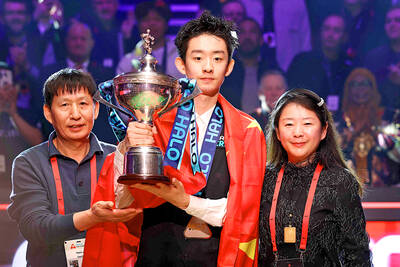
China’s Wu Yize on Monday won the World Snooker Championship for the first time with a dramatic 18-17 victory over Shaun Murphy in the final. Wu held his nerve to seal his thrilling triumph in a tense last frame shoot-out at Sheffield’s Crucible Theatre. The 22-year-old is the second Chinese player to win the world title after Zhao Xintong beat Mark Williams to make history as the first Asian to lift the trophy last year. Wu is also the second-youngest player to be crowned world champion at the Crucible after Stephen Hendry, who was 21 when he won in 1990. “I have been trying


 RSS
RSS